We build Next.js, Shopify, Laravel, Flutter, in Noida, India. Free 1-page audit, no obligation.
Get a free quote- Website Development Cost in India in 2026 | Complete Pricing GuideAugust 4, 2026
- OCPP and UPI: How EV Chargers in India Can Take Payments Without an AppJuly 27, 2026
- How to Take Orders on WhatsApp for Your Small Business in India (2026)July 24, 2026
- The website that kept Meera's oven warmJuly 21, 2026
- 1. The first year is supposed to feel like nothing is working
- 2. Pricing is not the problem you think it is
- 3. The clients you say no to matter more than the ones you say yes to
- 4. Hiring your first person is harder than you think and worth doing earlier than you'd plan
- 5. You are going to need a buffer rule, and protecting it is non-negotiable
- 6. The boring work compounds; the impressive work doesn't
- 7. You will lose people, and that is part of it
- What I want you to know if you're starting now
- What I'm proudest of after 5 years
- If this resonated
 Lessons
What I'd Tell Myself in 2021: 7 Things I Wish I Knew Before Starting an Agency in India
It's May 2026. I just signed off on a project that, five years ago, I would have told you I wasn't capable of taking on. The team is happy. The bank account doesn't have anxiety attached to it anymore. The version of me typing this is the same person who, in October 2021, sat in a borrowed laptop at home in Lucknow and wrote 'buildbyravirai' in a Google Doc as a name for something that didn't exist yet. If you're sitting where that version of me sat, this letter is for you.
“Most of what I know came from the worst years, not the best ones. The 'big break' moments people post about on LinkedIn are real, but they're 5% of the story. The other 95% is the years where you're just showing up, getting better, and trusting that the compound is happening even when the bank account doesn't show it yet.”
1. The first year is supposed to feel like nothing is working
In year one I made ₹2.4 lakh total. That's it. Less than what most software jobs in Bangalore pay in 3 months. Every Indian founder podcast I listened to back then made me feel like I was the only person whose first year was that small. Now, with 5 years of perspective, I can tell you: every single agency I respect today had a brutal first year. The ones who post 'crossed ₹1cr in year 1' on LinkedIn are 1% of the field, are usually exaggerating, or had ₹40L of family capital. Your year one is supposed to be small. Stay alive. Get better. The compound starts in year 2-3.
2. Pricing is not the problem you think it is
I spent year one undercharging because I was scared. ₹15,000 for a website that took me 80 hours. Then I read every 'price your services' guide on the internet and tried to charge ₹2L for the same work. Half my prospects ghosted. The actual answer, which took me three years to learn: price what you'd be embarrassed to NOT deliver against. If you charge ₹50,000, deliver ₹70,000 of value. The clients you keep are the ones who feel they got a deal even though you didn't undercharge. The clients who feel they overpaid never come back.
3. The clients you say no to matter more than the ones you say yes to
In year one I said yes to everything. By year three I had three clients I dreaded opening WhatsApp messages from. They paid late, scope-crept constantly, and made my Sundays heavy. Letting all three go in the same month dropped my revenue 30% and was the best thing I did that year. Within 60 days I had replaced them with three better clients I genuinely liked. The energy you save not dreading bad clients goes back into making your work and your team better.
4. Hiring your first person is harder than you think and worth doing earlier than you'd plan
I hired my first developer in year three. He stayed 14 months and then left for a bigger company, and I cried in my office for an hour because I had taken his leaving personally. He hadn't quit me, he'd taken a once-in-a-career opportunity. The mistake wasn't hiring him; it was waiting until I 'could afford it.' I should have hired in year two, taken less salary myself for six months, and started learning to be a person someone else works with. That delta, 14 months sooner, would have been worth a lot. If you have someone you trust, can pay them basic salary, and have enough work to keep them busy, hire now. You'll never feel ready.
5. You are going to need a buffer rule, and protecting it is non-negotiable
Three months of all fixed costs (salaries, rent, software, taxes) in a separate account I do not touch. It took me 18 months to build that buffer. Once it existed, the 'oh god, can I make payroll this month' feeling stopped happening. Cash flow problems still came, but they stopped being existential. The buffer is what lets you keep the team during a bad quarter, say no to a bad client, and sleep through nights you would otherwise lie awake. Build it before you upgrade your phone, your office, or your laptop.
6. The boring work compounds; the impressive work doesn't
In 2022 I wrote one blog post per month for the website. Most of them got 14 visits in their first six months. By 2025, the cumulative blog traffic was generating 60% of our inbound leads. None of those individual posts felt important when I wrote them. They were boring, they took 4-6 hours each, and I'd often skip the gym to write them. The same is true for case studies, recorded testimonials, decent invoicing, polite client emails, version-controlled code, basic SEO, and replying to comments on LinkedIn. None of those felt like 'real work' compared to landing a big client. All of them are why we still exist in 2026.
7. You will lose people, and that is part of it
Three people I considered close mentors in year one don't really speak to me anymore. Not because of any conflict, we just grew in different directions. Two clients I would have considered friends after a year of working together no longer exist in my circle. One developer who I thought I'd build the rest of the company with now runs a competitor agency in Pune. Building something means choosing direction, and direction means some people you started with won't be there at the end. This used to make me sad. Now it makes me grateful for the years they were there. Hold them with an open hand. Most relationships have a season, not a lifetime, and that's okay.
What I want you to know if you're starting now
Building anything in India in 2026 is hard but it is one of the best times to do it. The talent pool is deeper than it has ever been. AI tools have made the gap between solo founder and small studio shrink to almost nothing. Indian clients are starting to understand that good work costs money. Indian banking and payment infrastructure is genuinely world-class. None of that means it'll feel easy on a Tuesday in March when a client ghosts on a payment.
Three things to hold onto on the days when nothing is working:
- Most of the people you compare yourself to on LinkedIn are 30% bigger than you and 90% more anxious. Stop the comparison. The only honest comparison is between you-this-month and you-last-year.
- Tiny progress every day works. ₹1,000 more in revenue this month than last. One new piece of writing. One refactor. One conversation. The compound is invisible until it isn't.
- Your job, on the worst days, is just to not quit. That's it. Not to win. Not to grow. Just stay. The momentum will come back. It always does. I have lived through five 2 AM 'I should shut this down' nights and I have never once been right about that thought the next morning.
What I'm proudest of after 5 years
It is not the revenue. It is not the projects we shipped. It is not the products we built or the cities we now have clients in. It is the fact that the small group of people who joined me in 2022, 2023, 2024 are mostly still here. They've grown. They've gotten paid more every year. They have lives and families that are doing okay because of work they do at this small Indian agency. That is the part I would tell my 2021 self the most clearly: the meaning is in the people, not the numbers.
If you're starting something now and you're scared, that's correct. You should be scared. The scale of what you're attempting is real. But you can do the next 30 days. And then the next 30 days after that. I'm five years in. I still don't know what's coming next year. None of us do. We just keep showing up.
If this resonated
Save it. Send it to one other founder who's having a rough week. Not as a motivation post, those make people feel worse, but as a reminder that someone else, in a quiet office in Sector 62 Noida, has been exactly where they are and is on the other side of it. That solidarity is one of the most useful things we can give each other.
If you're scoping a project, hiring a team, or just want to talk to someone who's been at this for a while, drop us a message. No quote pressure, no sales call template. Just a conversation.
Reach outFounder of buildbyravirai, a web development agency based in Noida, India. 5+ years shipping Next.js, WordPress, Shopify, and Laravel projects for clients in India, USA, Canada, and the UK.
Working with us in your city
Keep Reading
LessonsTo the Founder Who's Up at 2 AM Wondering If They Can Do This
If you're reading this past midnight, staring at a Slack message you can't answer or a bank balance short of Friday, this is for you. Here's what I wish I'd known.
LessonsThe Indian Founder's Field Manual: 47 Things Nobody Will Tell You About Building an Internet Business Here
Five years building, three live products, 80+ clients. 47 things I would have paid ₹50,000 to know in 2021, about money, clients, hiring, taxes, and marketing.
 Lessons
The website that kept Meera's oven warm
A home baker in a small town was days from switching off her oven for good. Then a stranger found her online. Here is what a website really does.
 Lessons
We Built the Software for an EV Cycle, Then Drove to IIT Jammu to Watch It Roll
The behind-the-scenes story of building the app, firmware and dashboard for an EV cycle, and what the day at IIT Jammu watching our code move a machine taught me.
 Ecommerce
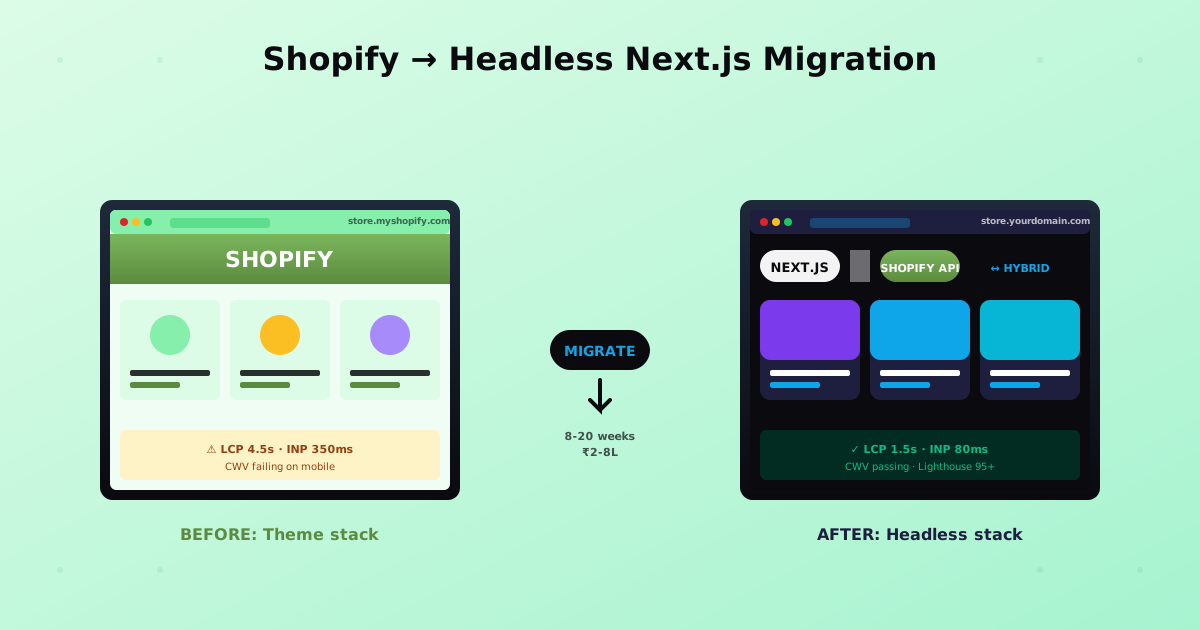
Shopify to Headless Next.js Migration in India: When It's Worth It, What It Costs, and the 8 Things You Lose
Headless Shopify on Next.js can lift conversion 15-30% and slash LCP from 4.5s to under 2s, but it costs ₹2-20L in India and breaks your theme editor.