We build Next.js, Shopify, Laravel, Flutter, in Noida, India. Free 1-page audit, no obligation.
Get a free quote- Top IT Solutions Transforming Financial Services in 2026August 10, 2026
- Website Development Cost in India in 2026 | Complete Pricing GuideAugust 4, 2026
- OCPP and UPI: How EV Chargers in India Can Take Payments Without an AppJuly 27, 2026
- How to Take Orders on WhatsApp for Your Small Business in India (2026)July 24, 2026
 Healthcare IT
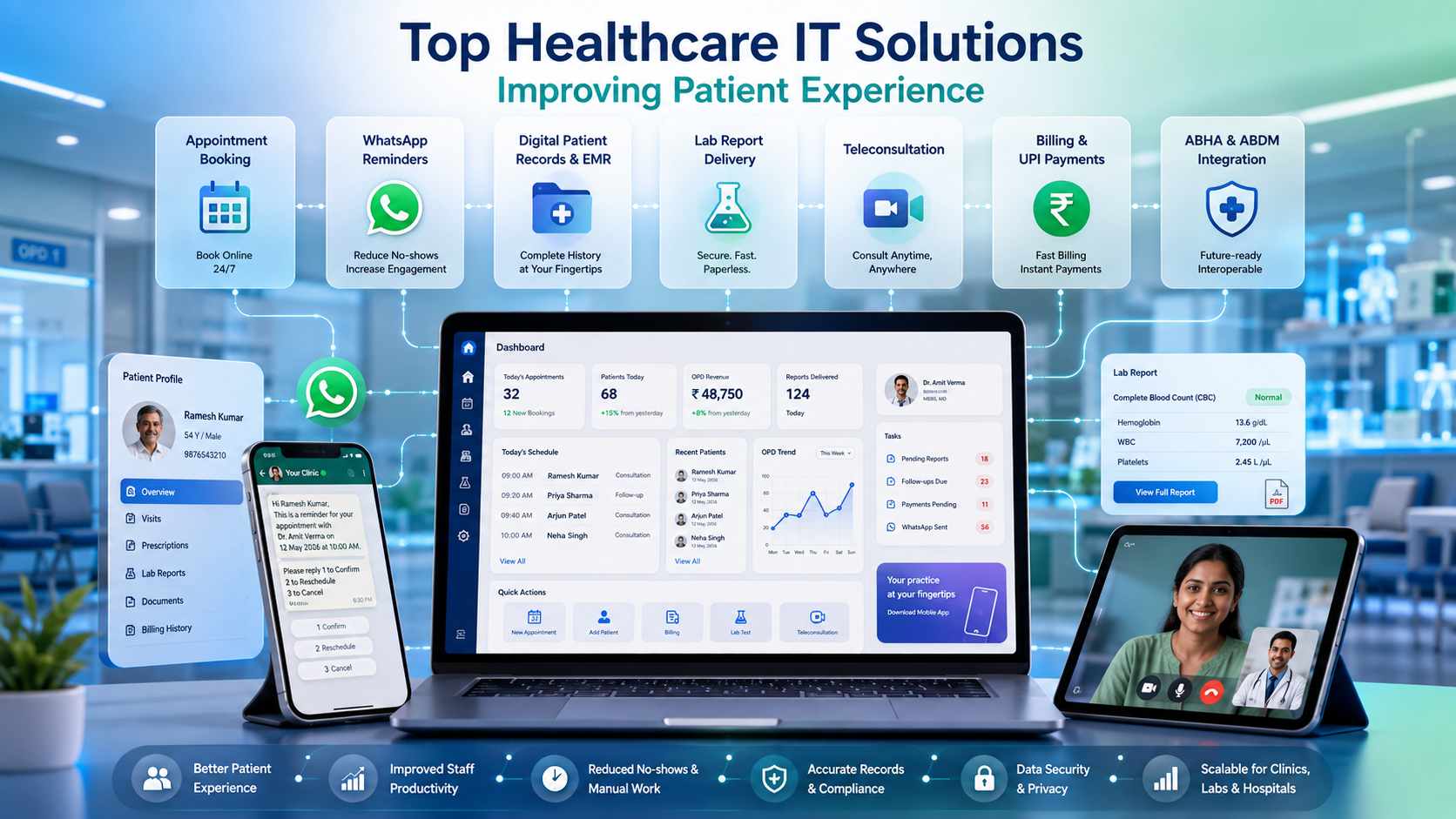
Top Healthcare IT Solutions Improving Patient Experience
Most clinic owners do not wake up wanting software. They want the landline to stop ringing through OPD hours, the waiting area to stop arguing about who came first, and lab reports to reach patients without three follow-up calls.
This is written for smaller Indian healthcare businesses: single-doctor clinics, polyclinics, diagnostic labs, dental and eye chains, small nursing homes. We build this kind of software at buildbyravirai, so where a tool is not worth your money yet, we say so instead of quoting for it.
What Patients Actually Complain About
The cheapest research you will ever do is sitting at your own front desk for two hours on a Monday and writing down every question a patient asks. The list comes back almost identical across Indian clinics.
- How long is the wait? Nobody at the desk can answer with a number.
- I called four times and the line was busy or nobody picked up.
- My report was supposed to be ready yesterday.
- The chemist could not read the prescription and rang to confirm the dose.
- I paid by UPI and the receipt says cash.
- I came for a follow-up and the file from my last visit cannot be found.
Each of those is a workflow problem with a software component, and none is a complaint about your website looking dated. Software will not fix the other half: a doctor running ninety minutes late, an overloaded receptionist, or forty slots sold for twenty-five feasible ones. Worth knowing before you sign anything, an honest wait time makes a packed OPD look worse, not better.
Start With the Front Desk, Not the Patient App
The usual mistake is buying the patient-facing product first, because that is the part an owner can show people. Patients use whatever is easiest for them, while staff use whatever they are required to use. If your receptionist keeps a parallel paper register because the software is slower than a pen, you hold two sources of truth and neither is complete.
- Digitise the appointment book, walk-ins included, not only online bookings.
- Digitise billing, because money enforces a discipline clinical notes never will.
- Open a slice of booking to patients once the desk genuinely works off the screen.
- Add records, report delivery and teleconsultation after that.
Billing first sounds unglamorous. It works because the receptionist cannot skip it, so an accurate patient record gets created on every visit. Most abandoned clinic systems we are asked to replace died because creating the record was optional.
Appointment Booking and Reminders
For most small clinics this returns the most value per rupee, and it is among the cheapest things to get right.
- One screen showing walk-ins and online bookings in the same column, updating live.
- Slot lengths set per doctor, not one global fifteen minutes. Your dermatologist and your orthopaedic surgeon do not run at the same pace.
- Blocking a doctor's leave in two taps, with automatic messages to everyone already booked into those slots.
- A booking link that loads on a four-year-old Android phone over weak mobile data. A heavy widget that takes eight seconds to appear pushes patients back to the phone.
Reminders belong on WhatsApp
SMS in India sits buried under promotional noise and patients have stopped reading it. Email is worse for this audience. You want a WhatsApp Business API account through a provider, templates approved in advance, and a few thousand rupees a month at small-clinic volumes for per-conversation charges.
- Keep the template boring: clinic name, doctor, date, time, a maps link, and one line on how to reschedule.
- That reschedule line is what cuts no-shows, because the patient's alternative is not turning up and telling nobody.
- Send one reminder the evening before and one about two hours ahead. More than that reads as spam and people mute you.
- For procedures, scans and other expensive slots, take a small advance. It changes behaviour more than any reminder.
Queue Management and the Waiting Room
Token systems are cheap and they fix a real irritation. The minimum useful version is a token number, a display in the waiting area, and a WhatsApp message when the patient is two or three ahead, which lets people wait in the car or step out for chai. The failure mode is an estimated wait time that is confidently wrong, so where consultation length varies wildly, show position in queue instead of minutes. You are number six ages gracefully. Eighteen minutes does not.
Patient Records: Buy Less Than You Are Sold
Every vendor will offer a full EMR. The honest test is whether your doctor will type during a consultation, and for plenty of senior consultants the answer is a flat no. A record with thirty structured fields per visit then decays into empty dropdowns within a month. A lighter record survives, and it solves the failure that actually costs you patients: a follow-up where nobody can find what happened last time.
- A patient master keyed on mobile number, with your own clinic ID alongside it.
- Visit history carrying date, doctor, a free-text complaint line, and that visit's bill.
- Photographed or scanned documents attached to the visit: outside reports, old films, discharge summaries.
- Prescriptions generated by the system rather than handwritten.
E-prescriptions earn their keep alone
Generated prescriptions end chemist callbacks about dosage, carry the doctor's registration number every time, and reach the patient as a PDF on WhatsApp. India's telemedicine practice guidelines expect any prescription, remote ones included, to identify the registered practitioner clearly, so build that into the template. Restrict the drug list to what your doctors actually prescribe, since a forty thousand item formulary is slower than a curated three hundred item list.
Teleconsultation, Honestly
For most small clinics teleconsultation is not a separate business line. It is follow-ups, report explanations, refills, and triage for patients who would otherwise burn half a working day to be told they are fine. Do not build your own video calling either, because keeping it working across Indian networks and old devices costs far more than the build. Use a provider and spend the budget on the workflow around the call.
- Booking, payment and consent captured before the call starts.
- A visible waiting state, so the patient knows the doctor is late instead of assuming the link is broken.
- Prescription and notes on WhatsApp within minutes of the call ending. Collect the fee before the call, since chasing a three hundred rupee payment afterwards costs more in staff time than the fee is worth.
Lab Report Delivery
For diagnostic labs, and any clinic with an in-house lab, report delivery is the largest single source of inbound calls. The pattern that works needs no integration with your analysers on day one.
- Report is finalised and approved by the pathologist.
- PDF is attached to the patient's visit record.
- A WhatsApp message goes out carrying a link, never the file itself.
- The link opens a page that asks for the patient's mobile number or an OTP before revealing anything.
Open attachments get forwarded onward, and a link anyone can open is a real data protection exposure. Analyser integrations, LIS middleware and barcode tracking are worth doing once volume justifies them. Below roughly a hundred samples a day, a disciplined manual upload beats a half-finished integration that silently drops results.
Billing and Payments
Billing repays you fastest because it touches cash, GST and staff accountability at once.
- One bill format covering consultation, procedures, pharmacy and lab, with a running patient ledger behind it.
- UPI as the default, with the payment reference captured against the bill instead of typed in later from memory.
- A daily closing report per counter, so cash gaps surface the same evening rather than at month end.
- Package handling for dental and eye plans, since part payments are exactly where paper registers fall apart.
- Insurance and TPA claims as a separate phase later, because paperwork rules differ by insurer and will slow a first build considerably.
The best clinic software is the software your receptionist stops noticing by eleven o'clock on a Monday morning.
Ravi Rai, buildbyravirai
ABDM, ABHA and Compliance in Plain Terms
The Ayushman Bharat Digital Mission provides the ABHA health ID, registries for facilities and professionals, and a consent-based framework for exchanging records. For a small clinic the useful pieces today are registering in the health facility registry, capturing ABHA numbers where patients have one, and scanning the ABHA QR at the desk so staff type less. Serving records on consent as a full health information provider is a real engineering effort, worth doing when you have a specific driver such as a government scheme.
Record-keeping duties under the Clinical Establishments Act vary by state, so your software should produce whichever registers your state asks for without a week of manual assembly. Health data is also personal data, and the Digital Personal Data Protection Act 2023 applies to your clinic as much as to a bank. The practical duties are not exotic.
- Collect what you need for care and billing, not every field a form template offers.
- Show a real notice and take consent, in plain language, at registration.
- Give every staff member an individual login, so an access log means something.
- Know which country the data physically sits in, and keep it in India absent a considered reason.
- Have a deletion and grievance path you can actually execute, not a policy paragraph nobody implemented.
Breaches at small clinics are rarely sophisticated: a shared admin password, a staff WhatsApp group full of patient reports, a former employee whose login was never disabled.
What It Costs and How Long It Takes
Rough Indian market bands for a small to mid-size establishment in 2026. Treat them as orientation, not quotations.
- Clinic website with online booking, doctor profiles and WhatsApp enquiries: about Rs 40,000 to Rs 1,50,000 one time.
- Off-the-shelf clinic management SaaS: roughly Rs 1,000 to Rs 5,000 per doctor per month, higher with lab and pharmacy modules.
- Custom clinic or lab management build: roughly Rs 3,00,000 to Rs 12,00,000, the upper end covering multi-branch, lab and inventory.
- WhatsApp Business API: a platform fee plus per-conversation charges, commonly a few thousand rupees a month at small-clinic volume.
- Teleconsultation on an existing video provider: usage based, a small per-session cost rather than a large fixed one.
- Hosting, maintenance and support: 15 to 20 percent of build cost per year, and be suspicious of anyone quoting zero.
Two things distort these numbers: multi-branch operation with consolidated reporting, and anything touching insurance claims or ABDM record exchange. We publish indicative ranges on our pricing page with the same caveat, since a fair quote follows a conversation about how your clinic runs. On timing, assuming you answer questions within a day or two:
- Clinic website with booking: three to five weeks.
- Booking plus WhatsApp reminders plus light patient records: six to ten weeks.
- Secure lab report delivery: add two to three weeks.
- Teleconsultation on an existing provider: add two to four weeks.
- Custom multi-module build with billing and inventory: four to six months, phased.
Schedules usually slip on the clinic side rather than the vendor side. Doctor availability for workflow review, final price lists, and the test catalogue stall more projects than any technical problem. Export that catalogue before development starts.
Staff Adoption, Where Most Projects Die
Your receptionist already has a working system. It is a register, a diary and her memory, it never crashes, and she is good at it. Anything you introduce is initially slower for her while being better for you, and that gap is where adoption fails.
- Train during a quiet session, then sit at the desk through one full peak OPD. Two hours of watching real usage beats a month of feedback forms.
- Count the taps for your three most common actions. Booking a walk-in should take under twenty seconds, and if it does not, fix the software rather than the staff.
- Retire the paper register on a stated date, with the owner present. Parallel running beyond two weeks means paper wins permanently.
- Give one person ownership of data quality and a small increment for it. Shared responsibility means nobody corrects wrong entries.
- Make the daily collection report available only inside the software. The owner then opens it every night, and the data stays clean on its own.
Doctors are a separate problem. They reliably adopt two things: prescription generation, if it beats writing by hand, and the previous visit appearing on screen as the patient sits down. Structured clinical data entry can come later or never, and the clinic still runs better.
What You Probably Do Not Need Yet
Most clinics your size do not need this yet is a complete sentence, and a good vendor will say it.
- A patient mobile app. Below a few thousand active patients almost nobody installs it, and you fund two more platforms forever.
- AI symptom checkers or triage chatbots on your website. They add liability and rarely convert better than a visible phone number.
- Full ABDM health information provider integration, without a concrete reason for it.
- Video calling infrastructure of your own.
- Analytics dashboards, when a weekly summary of footfall, revenue per doctor, no-show rate and repeat rate covers every decision you make.
Where to Start
If you run a single clinic and want a first phase that will not be thrown away later, this is the shape we would recommend.
- A fast clinic website with doctor profiles, timings, directions and a booking form that survives a weak connection.
- Appointment booking the front desk uses for walk-ins as well as online bookings.
- WhatsApp confirmations and reminders on pre-approved templates.
- Digital billing with UPI reference capture and a daily closing report.
- Prescription generation running off a curated drug list.
That is typically six to ten weeks of work and it answers most of the complaints at the top of this article. Records, teleconsultation, lab delivery and ABDM work layer on later without anything being rebuilt. If the website is the piece you need first, we have a page covering exactly that for clinic and doctor practices.
Three questions before you sign
- Can you describe our front-desk workflow back to us before quoting? A proposal without that conversation is a template with your clinic name pasted in.
- Who owns the data, and how do we export it? You want a full export in a standard format, on demand, written into the contract.
- What is the support commitment in hours? Same business day for critical issues means something, dedicated support means nothing.
Off-the-shelf usually suits a single clinic with standard workflows. Custom starts making sense once several branches, a lab and a pharmacy have to reconcile with each other. Either way, roll out to one branch first.
Patient experience at a small Indian clinic improves through boring, specific fixes: fewer calls answered because bookings arrive online, an honest wait time, a report delivered without a follow-up call, a prescription the chemist can read first time. If you want a second opinion on a proposal sitting in your inbox, talk to our team.
Frequently asked questions
Does a single-doctor clinic really need an EMR?
Can we send appointment reminders and lab reports on WhatsApp?
How much does clinic management software cost in India in 2026?
Do we have to integrate with ABDM and ABHA?
How long before our front-desk staff are comfortable with new software?
Should we build a mobile app for patients?
Founder of buildbyravirai, a web development agency based in Noida, India. 5+ years shipping Next.js, WordPress, Shopify, and Laravel projects for clients in India, USA, Canada, and the UK.
Working with us in your city
Keep Reading
 Technology
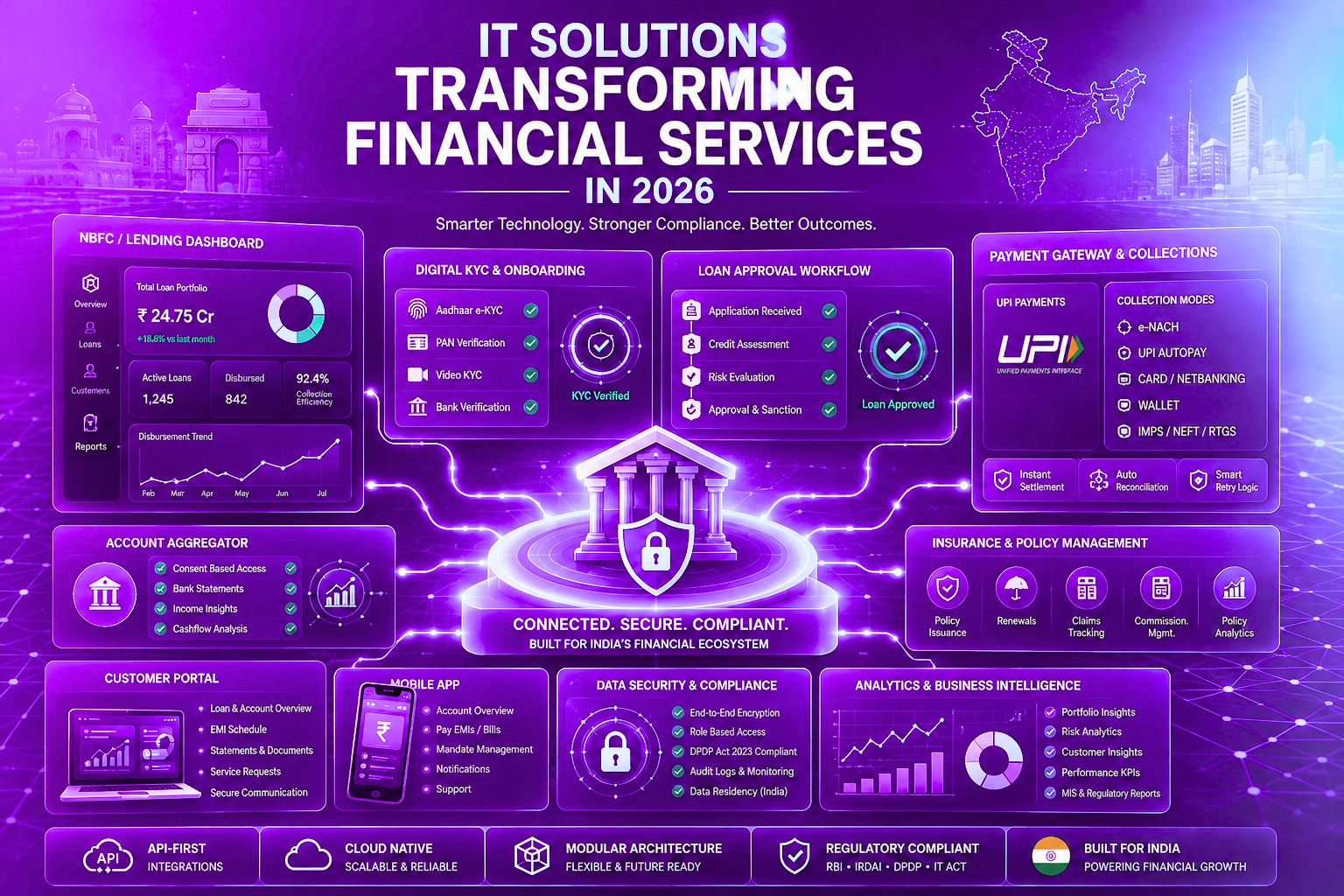
Top IT Solutions Transforming Financial Services in 2026
IT solutions for Indian NBFCs, lenders, insurers and fintech companies in 2026, covering KYC, lending software, payments, security, compliance and analytics.
 web development
Website Development Cost in India in 2026 | Complete Pricing Guide
Planning to build a website for your business? Explore website development costs in India, understand what affects pricing, and choose the right solution for your needs.
 Mobility
OCPP and UPI: How EV Chargers in India Can Take Payments Without an App
The Open Charge Alliance's two models for UPI payments at EV chargers, how they map onto OCPP under the hood, and what you can actually ship on OCPP 1.6-J today.
 Guides
How to Take Orders on WhatsApp for Your Small Business in India (2026)
A practical guide to taking WhatsApp orders in India: the three ways to do it, honest costs, and when a simple ordering website beats DIY chat.
 Lessons
The website that kept Meera's oven warm
A home baker in a small town was days from switching off her oven for good. Then a stranger found her online. Here is what a website really does.