We build Next.js, Shopify, Laravel, Flutter, in Noida, India. Free 1-page audit, no obligation.
Get a free quote- DLT Template Rejected? Fixes and Samples That Pass (2026)September 27, 2026
- Unified Bharat e-Charge (UBC), Explained for EV OperatorsSeptember 25, 2026
- AI Chatbot Development Cost in India (2026): Build and RunSeptember 25, 2026
- OCPP 1.6-J Source Code: Five Open-Source Codebases Worth Reading Before You Write a CSMSSeptember 19, 2026

Top IT Solutions Transforming Financial Services in 2026
Financial services in India run on software the customer never sees. A loan gets disbursed because a PAN check passed, a bank account was verified with a penny drop, a credit rule fired and a payout API returned a success code. The screen on top of all that is the smallest part of the system.
If you run an NBFC, a lending startup, an insurance brokerage, a wealth advisory or a cooperative bank, 2026 is an awkward year. Customers compare your product against the app of a large private bank, and regulators hold your records to the same standard as everyone else. Your budget was sized for neither.
What follows is what is worth building over the next twelve months, what it costs in rupees, and where these projects fall apart. We build this kind of software at buildbyravirai, so the opinions come from shipping it.
Who this is written for
None of this is aimed at a top five private bank with a thousand engineers in-house. It is aimed at companies of five to two hundred people where one or two people carry the technology load, and where the wrong project eats a year.
- An NBFC running on a bought lending platform, three spreadsheets and a WhatsApp group where approvals actually happen.
- A lending or fintech company with one channel working, now needing plumbing that will survive an inspection.
- An insurance broker whose policy data sits inside four insurer portals, with nobody able to produce a clean renewal list.
- A wealth advisory that assembles client reports by hand every quarter.
- A cooperative bank with a core system that works fine and a customer experience that does not.
Start with the system of record, not the app
The first question worth answering is where the truth lives. Not where data is displayed, where it is decided. If a customer's outstanding balance can differ between your loan system and your accounting software on the same day, a new interface only helps you notice it faster.
Most small financial companies have three or four systems that each believe they are in charge: a core or lending platform, Tally or Zoho Books, a CRM, and the memory of one operations manager. Write down which system owns each field before commissioning anything.
- Customer identity and KYC status: the core system or your KYC vendor's records, never a spreadsheet.
- Loan or policy terms: the lending platform or the insurer, not the CRM copy of it.
- Money movement: the payment gateway and the bank statement, reconciled daily against each other.
- Documents and communication history: one object store and one CRM, not email attachments and pen drives.
Settle one more thing early: what your core vendor will actually give you. Some expose a decent REST API. Plenty still hand over a nightly SFTP drop of flat files, and a few charge a separate licence fee for API access. That answer shapes your architecture more than any framework choice, so get it in writing first.
KYC and onboarding, where the money leaks
Onboarding is the most expensive screen you own. Every extra field costs you customers you already paid to acquire, and every verification call costs money per hit. Run the cheap checks early and the expensive ones late.
- Collect the minimum needed to identify the person, usually mobile with OTP and then PAN. Verify the PAN first.
- Search CKYC with the identifiers you now have. If a record exists, download it instead of collecting documents again.
- Use Aadhaar based verification through DigiLocker or offline XML where your product permits, with consent stored as evidence.
- Run bank account verification with a penny drop before you promise anyone a disbursal date.
- Trigger video KYC only for cases that need it, since an assisted session is the costliest step in the funnel.
- Write every check, its raw response and its timestamp to an audit log as it happens, not in a nightly batch.
Most drop-off is not caused by the KYC vendor. It is caused by asking for fourteen fields before the customer has seen anything of value, and by journeys that cannot be resumed. Saving partial applications and sending a resume link on WhatsApp recovers more customers than switching vendors.
Treat per check vendor charges as a customer acquisition cost, not an IT cost. PAN and penny drop verification are cheap enough to run on everyone. Video KYC and document parsing are not, so put a rule in front of them.
Payment rails, mandates and the reconciliation nobody budgets for
Collections in India are a mandate problem, not a checkout problem. One-time payment is solved. Getting a customer to pay every month without a phone call is where a system earns its keep.
- UPI collect requests and intent links for ad hoc payments, part payments and settlements.
- UPI Autopay mandates for recurring debits within the NPCI limits, which suit small ticket monthly amounts.
- e-NACH through NPCI for larger EMIs and longer tenures, with paper NACH kept as a fallback when e-mandate registration fails.
- IMPS, NEFT and RTGS payouts for disbursal, with the beneficiary account verified before the first transfer.
Mandate registration success varies by customer bank and by the sponsor bank behind your provider. Build for failure. Retry logic, a second rail to fall back on, and a message telling the customer what to fix are worth more than a prettier payment page.
Reconciliation is the actual product
Every collections system eventually becomes a reconciliation system. Settlement files arrive late, UTRs do not match your reference IDs, customers pay part amounts against the wrong loan, mandates bounce and generate charges, and GST applies to the fees. Design for it, or your finance team closes the month by hand.
Lending workflows, what to buy and what to build
Split the problem in two. Origination is where your business rules are genuinely yours. Servicing, meaning schedules, interest accrual, part payments, foreclosure and asset classification, follows rules that are the same for everyone and produces bugs that cost real money.
- Buy the loan management system. Writing your own accrual and day count engine is usually a waste of money for a company your size.
- Build the origination layer only if your credit policy or sourcing channel is genuinely different. That is where a custom rule engine pays back.
- Put the key fact statement, cooling off period and direct disbursal requirements from the RBI digital lending guidelines into the workflow itself, not a policy PDF nobody opens.
- Log every decision with the inputs that produced it, so a rejection can be explained eighteen months later.
- Model partner splits, co-lending shares and any guarantee arrangement from day one. Retrofitting them into a live book is slow and painful.
The account aggregator framework
For underwriting, the account aggregator framework is the most useful public infrastructure available to a small lender. Instead of asking for six months of statements as PDFs, you request consent through an AA and receive structured data tied to a stated purpose and duration. Bank coverage still varies, so keep the upload path alive as a fallback.
Compliance and audit trails
An inspection never asks whether your app is fast. It asks who approved this, on what date, against which document, and which version of the policy was in force at the time. A system that stores only current state cannot answer that.
- An append only event log for anything a regulator, an auditor or a customer might dispute later.
- Maker and checker approval on limit changes, waivers, write-offs and master data edits.
- Role based access with real segregation, so the person who creates a payout cannot approve it.
- Retention matching your sector's requirement, with documents kept even after an account closes.
- A period export in a format an auditor can open, because someone will ask at short notice.
Audit logging is cheap on day one and expensive to retrofit. Add it after two years of production and you can only prove what happened from the day it was switched on, which is exactly the answer nobody wants to give an inspection team.
Data security under the DPDP Act
The Digital Personal Data Protection Act 2023 changed the default position on consent. It has to be specific, in plain language, and tied to a stated purpose. Customers can ask what you hold and ask for erasure, so you need a process for that.
- Encrypt identity fields such as Aadhaar and PAN at field level, and never render them in full on a screen or in an export.
- Keep payment-system data, and confirm in writing where each vendor stores it.
- Log who read a customer record, not only who changed it. Read access is where most internal incidents start.
- Write a retention and deletion workflow that honours erasure requests while keeping records you must legally hold.
- Sign a data processing agreement with every vendor, including the small ones nobody remembers.
Get an annual VAPT done even if no one has demanded it. Bank partners, insurers and enterprise customers ask for the report during onboarding, and not having one costs you weeks mid-negotiation.
Legacy migration without ruining a quarter
Migrations fail on data far more often than on code. The old system holds fifteen years of records with inconsistent formats, duplicate customers, and a field quietly reused for something else in 2019. The work is in the mapping, and it does not demo well.
- Stand up a read only mirror of the old data and reconcile it against the old system's reports until the numbers match exactly.
- Move one module at a time: customer master first, then products, then transactions.
- Run both systems in parallel for one full cycle, including a month end close and a regulatory return.
- Cut over module by module, with a rollback plan you have tested rather than written down.
- Keep the old system readable for the retention period after it stops being written to.
Do not schedule a cutover in the last week of March or around a GST filing deadline. Pick a quiet window and accept that the parallel run costs money while producing nothing visible. It is cheap insurance.
Where AI actually helps, and where it does not
The honest position in 2026 is that language models read messy documents very well and perform poorly at anything that has to be defended to a regulator. Point them at the first category.
- Extracting figures from bank statements, ITR acknowledgements, GST returns and salary slips, with a human check on low confidence cases.
- Turning collections calls and support chats into structured notes on the customer record instead of free text nobody reads.
- Answering routine servicing questions, with balances and status pulled from your systems rather than generated.
- Internal search across circulars, product notes and past decisions, which saves your operations team real hours.
It does not belong inside a credit decision you cannot explain. If you decline an applicant, you should be able to state the reason and show the inputs. A scorecard a human can read beats a model nobody can, and for most companies this size a custom model is an expense with no measurable return.
Customer portals and mobile apps
Not every company needs an app. If a customer interacts with you twice a year, an app is a download they will delete and a store listing you maintain forever. A fast mobile web journey plus WhatsApp updates serves them better at a fraction of the cost.
An app earns its place when usage is repeated: daily balances, frequent payments, portfolio views, field staff workflows. On the web side we usually build with Next.js over a typed API layer, because server rendered pages load quickly on the mid range Android phones and uneven networks your customers actually use.
What usually goes wrong
- Scope is written as a feature list instead of a workflow, so nobody notices step four has no owner until user testing.
- API access from the core vendor is assumed. It becomes a three month commercial negotiation and the plan slips.
- Sandbox environments behave differently from production, particularly for mandates and video KYC, so real failures appear after go live.
- Compliance reviews the build at user testing rather than at design, and one late rule forces a rewrite of the data model.
- Nobody owns test data, so the team tests against three clean customers and never meets the messy ones.
- Reconciliation is left out of scope, and the first month end close takes two weeks.
- Year two is unbudgeted. Vendor charges, support, hosting and regulatory changes keep arriving after the project is declared finished.
Almost every item there is a scheduling failure, not an engineering one. The fix is boring. Finish the vendor conversations and the compliance review in the first three weeks, while design is still cheap to change.
What this costs in India
Prices move with complexity and with how unusual your process really is, but these are the bands we see for competent agency work in India in 2026. A quote far below a band is usually a fixed price that gets renegotiated halfway through.
- Payment and mandate integration into an existing system: roughly INR 2 to 6 lakh, four to eight weeks.
- A full KYC and digital onboarding journey with vendor integrations: roughly INR 6 to 15 lakh, eight to fourteen weeks.
- A customer portal or servicing app: roughly INR 10 to 30 lakh, three to five months.
- A custom origination layer on a bought loan management system: roughly INR 20 to 50 lakh, five to nine months.
- A core migration: budget a year, and price it phase by phase rather than as a single number.
Then there is the part most budgets miss. Hosting and monitoring, per hit vendor charges that scale with volume, an annual security test, and support at roughly fifteen to twenty percent of the build cost each year. GST at eighteen percent sits on top. Our pricing page sets out how we structure this, and we would rather have the awkward budget conversation in week one than month four.
A sensible order to do this in
- Document the system of record for every important field, and confirm what your core vendor's API can do.
- Fix reconciliation and the audit log. Both are unglamorous and everything else depends on them.
- Improve the onboarding journey next, since that is where revenue leaks every day.
- Automate collections, mandates and reminders after that, because the payback is fastest to measure.
- Rebuild the customer facing surface once the data behind it can be trusted.
- Take on the core system or a migration last, when you know what it has to do.
What works is small verifiable pieces delivered every few weeks on top of a system you can already audit. If you want a second opinion, tell us what you are running and we will give you a straight answer about what to fix first, including the parts not worth spending money on this year.
Frequently asked questions
How long does a KYC and digital onboarding build take for an NBFC?
Should we buy a lending platform or build our own?
What does the DPDP Act 2023 mean in practice for a small financial company?
Is an account aggregator integration worth it for a small lender?
Do we need a mobile app or is a good website enough?
What are the ongoing costs after the project is delivered?
Founder of buildbyravirai, a web development agency based in Noida, India. 5+ years shipping Next.js, WordPress, Shopify, and Laravel projects for clients in India, USA, Canada, and the UK.
How this worked in practice
Working with us in your city
Keep Reading
What to Send a QA Team, and What You Should Get Back
Most manual testing engagements go wrong in the brief, not the testing. What a QA team actually needs from you, what a bug report has to contain to be actionable, and how to tell a good one from a list of screenshots.
 Technology
Angular vs React in India 2026: Which Front End to Commit To
React for startups and SMBs, Angular for banks and enterprise teams, Next.js for most Indian SMB sites. The 2026 call turns on hiring, not benchmarks.
 Technology
Top Retail Technology Trends Boosting Sales
Discover retail technology trends in India, from UPI checkout and WhatsApp automation to inventory sync, RTO reduction and e-commerce growth strategies.
 Technology
Enterprise IT for Digital Transformation
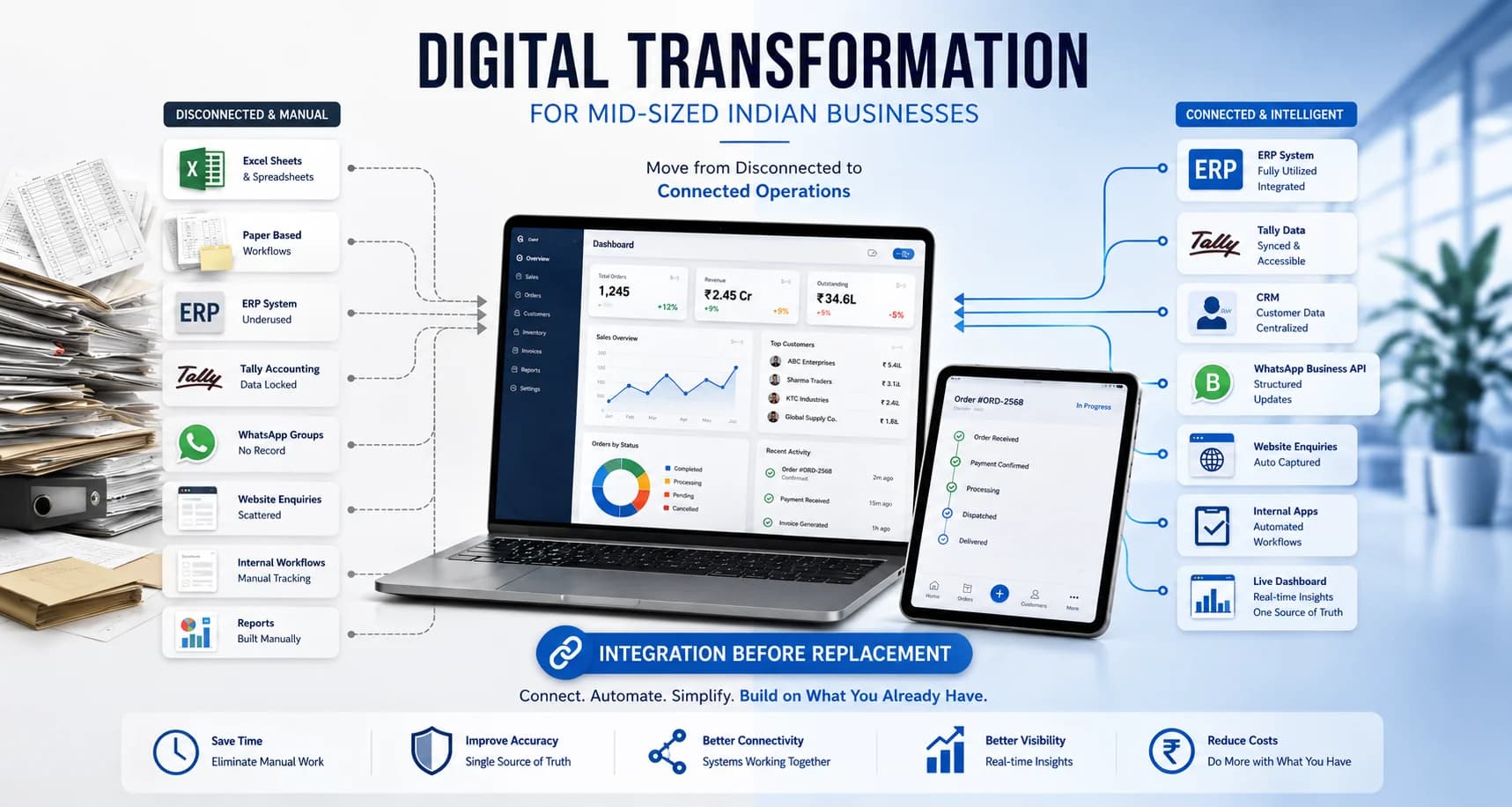
A practical look at how Indian businesses can use technology, integrate existing systems and automate everyday work without costly IT projects.
OCPP and UPI: How EV Chargers in India Can Take Payments Without an App
The Open Charge Alliance's two models for UPI payments at EV chargers, how they map onto OCPP under the hood, and what you can actually ship on OCPP 1.6-J today.