We build Next.js, Shopify, Laravel, Flutter, in Noida, India. Free 1-page audit, no obligation.
Get a free quote- How to Build a Subscription Billing System in India (2026): Mandates, Proration, Dunning, GST Invoices, and Build vs BuyJuly 20, 2026
- DLT-Compliant Notification Service Architecture in India (2026): SMS, WhatsApp, and Email Without Silent OTP FailuresJuly 17, 2026
- Zoho Books Integration in India (2026): Connect Your Website, Store, or CRM to Your Books, What It Costs, and Build vs BuyJuly 14, 2026
- Tally Integration With Your Website or Custom Software (India, 2026): How It Actually Works, What It Costs, and When to Build vs BuyJuly 13, 2026
- Why the map pack beats almost everything else in local search
- Step 1: Claim and 100% complete your Google Business Profile
- Step 2: Understand the 3 things Google actually ranks local results on
- Step 3: Reviews, the single biggest lever you control
- Step 4: NAP consistency + local citations
- Step 5: Your website still matters (local on-page signals)
- Step 6: Stay active with posts, photos, and Q&A
- The 2026 layer: 'near me' on phones and AI search
- Your realistic 30-day action plan
- FAQ
 SEO
SEOHow to Rank #1 on Google Maps for Your City in 2026: The Local SEO Playbook for Indian Businesses
Right now, someone in your city is typing "[your service] near me" into Google on their phone. They're not researching. They're ready to call, visit, or buy in the next hour. Google shows them a map with three businesses pinned at the top. If you're one of those three, you get the customer. If you're not, you don't exist, and it doesn't matter how good you are, how long you've been in business, or how nice your website looks.
That block of three businesses on the map is called the map pack (or local 3-pack), and it's the single most valuable piece of real estate in local search. Here's the good news I tell every Indian SMB owner I run buildbyRaviRai for. Ranking there is far more achievable than ranking #1 in regular Google results, because it's a different game with clear rules, and most of your local competitors haven't bothered to learn them. This is the full playbook, in order.
Why the map pack beats almost everything else in local search
There are three reasons it matters more than your regular Google ranking. The first is intent. 'Near me' and 'in [city]' searches are bottom-of-funnel, so these people are ready to act, not just browse. The second is position. The map pack sits ABOVE the normal blue-link results, so it catches the eye (and the tap) first, especially on mobile where most Indian local searches happen. The third is trust. A business with reviews, photos, and a pin on the map reads as real and established in a way a website alone never does.
National SEO pits you against giant brands with huge content teams. Local is a fight against the dentist, plumber, or boutique down the road, and most of them haven't claimed their profile properly. The bar is low. You can win this.
Step 1: Claim and 100% complete your Google Business Profile
Everything starts here. Your Google Business Profile (GBP, formerly Google My Business) is what populates the map pack. If you haven't claimed it, or you claimed it and left it half-empty, that's your #1 problem and your #1 quick win. Go to google.com/business, claim your listing, and verify it (usually by postcard, phone, or video). Then fill in every single field, because Google rewards completeness:
- Exact business name. Use your real name, not a keyword-stuffed one ('Sharma Dental', not 'Sharma Dental Best Dentist Cheap Clinic Noida'). Stuffing gets you suspended.
- Primary and secondary categories. Pick the most specific primary category that fits, because this is a huge ranking factor, then add relevant secondary ones.
- Complete address and service area. Keep it accurate and consistent, and define a service area if you travel to customers.
- Phone number and website. A local number is ideal, and you should link to the most relevant page, not just the homepage.
- Hours (including holidays). Wrong hours is the fastest way to a 1-star review and a lost customer.
- Services and products with descriptions and prices. Fill these out. They help relevance and show in your profile.
- Real photos. Exterior, interior, team, work samples. Profiles with photos get dramatically more clicks and calls than those without.
Step 2: Understand the 3 things Google actually ranks local results on
Google is unusually open about how local ranking works. There are three factors, and getting all three right is how you climb:
- Relevance. How well your profile matches what the person searched. It's driven by your category, your services, and the keywords in your profile and website. A plumber whose profile clearly says 'plumber' and lists plumbing services beats one with a vague profile.
- Distance. How close you are to the searcher (or to the city they named). You can't move your shop, but you CAN make sure your address and service area are accurate so Google knows where you actually serve.
- Prominence. How well-known and trusted you are. This is the big lever you control through reviews, citations, your website's SEO, and overall web presence. Prominence is where most of your effort pays off.
Step 3: Reviews, the single biggest lever you control
If you do only one thing after claiming your profile, do this. Reviews are the strongest prominence signal you can actively influence, and Indian buyers read them obsessively before choosing a local business. Here's how to win at reviews honestly. Never buy fake ones, because Google detects and penalises them:
- Just ask. The #1 reason businesses have few reviews is they never ask. After every happy transaction, send a WhatsApp with your Google review link. A simple 'it would mean a lot if you left us a quick review' converts surprisingly well.
- Make it one tap. Use your GBP short review link, or a QR code at your counter. Every extra step loses people.
- Aim for steady velocity, not a burst. 30 reviews trickling in over months looks natural and ranks. 30 in one day looks fake and can get flagged.
- Respond to every review. Thank the positive ones, and address the negative ones calmly and publicly. Responses are a ranking and trust signal, and a graceful reply to a 1-star says more than ten 5-stars.
- Keywords in reviews help. You can't script them, but when customers naturally mention the service and the area ('great biryani in Andheri'), it reinforces relevance. Sometimes a gentle prompt ('mention what you ordered') nudges this.
Step 4: NAP consistency + local citations
NAP stands for Name, Address, Phone. Google cross-checks your details across the web to confirm you're a real, consistent business. If your address says '2nd Floor, Sector 62' on Google but 'Plot 14' on JustDial and a different phone number on Facebook, that inconsistency hurts you. So fix it. Make your NAP identical everywhere, then build citations, which are listings on the directories Indians and Google actually use:
- The India staples: JustDial, Sulekha, IndiaMART (if B2B), and your industry-specific directories.
- The global ones that still matter: your Facebook and Instagram business profiles, Bing Places, and Apple Maps.
- Consistency over quantity: 15 accurate citations beat 50 sloppy ones. Audit and fix the wrong ones before adding new.
Step 5: Your website still matters (local on-page signals)
Your GBP doesn't exist in isolation. Google reads your website to judge relevance and prominence, and the map pack and your organic ranking feed each other. On your site:
- Create dedicated service and city pages. Build a page targeting 'service in your city' with genuinely useful content, not a thin doorway page.
- Add LocalBusiness schema. This is structured data that tells Google your name, address, hours, and geo-coordinates in a machine-readable way.
- Embed a Google Map of your location and link your GBP.
- Get the technical basics right. Fast mobile load, clear contact info, click-to-call. We cover the common failures in 11 SEO Mistakes Indian Small Businesses Make in 2026 and why a slow or unclear site loses ready buyers in 7 Reasons Your Website Isn't Bringing You Clients.
Step 6: Stay active with posts, photos, and Q&A
A claimed-then-abandoned profile slips. An active one climbs. Spend 15 minutes a week. Add a couple of fresh photos, publish a GBP 'Post' (an offer, an update, a new service), answer the Q&A section yourself before randoms do, and keep your hours and services current. Activity signals to Google that you're a live, real business, and it gives returning searchers a reason to choose you.
The 2026 layer: 'near me' on phones and AI search
There are two shifts worth knowing. First, the overwhelming majority of local searches in India are now on mobile with location on, which makes distance and a complete, photo-rich profile matter even more. Second, AI-powered answers (Google's AI Overviews, ChatGPT and Perplexity with web access) increasingly summarise 'best [service] in [city]', and they pull heavily from the same signals: your GBP, your reviews, and clear, structured information on your site. The businesses that nail traditional local SEO are also the ones AI search recommends, so doing the basics future-proofs you.
Your realistic 30-day action plan
- Week 1: Claim and verify your GBP. Fill in 100% of fields. Add 10+ real photos. Pick the right primary category.
- Week 2: Set up a one-tap review link and a QR code. Message your last 20 happy customers asking for a review. Respond to any existing reviews.
- Week 3: Audit your NAP everywhere. Fix inconsistencies. Claim or correct JustDial, Sulekha, Facebook, Bing Places, Apple Maps.
- Week 4: Add LocalBusiness schema, a city or service page, and an embedded map to your website. Publish your first GBP post. Set a 15-min weekly recurring reminder to stay active.
Do this and within 4 to 8 weeks you'll typically see movement. More profile views, more calls, more direction requests, because most of your local competitors have done none of it. Local SEO compounds. The reviews and citations you build now keep working for years.
FAQ
How long until I rank in the map pack?
For a low-competition local category, a fully optimised profile with a steady flow of reviews can crack the top 3 in 4 to 12 weeks. Competitive categories in metros (e.g. 'dentist in Bandra') take longer and need more reviews plus stronger website SEO. The first wins, more views and calls, usually show within the first month even before you hit #1.
Can I do this myself or do I need an agency?
Steps 1 to 4 (claim profile, complete it, get reviews, fix NAP) are 100% DIY-able with a few weekends, and they're where most of the gains are. The website-side work (schema, city pages, technical SEO) is where a developer or SEO consultant helps. Many Indian SMBs do the GBP work themselves and hire out the website layer. If you'd rather have it done for you, we offer local and technical SEO services, and we wrote an honest guide to hiring a freelance SEO consultant in India.
What if I have multiple locations?
Create a separate, fully-optimised GBP for each physical location, each with its own address, phone, reviews, and a matching location page on your website. Don't try to rank one profile for multiple cities. Google ranks by location, so each branch needs its own listing to show up in its own area's map pack.
Does this cost anything?
Google Business Profile is free, and the highest-impact steps (claiming, completing, reviews, NAP) cost nothing but time. Costs only come in if you pay for the website-side SEO or hire someone to manage it. Start with the free wins. They're the bulk of the result.
Want to know exactly why you're not ranking in your city's map pack, and the fastest fixes? We'll audit your Google presence free.
Get a free local SEO auditFounder of buildbyRaviRai, a freelance web development agency based in Noida, India. 5+ years shipping Next.js, WordPress, Shopify, and Laravel projects for clients in India, USA, Canada, and the UK.
Working with us in your city
Keep Reading
SEO11 SEO Mistakes Indian Small Businesses Make in 2026, And the Quick Fixes That Actually Bring Clients Back
If you run a small business in India and your website used to bring leads but doesn't anymore, or never has, there are 11 specific mistakes that account for ~90% of the cases we see. Most are fixable in a weekend. This is the honest checklist, in priority order, with the exact fix for each one.
 Guides
Website Security for Indian Businesses 2026: The Basics That Actually Stop Most Attacks
Most websites are not hacked by a person who chose you. They are hacked by bots that scan millions of sites for the same handful of holes: an outdated plugin, a weak password, an exposed admin page. The good news is that the basics stop almost all of it. This is the plain-language guide for Indian business owners in 2026: what actually attacks your site, the few things that genuinely protect it, and what to do if you do get hacked.
BusinessHow to Attract Clients Online in India 2026: An Honest Playbook for Small Businesses
Most businesses do not have a client problem, they have a leaky-bucket problem. Attracting clients is not a single tactic; it is four jobs that have to work together: be findable, be credible, convert the visitor, and follow up fast. This is the honest playbook for Indian small businesses in 2026: the four jobs, the order to fix them in, which channels actually bring clients here, and the mistakes that quietly keep them away.
 Guides
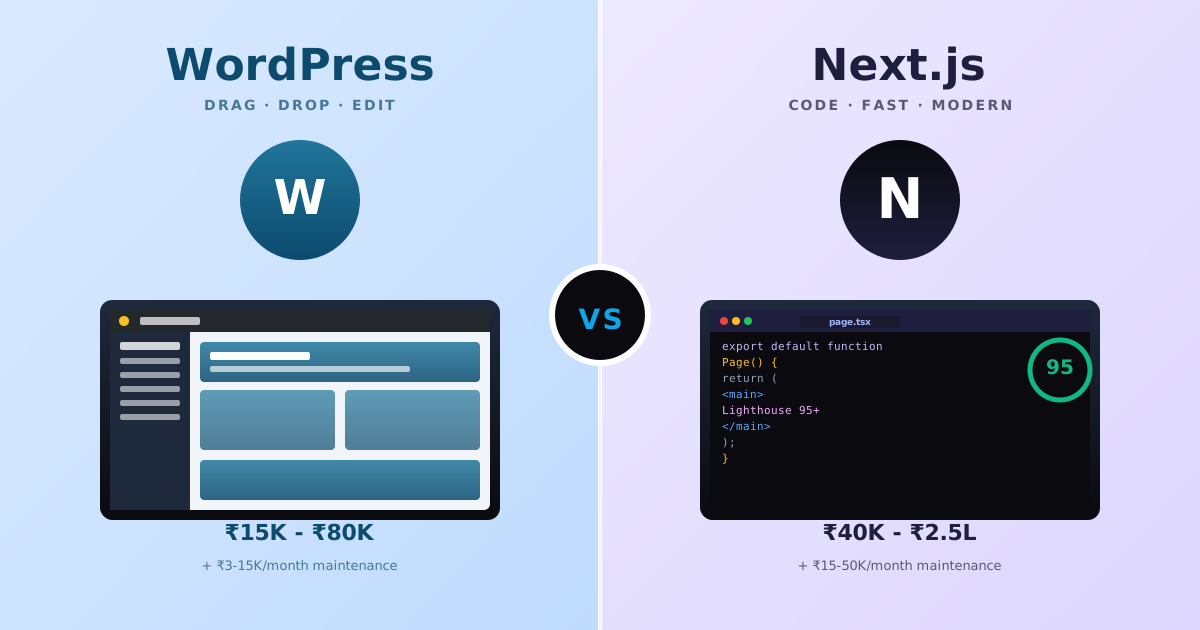
WordPress vs Next.js for Indian Small Businesses (2026): When Each Wins, Real INR Costs, and the 8 Hidden Trade-offs
Indian founders keep asking the wrong question, "WordPress or Next.js?", when the real question is what each stack actually solves for a ₹50K-2L budget, who edits content, and what breaks 18 months later. Real INR pricing, the 8 hidden trade-offs, and a decision matrix by business + team type.
 SEO
SEOHire a Freelance SEO Consultant in India: 2026 Pricing, What to Ask, and the 7 Red Flags That Cost Founders Lakhs
Freelance SEO consultants in India cost 60-80% less than agencies, but the floor is shockingly low and the difference between a senior consultant and a 'SEO expert' with three Udemy certificates is invisible until 8 months in. Real 2026 rates, the 12 questions to ask before paying, the 7 red flags every founder misses, and what good SEO actually looks like in months 1, 3, and 6.