We build Next.js, Shopify, Laravel, Flutter, in Noida, India. Free 1-page audit, no obligation.
Get a free quote- Manufacturing Software for Indian MSMEs Industry 4.0 GuideAugust 22, 2026
- Top Healthcare IT Solutions Improving Patient ExperienceAugust 12, 2026
- Top IT Solutions Transforming Financial Services in 2026August 10, 2026
- Website Development Cost in India in 2026 | Complete Pricing GuideAugust 4, 2026
- The actual question Indian founders are asking
- The 30-second answer
- What WordPress actually gives you in 2026
- What Next.js actually gives you in 2026
- The 8 hidden trade-offs founders miss
- INR pricing reality, what you'll actually pay in 2026
- Performance reality, real numbers from Indian sites we've audited
- Decision matrix by business type
- Decision matrix by team type
- The hybrid play that wins for most Indian SMBs in 2026
- What to NOT do
- Migration paths, when and how to switch stacks
- FAQ
- Final word, picking the right stack for your next 2 years
 Guides
WordPress vs Next.js for Indian Small Businesses (2026): When Each Wins, Real INR Costs, and the 8 Hidden Trade-offs
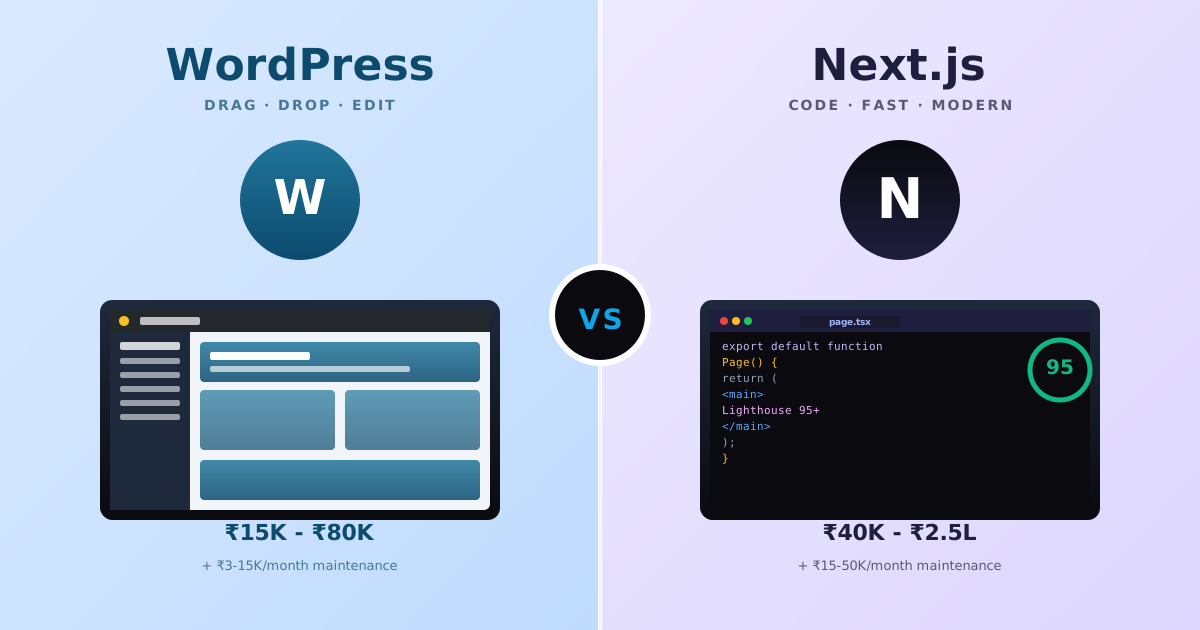
Every week I get the same WhatsApp message from a founder in Delhi, Noida, Bangalore, or Surat: "Ravi, WordPress ya Next.js, kya banayein?" And every week I have to gently reframe the question. The real question isn't which framework. It's this: "I have ₹50,000 total budget. I want a business website built in 3 weeks. My cousin's wife will update the photos and prices for the next 2 years. Which stack survives that?" Once you ask the question that way, the answer becomes obvious, and very different from what most Twitter threads tell you.
I run buildbyravirai, a Noida-based web dev agency. We build both WordPress and Next.js sites. We've also rescued dozens of projects where founders picked the wrong stack and lost 6-9 months. This guide is the unfiltered version of the conversation I have with founders before they sign a contract, INR pricing, hidden trade-offs, decision matrix by business type, and the hybrid play that actually wins for most Indian SMBs in 2026.
The actual question Indian founders are asking
Strip the framework-war noise away and 90% of Indian founders are asking one of these three things, whether or not they realise it:
- "If I spend ₹50K-1L now, can someone non-technical edit the site for the next 2 years without calling a developer?", this is the WordPress question.
- "If I spend ₹1-3L now, will my site load fast enough that Google ranks it and customers don't bounce, even when I run Meta ads?", this is the Next.js question.
- "Can I have both, non-technical editing AND a fast site, without doubling my budget?", this is the headless / hybrid question, and it's the answer for most Indian SMBs in 2026.
The founder is not asking about React Server Components or Gutenberg blocks. They're asking about who maintains the site after the developer disappears, and how much it costs per month. Everything else is downstream of those two questions.
The 30-second answer
If you skim only one section, read this one.
- Pick WordPress if your site is content-heavy (blog, news, edtech, services pages), your non-technical team needs to update content weekly, you don't expect to scale beyond 50,000 monthly visitors anytime soon, and your budget for the first year (build + hosting + maintenance) is under ₹1.5 lakhs.
- Pick Next.js if you're building a customer-facing app, ecommerce checkout, SaaS marketing site, booking engine, lead-gen funnel with strict CWV targets, or anything where a 0.5-second delay measurably loses you revenue. Budget at least ₹1L for build, ₹15-30K/month for hosting + maintenance.
- Pick Next.js + headless CMS if you want both, performant frontend + content-team editing. ₹60K-1.5L build, ₹15-30K/month ongoing. This is the sweet spot for most ambitious Indian SMBs in 2026.
What WordPress actually gives you in 2026
WordPress in 2026 is not the WordPress of 2015. The page-builder revolution (Elementor, Bricks, Spectra, Breakdance) plus full-site editing via Gutenberg blocks means a non-technical user can genuinely build and edit a real business website without writing a line of code. Here's what you actually get for your money.
- Drag-and-drop editing, Elementor Pro, Bricks Builder, Spectra, Kadence, Gutenberg blocks. Your marketing person can re-arrange the homepage on a Sunday evening without a developer on call.
- Plugin ecosystem for everything, contact forms (WPForms, Fluent Forms), SEO (Rank Math, Yoast), booking (Amelia, Bookly), ecommerce (WooCommerce), membership, LMS, multi-language (WPML, Polylang). 60,000+ plugins. You almost never need to code.
- Cheap, predictable hosting, Hostinger Business plan ₹400-700/month, Cloudways DigitalOcean ₹1,200-2,500/month, Rocket.net ₹2,500-5,000/month for serious managed WordPress. Most Indian SMBs run fine on ₹500-2,000/month.
- Familiarity at the agency level, every solo developer, every small agency in India can take over a WordPress site. You're never locked to one developer. This is huge for founder peace of mind.
- SEO tooling that just works, Rank Math + a good theme handles schema, sitemaps, redirects, meta tags out of the box. Pair with our SEO services and you're competitive on Google quickly.
- Content team training, even your operations manager who's "not technical" can learn WordPress admin in 2-3 hours. Try teaching them a Next.js MDX content workflow.
If you're launching a local services business, content-marketing-led brand, or a regional-language site with a small editorial team, WordPress in 2026 is still the most pragmatic choice. We do WordPress development projects in this exact lane every month.
What Next.js actually gives you in 2026
Next.js 15 and 16 changed the math significantly. ISR (Incremental Static Regeneration), edge functions, partial pre-rendering, Server Components, and Vercel's deployment workflow mean a small team can ship a site that outperforms 99% of WordPress sites, without a DevOps engineer. Here's the honest list of what you get.
- Lighthouse 95+ as the default, not an achievement, Server Components + automatic code-splitting + image optimization + edge caching means you start at 95+ and stay there. WordPress starts at 50-70 and you spend ₹20K/month fighting to keep it above 80.
- Real LCP under 1.5 seconds on 4G, Indian mobile users on Jio 4G see your homepage in 800ms-1.5s on Vercel edge. WordPress on shared hosting clocks 3-5s LCP on the same connection. That difference is a 20-30% bounce-rate gap.
- ISR, content updates without a rebuild, Indian founders worry that "Next.js means rebuild for every edit". False. ISR + on-demand revalidation means content updates within seconds, no full deploy needed. This is the feature that killed WordPress's caching argument.
- Vercel deploy in 60 seconds, connect GitHub repo, push to main, your site is live globally in under 90 seconds. No FTP, no cPanel, no "why is wp-config.php returning 500?".
- Edge functions + middleware, A/B testing, geo-redirects (show INR to Indians, USD to US visitors), authentication, bot blocking, all at the edge, sub-50ms. WordPress can't touch this.
- Multi-currency, multi-language, multi-region, much cleaner, i18n routing built in, currency switching via middleware, regional content via Vercel edge config. WordPress + WPML is a constant fight to keep performant.
- Modern developer experience, TypeScript, ESLint, hot reload, component library reuse across web + mobile (React Native), CI/CD on Vercel preview branches per PR. Your dev team ships faster.
We've documented some of these in our Next.js 16 production lessons write-up, what actually breaks vs. what the docs promise. Worth reading before you commit.
The 8 hidden trade-offs founders miss
Both Twitter and YouTube give you the highlight reel. Here's what nobody tells you until you're 6 months in.
1. WordPress plugin bloat, your fast site becomes a slow site in 18 months
Day 1: clean WordPress install, 4 essential plugins, Lighthouse 88. Day 540: 23 plugins (contact form, security, backup, SEO, image optimizer, social share, popup, analytics, GDPR, schema, related posts, AMP, page builder add-ons), Lighthouse 42. This isn't hypothetical, we audit a site like this every 2 weeks. The fix is plugin discipline most founders don't have.
2. WordPress update breakage when 3-5 plugins update on different schedules
WP core updates monthly. Elementor updates weekly. Rank Math updates every 2 weeks. WooCommerce updates monthly. Each update has a non-zero chance of breaking something, a popup, a checkout step, an admin page. Without staging + version control, you'll hit production breakage 2-3 times a year. Real cost: ₹5-15K/incident in emergency dev time.
3. WordPress security patching is an ongoing monthly cost
WordPress is the most-attacked CMS on the internet, not because it's insecure, but because it's ubiquitous. You need Wordfence or Sucuri, regular plugin updates, monthly malware scans, hardened wp-admin. Realistic security maintenance: ₹3-8K/month, every month, forever. Skip this and you'll get hacked within 18 months, we've seen it dozens of times.
4. Next.js requires a developer for every content change, unless you add a headless CMS
If your founder/marketing team can't edit content without filing a Jira ticket, your Next.js site becomes a bottleneck. Without Sanity/Strapi/Contentful, every "change this headline" is a git commit. This is the #1 reason small businesses regret going pure Next.js. Plan for the CMS from day 1.
5. Next.js hosting cost climbs with traffic, sometimes painfully
WordPress on Hostinger: ₹500/month regardless of whether you have 1,000 or 50,000 visitors. Next.js on Vercel: free at low traffic, but at 200K+ pageviews/month with ISR, you're on the Pro plan (₹1,800/month) + bandwidth + function invocations. We've seen busy Indian sites hit ₹15-50K/month on Vercel. Self-hosting on AWS/Railway/Coolify can cut that to ₹3-8K/month but adds DevOps overhead.
6. Next.js content workflow needs JS skills for your content team (or careful CMS setup)
MDX is great for developers, terrible for marketing managers. If your content team writes in Markdown without preview, formatting will be inconsistent and broken. Either accept that content lives in a CMS (Sanity preview, Storyblok visual editor), or accept that your developer becomes the content bottleneck. There's no third option.
7. WordPress hits limits at multi-region, multi-currency, complex personalization
WPML + WooCommerce + a multi-currency plugin + a geo-redirect plugin = 4 plugins fighting each other, all slowing down your site. We've audited Indian D2C brands trying to sell in INR + USD + GBP on WordPress, performance is consistently bad. This is where Next.js + headless wins decisively.
8. Next.js learning curve for marketing team is real, and underestimated
Your marketing manager who can publish on WordPress in 5 minutes will spend a week learning Sanity Studio or Strapi admin. They'll need training. They'll need preview environments. They'll need to understand publish vs. draft vs. revalidate. Budget 10-15 hours of training and 4-6 weeks of hand-holding. Skip this and they'll quietly stop publishing.
INR pricing reality, what you'll actually pay in 2026
Numbers from real projects we've quoted and delivered in the last 12 months across Noida, Delhi, Bangalore, and other cities.
WordPress build
- Basic 5-7 page brochure site (Elementor or Astra theme): ₹15,000-30,000. 2-3 week timeline.
- Mid-tier services site with booking + blog + SEO setup: ₹30,000-60,000. 4-6 weeks.
- Premium custom WordPress with Bricks/Gutenberg + Rank Math + speed optimization: ₹60,000-1,20,000. 6-8 weeks.
- WooCommerce store (200 SKUs, payment + shipping integration): ₹50,000-1,50,000. 8-12 weeks.
WordPress maintenance retainer
- Basic (updates + backup + uptime monitoring): ₹3,000-7,000/month.
- Standard (everything + 2-4 hours content edits + security): ₹7,000-15,000/month.
- Premium (active development + performance + 8+ hours/month): ₹15,000-30,000/month.
Next.js build
- Landing page / 5-page marketing site (Tailwind + Vercel): ₹40,000-80,000. 3-4 weeks.
- Mid-tier Next.js + headless CMS (Sanity/Strapi) + blog + forms: ₹80,000-1,50,000. 5-8 weeks.
- Premium custom Next.js app (auth + dashboard + payments + admin): ₹1,50,000-3,50,000. 10-16 weeks.
- Headless ecommerce (Shopify Hydrogen, Medusa, or custom): ₹2,00,000-6,00,000. See our Shopify to headless Next.js migration guide for cost breakdown.
Next.js maintenance
- Hosting on Vercel Pro: ₹1,800/month + usage (most SMBs ₹3-8K/month all-in).
- Standard maintenance retainer (bug fixes, minor features, monitoring): ₹15,000-30,000/month.
- Premium (active feature dev, CMS support, performance): ₹30,000-60,000/month.
Performance reality, real numbers from Indian sites we've audited
Forget marketing claims. Here are the median numbers we see across 100+ audits in the last 18 months, all measured on a Moto G Power emulating 4G in Delhi.
- WordPress on shared hosting (Hostinger/GoDaddy basic): LCP 3.2-5.1s, CLS 0.15-0.30, INP 280-450ms. CWV pass rate: ~25%.
- WordPress on managed hosting (Cloudways/Rocket.net) + caching: LCP 1.6-2.5s, CLS 0.08-0.15, INP 180-260ms. CWV pass rate: ~55%.
- Next.js on Vercel default: LCP 0.8-1.5s, CLS 0.00-0.05, INP 80-160ms. CWV pass rate: ~85%.
- Next.js on Vercel + ISR + optimized images + good fonts: LCP 0.6-1.1s, CLS 0.00-0.02, INP 60-120ms. CWV pass rate: ~95%.
That CWV pass-rate gap (~25% WordPress shared vs. ~85% Next.js) is the single biggest reason to consider Next.js if you're running paid traffic or competing on organic SEO. Google's ranking signals favor sites in the green. With our SEO services, we see Next.js sites rank 30-60% faster than equivalent WordPress sites in the same niche.
Decision matrix by business type
- Local services, restaurant, salon, clinic, lawyer, CA: WordPress. Volume is low, edits are infrequent, budget is tight. WordPress wins on cost + simplicity.
- Content site, blog, news, edtech, regional-language publishing: WordPress. Plugins for AMP, monetization, comments, paywall all exist. Editorial team familiarity matters more than 200ms LCP.
- Ecommerce, under 200 SKUs, India-only: Shopify (not WordPress, not Next.js), see our WordPress vs Shopify ecommerce comparison. Above 500 SKUs or multi-region: Next.js headless + Shopify or Medusa.
- SaaS marketing site: Next.js. CWV directly affects ad-to-signup conversion. The 30-50% better LCP shows up in MRR within 90 days.
- Booking engine, hotel, clinic, fitness, salon: Next.js. Real-time availability, payment flow, mobile UX matter too much for WordPress.
- Government / PSU / heavy compliance: WordPress. Familiarity with the procurement team wins over performance. They've approved WordPress vendors before.
- Restaurant chains (3+ outlets): Next.js. Multi-location, online ordering, reservation, table booking, too complex for WordPress to stay performant.
- Real estate (listing portals, builder sites): Next.js. Heavy image use + map integration + filtering need ISR + edge functions.
- D2C launch: Depends on volume. Under ₹50L/year revenue: WordPress + WooCommerce or Shopify. Above ₹50L/year: Next.js headless or Shopify Plus.
Decision matrix by team type
- Solo founder, no developer, will hire solo developer for edits: WordPress. You can hire any of 50,000 WP solo developers in India for ₹500-1,500/hour.
- Founder + offshore developer: Either works. Match the stack to the dev's strength.
- In-house design team but no developer: WordPress with Elementor/Bricks. Designers can ship pages without a dev.
- Tech-savvy founder + budget for a dev contractor: Next.js. You'll appreciate the performance + control.
- Pre-existing WordPress site with good performance: Stay WordPress. Don't migrate for the sake of it. Migration is a 2-3 month project with real risk.
- Pre-existing WordPress with bad performance + ad spend going up: Migrate to Next.js. The CWV improvement alone justifies the migration cost within 6 months.
- Series A startup, 5-15 person team, growth in scope: Next.js + headless CMS. Build for the next 3 years, not the next 3 months.
The hybrid play that wins for most Indian SMBs in 2026
If you've read this far, you've probably guessed the punchline. For most ambitious Indian small businesses in 2026, the answer is neither pure WordPress nor pure Next.js, it's Next.js frontend + headless CMS. You get Next.js' performance + DX. Your marketing team gets WordPress-like editing. Your developer doesn't become the bottleneck. Here's how it actually works.
The stack
- Frontend: Next.js on Vercel (App Router, ISR, edge functions).
- CMS: Sanity (most popular, generous free tier, great preview), Strapi (self-hosted, full control), Contentful (enterprise polish, ₹15K+/month), or Storyblok (best visual editor for non-tech teams).
- Forms: Formspree, Resend + a custom API route, or Sanity-backed form schemas.
- Search: Algolia, Typesense, or pgvector if you want AI-powered.
- Auth (if needed): Clerk, Supabase Auth, or NextAuth.
- Analytics: Plausible or Vercel Analytics (privacy-friendly, GDPR + DPDP compliant).
How content editing actually feels
Marketing manager opens Sanity Studio in browser. Clicks "Blog Posts" → "New post". Types title, body, drops in images, selects category. Clicks "Publish". Sanity webhooks fire a revalidation request to Next.js. Within 5-10 seconds, the new post is live on the production site. No git commit. No deploy. No developer. This is the workflow that flips skeptics. We do this every week for clients across Noida and other cities.
Cost reality for the hybrid stack
- Initial build: ₹60,000-1,50,000. Includes Next.js setup, Sanity schema design, 8-15 pages, blog + CMS integration, deploy on Vercel.
- Sanity: Free tier covers most SMBs (3 users, 10K documents). Paid plans start at ~₹1,500/month for more seats.
- Vercel: Pro plan ₹1,800/month covers most SMB traffic. Add ₹500-2,000 for higher usage.
- Maintenance retainer: ₹15,000-30,000/month for active improvement + CMS support + monitoring.
- Total year-1 cost: roughly ₹3-5 lakhs. Compare to WordPress year-1 at ₹1-2 lakhs OR pure Next.js with developer-only content workflow at ₹2-3 lakhs.
For an Indian SMB with growth ambitions, that extra ₹2-3 lakhs in year 1 pays for itself in three ways, better CWV ranking (cheaper SEO), faster site (lower bounce, higher conversion), content team independence (no dev bottleneck). 80% of our 2025-2026 builds at buildbyravirai are this stack. It's the modal choice.
What to NOT do
Three patterns we see weekly that cost founders money.
- WordPress on shared hosting + 15+ plugins: slow site (LCP 4-6s), insecure (gets hacked within 12-18 months), painful to fix later. If you must do WordPress, do managed hosting (Cloudways minimum) and ruthless plugin discipline.
- Next.js without a content strategy: developer becomes the bottleneck. Marketing manager files Jira tickets to update a headline. Site stagnates. Add a CMS from day 1, not as an afterthought.
- Wix / Squarespace / Webflow for serious Indian businesses: you'll outgrow them. SEO, performance, custom features, multi-language all hit walls. Migration off these platforms is 2-3x harder than off WordPress. Don't start there.
- Custom PHP / Laravel for a marketing site: there's no reason in 2026. WordPress or Next.js cover 99% of small-business needs.
Migration paths, when and how to switch stacks
Most stack switches in 2026 are WordPress → Next.js (or Next.js + headless). We rarely see the reverse.
WordPress to Next.js, what to expect
- Timeline: 8-16 weeks depending on site complexity, custom post types, plugin functionality to replace.
- Cost: ₹1.5-5 lakhs for typical SMB site. Heavy WooCommerce or membership sites can hit ₹6-10 lakhs.
- What survives: content (posts, pages, media), SEO equity (URLs + redirects), domain. We export content via WP REST API → import to Sanity / Strapi.
- What changes: theme (rebuilt in Next.js + Tailwind), plugins (replaced with code or services, forms, SEO, analytics), admin (Sanity Studio instead of WP admin), hosting (Vercel/Railway instead of cPanel).
- Risk: SEO ranking drop during migration if redirects are sloppy. We use a 301 map covering every old URL → new URL. With careful execution, ranking dip is 2-4 weeks max.
If you're running an ecommerce stack, the migration playbook is different, see our detailed Shopify to headless Next.js migration guide which covers product imports, checkout flow, payment continuity, and SEO preservation.
FAQ
Will Next.js rank better on Google than WordPress?
Not automatically. Google ranks pages, not frameworks. BUT, Next.js sites typically have better Core Web Vitals, faster LCP, and better mobile UX, all of which are ranking signals. In competitive Indian niches (real estate, fintech, ecommerce), Next.js sites rank 20-40% faster for the same content quality, in our experience. In low-competition niches, it doesn't matter, WordPress ranks fine.
What's the real performance difference on mobile 4G?
Median we see in audits: WordPress on shared hosting clocks 3-5 second LCP on Indian 4G. Same content on Next.js + Vercel clocks 0.8-1.5 seconds. That's a 2-4 second difference. For a Meta ad campaign, that's the difference between 4% and 7% landing-page conversion. Real money.
Is migration risky? Will I lose my Google rankings?
With careful execution, comprehensive 301 redirect map, identical URL structures where possible, content parity, sitemap submission post-launch, ranking dip is 2-4 weeks then recovery. We've done 30+ migrations with no permanent ranking loss. Risk comes from sloppy redirects, missing URLs, or changing URL structures without redirects. Hire a migration team that knows SEO, not just dev.
Can my non-technical content team really use a headless CMS like Sanity?
Yes, but with training. Sanity Studio is friendly but different from WordPress admin. Budget 10-15 hours of structured training + 4-6 weeks of hand-holding (Slack channel, screen-share when stuck). After 6 weeks, your team will be faster on Sanity than on WordPress. Storyblok is even easier if visual editing matters more than schema flexibility.
What's the realistic monthly cost of running a Next.js site for an Indian SMB?
Most SMB sites: Vercel Pro ₹1,800 + Sanity free tier + minimal usage = ₹2-4K/month hosting. Add a maintenance retainer of ₹15-30K/month for ongoing work. Total ₹20-35K/month. Compare to WordPress: ₹500-2K hosting + ₹5-15K maintenance = ₹6-17K/month. Next.js is roughly 1.5-2x the monthly cost, buys you significantly better performance and team independence.
What if I'm on WordPress now and performance is fine, should I still migrate?
No. If your WordPress site has Lighthouse 80+, CWV passing, your team is productive, and you're not hitting traffic / feature limits, stay put. Migration costs ₹2-5 lakhs and 3 months of distraction. Don't fix what isn't broken. Migrate when you hit real limits (performance, multi-region, scale), not when you read a Twitter thread.
Final word, picking the right stack for your next 2 years
The framework war is real but mostly noise. What actually matters: who edits content, what your traffic looks like in 12 months, how much you can spend monthly, and whether your business depends on a fast site. Match the stack to those answers, not to Twitter consensus.
If you're a content-heavy local business with a small team and tight budget, WordPress is your friend. If you're a growth-stage SaaS, D2C, or service brand with paid traffic and performance ambitions, Next.js is your friend. If you want the best of both, go headless.
We build both at buildbyravirai, and we'll honestly tell you which one fits your situation, even if it's not the more expensive option. If you want a 20-minute call to figure out the right stack for your specific business, get in touch and we'll work through it on a free WhatsApp audit.
Not sure if WordPress or Next.js is right for your business? Send us your current site or a description of what you're trying to build, we'll send back a 5-minute Loom audit with the stack we'd recommend and why, no obligation.
Get a free stack audit on WhatsAppFounder of buildbyravirai, a web development agency based in Noida, India. 5+ years shipping Next.js, WordPress, Shopify, and Laravel projects for clients in India, USA, Canada, and the UK.
Working with us in your city
Keep Reading
 Guides
We Build FREE Websites for Indian Small Businesses in 2026, Here's Exactly How It Works (and What Costs Money)
Yes, we genuinely build free websites for Indian small businesses. No tricks. A real 5-page site on real hosting. What's free, who qualifies, and how to apply.
Guides₹4,200 Crore: What Indian Small Businesses Quietly Lost to Bad Websites in 2025
Indian small businesses lost ₹4,200 crore in 2025 to customers who searched on Google, didn't find them, and went to a competitor. The breakdown and a 30-day plan.
 Guides
Website Security for Indian Businesses 2026: The Basics That Actually Stop Most Attacks
The plain-language guide to website security basics for Indian business owners in 2026: what actually attacks your site, and the few things that protect it.
GuidesWhat We Actually Fix When Indian Businesses Hire Us to Rebuild Their Website (8 Patterns from 30+ Rescue Projects)
Indian founders hire us to rebuild their website for one of 8 reasons, every single time. Here are the exact 8 patterns we see, the real fixes, and what each costs.
GuidesWhatsApp Business API for Indian Businesses in 2026: Setup, Pricing, and the Mistakes Everyone Makes
Every Indian business owner asks 'should I get the WhatsApp Business API?' Most don't need it. Business App vs API, when each makes sense, and real INR pricing.