We build websites, web apps and mobile apps in Next.js, NestJS, Shopify and Flutter for businesses across India. Free 1-page audit, no obligation.
Get a free quote- How to Get Google Reviews for Your Business in India (2026)October 17, 2026
- Payment Gateway Rejected Your Website? 5 Pages to Add (2026)October 16, 2026
- How Clients Judge Your Business Name Before They Ever See Your WorkOctober 15, 2026
- EV Charging Rules Every Indian Company Has to Follow in 2026 (And the Software That Proves It)October 13, 2026
- The real problem isn't that you're disorganised. It's that your tools were never built for you.
- What I'd actually build you (a CRM shaped around your business)
- Why custom, and not Salesforce, HubSpot, or another monthly subscription
- The honest math (what it costs vs what you're losing)
- The objections you're already thinking (and my honest answers)
- How we'd start, without you taking a big risk
Your Business Is Leaking Money Through the Cracks in Your Spreadsheet. Here's the CRM We'd Build You.
Let me make you a pitch. Not a brochure, not a feature list, but the actual case I'd make if you were sitting across the table from me, telling me how your business runs. I've heard some version of your story a hundred times, and it almost always starts the same way: "We're doing okay, but leads keep falling through the cracks and I can't see what's happening."
You're running sales on a combination of WhatsApp chats, an Excel sheet someone updates when they remember, a notebook, and your own memory. It worked when you were small. It's quietly costing you money now. I run buildbyravirai, and what we build for businesses like yours is a CRM shaped around how you actually work. Not another subscription that forces you into someone else's boxes. Here's why that matters, with the honest math.
The real problem isn't that you're disorganised. It's that your tools were never built for you.
Here's what I want you to notice. You're not failing at follow-up because you're lazy or your team is careless. You're failing because the information lives in five places that don't talk to each other. A lead WhatsApps you, your salesperson replies, then goes to lunch, and that conversation now exists only in one phone. Nobody else can see it. There's no reminder to follow up. When that salesperson leaves, the relationship leaves with them.
Multiply that by every lead, every day. The ones who didn't get a follow-up. The hot enquiry that got buried under 40 newer WhatsApp messages. The customer who asked for a quote on Tuesday and got it on Friday, by which point they'd already bought from someone faster. None of that shows up on a P&L as a loss, but it is one. That invisible leak is what a CRM plugs.
What I'd actually build you (a CRM shaped around your business)
Not a generic tool you bend your business to fit. A system that mirrors how your sales already flow, just made visible, shared, and impossible to forget. Concretely:
- Lead capture from where your leads actually come from: your website forms, WhatsApp, missed calls, IndiaMART and JustDial, Instagram DMs. They all land in one place automatically, so nothing lives in a single person's phone.
- A pipeline that matches YOUR stages, named in your language. Not 'Opportunity / Qualified / Closed-Won', but the actual steps your business uses (Enquiry, Quote Sent, Site Visit, Negotiation, Order, or whatever yours are).
- Automated follow-up reminders so no lead goes cold because someone forgot. The system nudges. Nobody has to remember.
- Your team's real roles and permissions. Who sees what, who owns which leads, who the manager can review, built around your org and not a one-size template.
- Reports you'll actually open: how many leads this week, where they came from, who's converting, what's stuck and where. The numbers you currently can't see.
- India-specific integrations: WhatsApp for conversations, Razorpay for payments, Tally and GST for invoicing. The tools you already run, connected. (We go deep on WhatsApp specifically in our WhatsApp CRM guide.)
The point isn't the feature list. It's that every one of those is built to match your workflow, so your team adopts it because it makes their day easier, not because you forced them to.
Why custom, and not Salesforce, HubSpot, or another monthly subscription
You'll be tempted to just buy a SaaS CRM. It feels safer and faster. Here's the honest trade-off, because I'd rather you understand it than feel sold to. A generic CRM makes you reshape your business to fit its assumptions, charges you per user per month forever (often billed in USD), keeps your data on their servers, and is still full of features you'll never touch while missing the India-specific ones you need.
A custom CRM is a one-time build you own. No per-seat fee multiplying as your team grows, your data in your control, your exact workflow, and integrations with the Indian tools you actually use. The trade-off is honest. You depend on a competent dev team for changes, and there's an upfront build instead of a small monthly fee. I've written the full, unbiased comparison (including when SaaS genuinely wins) in Custom CRM vs Salesforce + HubSpot for Indian SMBs, so read it even if you don't hire us.
The honest math (what it costs vs what you're losing)
Here's the part most pitches skip. A custom CRM built for an Indian SMB is typically ₹40,000 to 1,50,000 one-time plus ₹15,000 to 30,000 a month for maintenance. Compare that to two things:
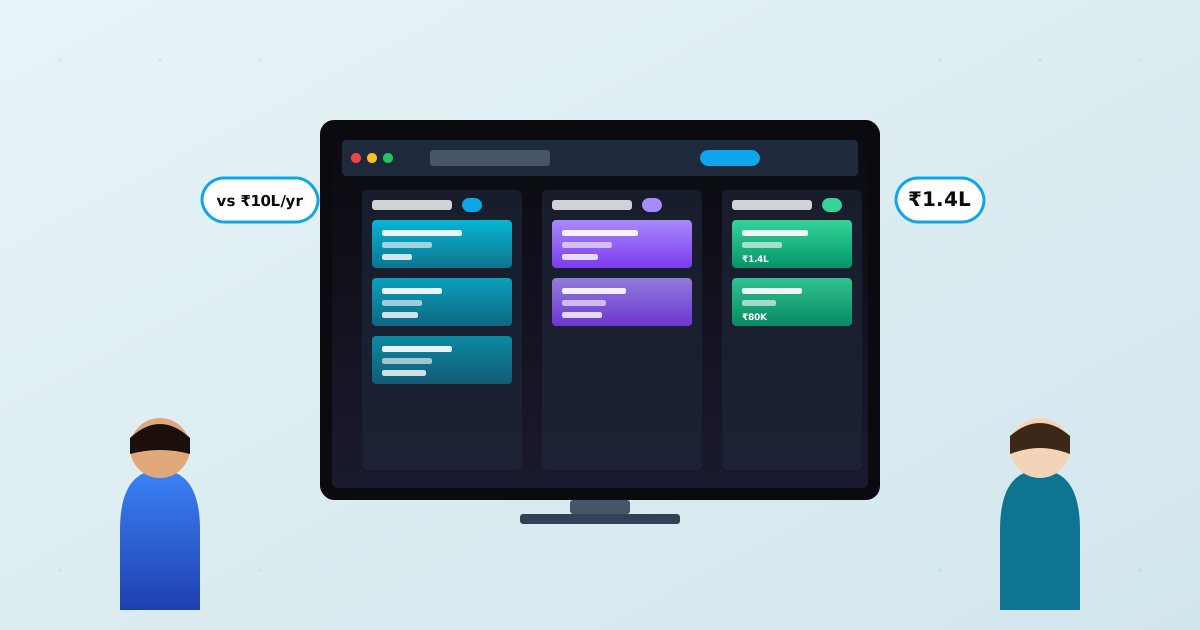
- Versus SaaS: Salesforce or HubSpot for a 10-person sales team runs ₹3 to 8 lakh a year, every year, forever, and it goes up as you add people. The custom build pays for itself against SaaS fees inside the first 12 to 18 months, then keeps saving.
- Versus the status quo (the bigger number): if you're getting, say, 100 leads a month and even 15 of them go cold purely because of missed follow-up, at a ₹10,000 average order value that's ₹1.5 lakh a month leaking out, or ₹18 lakh a year. A CRM that recovers even a third of that pays for itself in weeks, not months.
That's the real pitch. It's not an expense, it's plugging a leak you're already paying for. You just can't see the leak today, which is exactly the problem.
The objections you're already thinking (and my honest answers)
"What if my team won't use it?"
The #1 reason CRMs fail is exactly this, and it's why we build around your existing workflow instead of imposing a new one. If the CRM makes your salesperson's day easier (lead lands automatically, reminders fire, no double data-entry), they use it. If it adds work, they won't. We design for adoption first, and we pilot with one team before rolling out to everyone.
"What if you disappear or I want to change something later?"
Fair, and it's the most important question you can ask any dev shop. You get the code and the data, and you own it. We document the build, hand over access from day one, and write a scope you keep. If you ever want to move to another team, you can. We also offer a maintenance retainer so changes are quick, but you're never locked to us by force, only by being worth keeping.
"Isn't SaaS safer and faster to start?"
It's faster to switch on, yes. You can sign up for a SaaS CRM this afternoon. But 'fast to start' and 'right for your business' aren't the same. A SaaS tool you've contorted your process around, that nobody uses properly, that bills you forever, isn't safe. It's just a different kind of expensive. Custom takes 4 to 8 weeks to build, and that's the trade for a tool that fits and that you own.
"I'm too small for a CRM."
If you have more leads than you can personally remember, you're not too small. You're exactly the size where a CRM starts paying off. The best time to put one in is before the leaks get expensive, not after you've lost a year of follow-ups. If you genuinely are too early, I'll tell you that in the first call.
How we'd start, without you taking a big risk
You don't sign a big contract and hope. Here's the low-risk path we actually use:
- Discovery call (free): you walk me through how your sales actually works. Your lead sources, your stages, your team, where things slip. I tell you honestly whether a CRM is worth it for you yet.
- Written scope and flat INR quote: exactly what we'll build, the stages, the integrations, the timeline, the price. No hourly surprises. With a GST invoice.
- Build and pilot: we build the core, then roll it out to ONE team first. You see it working on real leads before it goes company-wide.
- Roll out and support: full team, training, and a maintenance retainer so it evolves with your business. Post-launch warranty included.
That's the whole pitch. It isn't 'buy our product'. It's 'let me show you the money you're already losing, and the system that stops it.' If any of this sounded like your business, the next step is a 20-minute conversation about how your sales actually works. No slide deck, no pressure. I'll either show you the CRM I'd build, or tell you honestly that you're not ready for one yet.
Tell me how your sales actually works, the leads, stages, and team, and I'll show you the custom CRM I'd build for it (and the math behind it).
Book a 20-minute CRM callFounder of buildbyravirai, a web development agency based in Noida, India. Building websites, web apps and mobile apps in Next.js, NestJS, Shopify and WordPress since 2021, for clients in India, the US, Canada and the UK.
Working with us in your city
Keep Reading
 Guides
Custom CRM Development in India 2026: Why a ₹40K-1.5L Build Beats Salesforce + HubSpot for Most Indian SMBs
Salesforce and HubSpot bill in USD per user, ₹3-8 lakh/year for a 10-person team. A custom CRM is ₹40K-1.5L one-time. Real INR costs and when custom wins vs SaaS.
How to Get Google Reviews for Your Business in India (2026)
A client paid ₹8,000 for 20 Google reviews and lost all of them in three weeks. The rules that delete reviews, four request messages you can copy, and what to do about a fake one star.
How Clients Judge Your Business Name Before They Ever See Your Work
Same scope, same people doing the work, two quotes: eighteen thousand and one lakh forty. The only thing that changed was the name on the proposal. What Indian buyers read into a business name, and how to stop being priced as one person with a laptop.
Business Email ID in India: Cost and Setup Guide (2026)
A business email ID on your own domain starts at ₹59 a user per month in India. 2026 prices, setup steps, and the DNS records that keep you out of spam.
How to Start Selling Online in India in 2026: The Honest Beginner's Guide (From Zero to First Orders)
The no-jargon, India-specific path from zero to your first online orders: where to sell, how Indians pay (UPI, COD), shipping, GST, costs, and your first 10 orders.