We build Next.js, Shopify, Laravel, Flutter, in Noida, India. Free 1-page audit, no obligation.
Get a free quote- Manufacturing Software for Indian MSMEs Industry 4.0 GuideAugust 22, 2026
- Logo Design and Report Design: What Indian Businesses Get Wrong22 August 2026
- Top Healthcare IT Solutions Improving Patient ExperienceAugust 12, 2026
- Top IT Solutions Transforming Financial Services in 2026August 10, 2026
 Technology
Top Enterprise IT Solutions Driving Digital Transformation
The phrase digital transformation has been sold to Indian businesses for over a decade, and it still does not mean anything specific. It has been attached to ERP licences, cloud migrations, chatbots, and slide decks, sometimes to the same company in the same financial year.
Underneath the phrase there is something real. Work that currently lives on paper, in one person's head, or in a shared Excel file moves into software where everyone can see it and where the company keeps a record it can query later. That is the whole idea.
This guide is written for Indian companies with roughly 50 to 500 people. A manufacturer in Greater Noida, a distribution business in Delhi, a services firm in Pune. Not a bank with a dedicated change management department and a two year budget cycle.
What Enterprise IT Means When You Are Not a Fortune 500
At this size the constraint is never technology. It is that two people know how the process really works, the operations head is firefighting most days, and nobody has three spare months to give to a software rollout.
So the useful definition is narrow. Enterprise IT here means the small set of systems that hold your orders, stock, money, and customer history, plus the connections between them. Everything else is optional until those are trustworthy.
The Patterns We See in Almost Every Company
Before recommending anything, we spend time watching how work actually moves through a business. The same five patterns come up again and again, across very different industries.
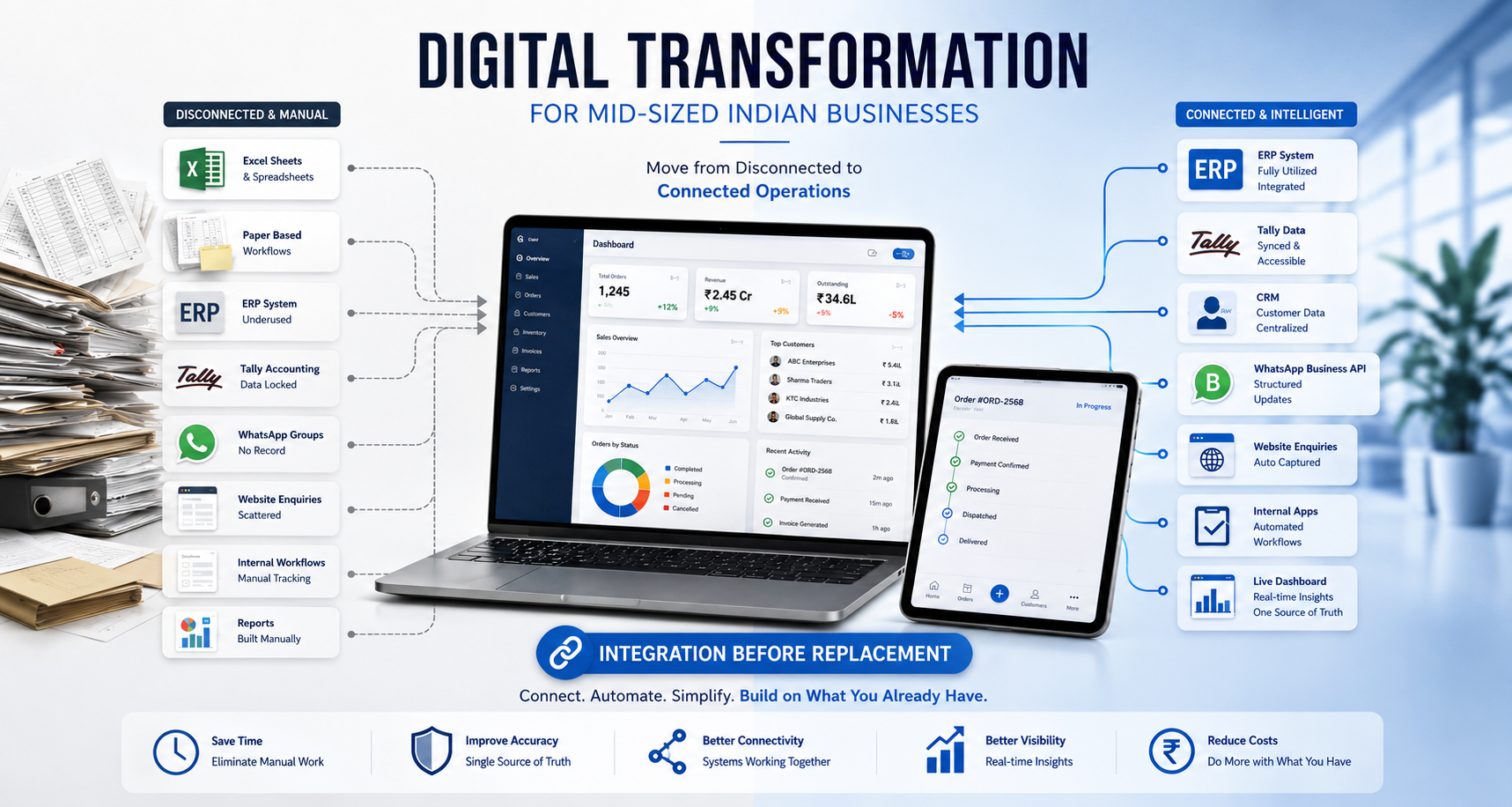
The spreadsheet that runs a department
There is always one. A production planning sheet, a dispatch tracker, a commission calculator with formulas nobody dares touch. It works, which is exactly why it survived. It also has no access control, no history of who changed what, and one person who genuinely understands it.
That spreadsheet is usually the best documentation of your process that exists anywhere in the company. Treat it as a specification, not as a problem to be deleted. The first move is to read it line by line, not to replace it in week one.
The ERP nobody uses
A licence was bought, consultants configured it, training happened, and now finance uses two modules while production runs on WhatsApp and Excel. Usage collapsed because the software demanded data at a moment when the person entering it had no time and no reason to care. Reviving the unused parts of a system you already own is usually cheaper than buying a new one, and often the fix is a simple entry screen on a phone that writes into the same database the ERP already reads from.
The WhatsApp group that is the real workflow
Approvals, dispatch photographs, quality complaints, payment follow ups. It moves fast, everyone is already on it, and it works well until somebody needs to answer a question about what happened last March. Fighting WhatsApp rarely works, but connecting to it does. A WhatsApp Business API flow that captures a structured update and files it against a job number keeps the habit intact and gains you the record.
Data locked inside Tally
Tally holds the ledgers, invoices, and outstanding balances for a very large share of Indian businesses. Sales wants to see receivables before promising a delivery. Management wants margin by customer. Getting either out is a real engineering task, not a settings toggle.
It is solvable. Tally exposes an XML request interface over a local port, and there are export routes and connectors available for Prime. The work sits in scheduling the sync, mapping ledger names to real customer records, and handling the days when that machine is simply switched off.
Three systems that do not talk
A website that takes enquiries, a CRM that holds the pipeline, and an accounting package that issues invoices. The same customer exists three times, spelled three ways. Monthly reports get assembled by hand because no single system holds the full picture. This is the highest value problem on the list and often the cheapest to fix, because you are writing connectors rather than replacing anything.
Why Big Bang Transformation Projects Fail
The failure is predictable enough to describe in advance. An eighteen month programme gets signed, requirements are gathered from managers rather than from the people doing the work, and by the time anything ships the business has moved on.
- Requirements come from people who describe the process as it should be, not as it is
- A single go live date forces every department to switch on the same weekend
- Nobody budgets for the messy, duplicated data already sitting in the old system
- Training happens weeks before the software is usable, so it has been forgotten by launch
- The one person who knows the real process was too busy to be interviewed properly
What you end up with is a system that is technically complete and practically ignored, plus a management team that will not fund software again for another three years. The second cost is worse than the first.
The projects that work start with one team, one process, and one honest problem. The projects that fail start with a roadmap.
Integration Before Replacement
The instinct is to replace. One new platform to hold everything, one vendor to blame. That is a large cheque, a long timeline, and it throws away years of accumulated configuration and staff habit that nobody has written down. The alternative is to leave your systems of record where they are and build the connections and missing screens around them, which is less impressive in a board presentation and far more likely to still be running in three years.
- Enquiries from the website and ad landing pages flowing into the CRM with source, campaign, and timestamp attached
- Confirmed orders creating invoices in the accounting system without anyone retyping line items
- Tally balances syncing nightly so sales can see what a customer owes before committing a dispatch
- Biometric attendance data feeding payroll instead of being keyed in once a month from a report
- One customer master that all three systems agree on, with a rule for who wins when they disagree
Most of this is unglamorous plumbing: scheduled jobs, retry queues, and a few hundred lines of mapping code. It also removes more manual effort per rupee than anything else you can buy. Our web application development work is mostly this kind of connective build.
The Small Internal Tool Is Often the Right Answer
A surprising share of transformation problems are solved by one screen used by nine people. Not a platform and not a suite. A form, a list, a status, and a record of who did what and when.
- A dispatch app where the loader photographs the vehicle and challan, timestamped and tied to the order number
- A quotation builder that pulls current rates so sales stops rebuilding a spreadsheet for every enquiry
- An approval screen for purchase requests above a threshold, with the trail preserved for audit
- A field service log that works on a low end Android phone with two bars of signal
- A vendor portal where suppliers upload invoices and check payment status, cutting the follow up calls to accounts
These take weeks rather than quarters, and they can be built against the systems you already run. If one fails to catch on, you have lost a small amount of money and learned something concrete about your own process. So when a proposal for your problem opens at a crore and eighteen months, ask what the smallest useful version costs and what exactly it would prove.
Dashboards People Actually Open
Most dashboards get built once, shown in a review meeting, and never opened again. Usually they answer questions nobody was asking, or the numbers are wrong often enough that people quietly stop trusting them.
- Build for one person and one decision first, normally the operations head or the founder
- Show fewer numbers, with the definition of each written next to it in plain words
- Display the timestamp of the last successful data sync where nobody can miss it
- Make every figure clickable down to the rows behind it, so disagreements end in thirty seconds
- Push the two or three numbers that matter to WhatsApp or email each morning, because people do not visit dashboards
A dashboard has earned its place when somebody notices it is broken within the hour. If it stays down for a week and no one complains, it was decoration.
Getting Data Out of Tally and Other Closed Systems
This comes up in almost every project, so it is worth being specific about the available routes rather than promising it will be easy.
- The Tally XML gateway over the local network, polled on a schedule by a small connector service running on site
- Scheduled exports dropped into a shared folder and parsed, which is crude but very reliable
- Published APIs if you have already moved to a cloud accounting product such as Zoho Books
- Direct database reads for systems that permit it, kept strictly read only so nothing can corrupt the source
- Screen level automation as a genuine last resort, which works and then breaks on every vendor update
Whichever route you take, the design rule stays the same. The accounting system remains the single source of truth for money, your copy is read only, and the sync writes a log so you can prove where a mismatched number came from at 11pm on a Friday.
What Enterprise IT Work Costs in India
Ranges below are for 2026, for work delivered by a competent Indian development team. Treat them as bands rather than quotes, because scope moves the final number more than any other factor.
- A discovery and process audit that produces a written plan you own: INR 60,000 to 2 lakh
- One focused internal tool covering a single workflow, mobile friendly: INR 2 lakh to 6 lakh
- An integration between two systems with scheduled sync and error handling: INR 1.5 lakh to 5 lakh
- A reporting and dashboard layer built over data you already have: INR 1.5 lakh to 5 lakh
- A custom internal platform with roles, approvals, and reporting: INR 10 lakh to 35 lakh
Running costs are the part buyers forget to plan for. Hosting, monitoring, backups, and a support arrangement usually land between INR 15,000 and INR 75,000 a month, depending on how critical the system is and how fast you need somebody to answer on a Sunday. Our pricing page sets out how we structure this, but the general rule is that a fixed price suits a well defined tool with a clear boundary, while a monthly arrangement suits continuing integration work where scope keeps revealing itself.
A Rollout Sequence That Holds Up
- Spend two weeks watching the process, sitting with the people doing it and collecting the spreadsheets they really use
- Pick one workflow that is painful, measurable, and owned by a manager who actively wants it fixed
- Ship a first version to one team within six to eight weeks, running alongside the old method rather than replacing it
- Let both run in parallel for a month and compare outputs, which is how the hidden data problems surface
- Retire the old method only when that team asks you to, then move to the next workflow
- Add cross system integrations once two systems have proved they hold data worth trusting
Notice what is absent. No company wide go live date, no weekend cutover, no training programme for people who will not touch the system for another quarter. Departments join when the previous one is stable, and budget is released in stages against working software.
How to Read a Proposal
- Ask who owns the source code and the database, and get that answer in writing before signing
- Ask what happens to your data and your deployment if the relationship ends next year
- Ask for the smallest useful first release and its date, not only the final scope
- Ask how the system behaves on the day an integration fails, because at some point it will
- Ask whether the team has worked with your specific accounting or ERP product before
A vendor who cannot describe your current process back to you in plain language has not understood it yet. That is a reason to slow down and keep talking, not a reason to negotiate harder on price.
When the Answer Is to Build Nothing
Sometimes the honest recommendation is that software is not your constraint. We have told companies to settle the process on paper first and come back in three months.
- The process still changes every month because the business model itself is being worked out
- Two departments disagree about who owns a step, and software will only make the argument louder
- An off the shelf product already covers ninety percent of it for a few thousand rupees a month
- Nobody internally has the time to own the project, test releases, and answer the team's questions
Software freezes a process into a fixed shape. Freezing the wrong shape is slow and expensive to undo, and the people who have to live with it will remember.
How We Approach This at buildbyravirai
buildbyravirai is a web and software development team based in Noida. The enterprise work we take on is mostly integrations, internal tools, and reporting layers for companies that already own systems and need them to cooperate.
We map what exists before proposing anything, build the smallest version that proves value, and keep the source code and database yours from the first commit. If that matches how you want to work, tell us what is breaking and we will say honestly whether it needs software at all.
Digital transformation as a phrase will keep getting sold, usually by whoever has a licence to move. The work underneath it stays ordinary and specific: read the spreadsheet, connect the two systems, build the one screen that removes an hour of retyping a day, then do it again next quarter.
Frequently asked questions
What does digital transformation actually mean for a mid sized Indian company?
Should we replace our ERP or build around it?
How much does a custom internal tool cost in India?
Can data in Tally be connected to a web application?
How long does a phased rollout take?
What is the most common reason these projects fail?
Founder of buildbyravirai, a web development agency based in Noida, India. 5+ years shipping Next.js, WordPress, Shopify, and Laravel projects for clients in India, USA, Canada, and the UK.
Working with us in your city
Keep Reading
 Technology
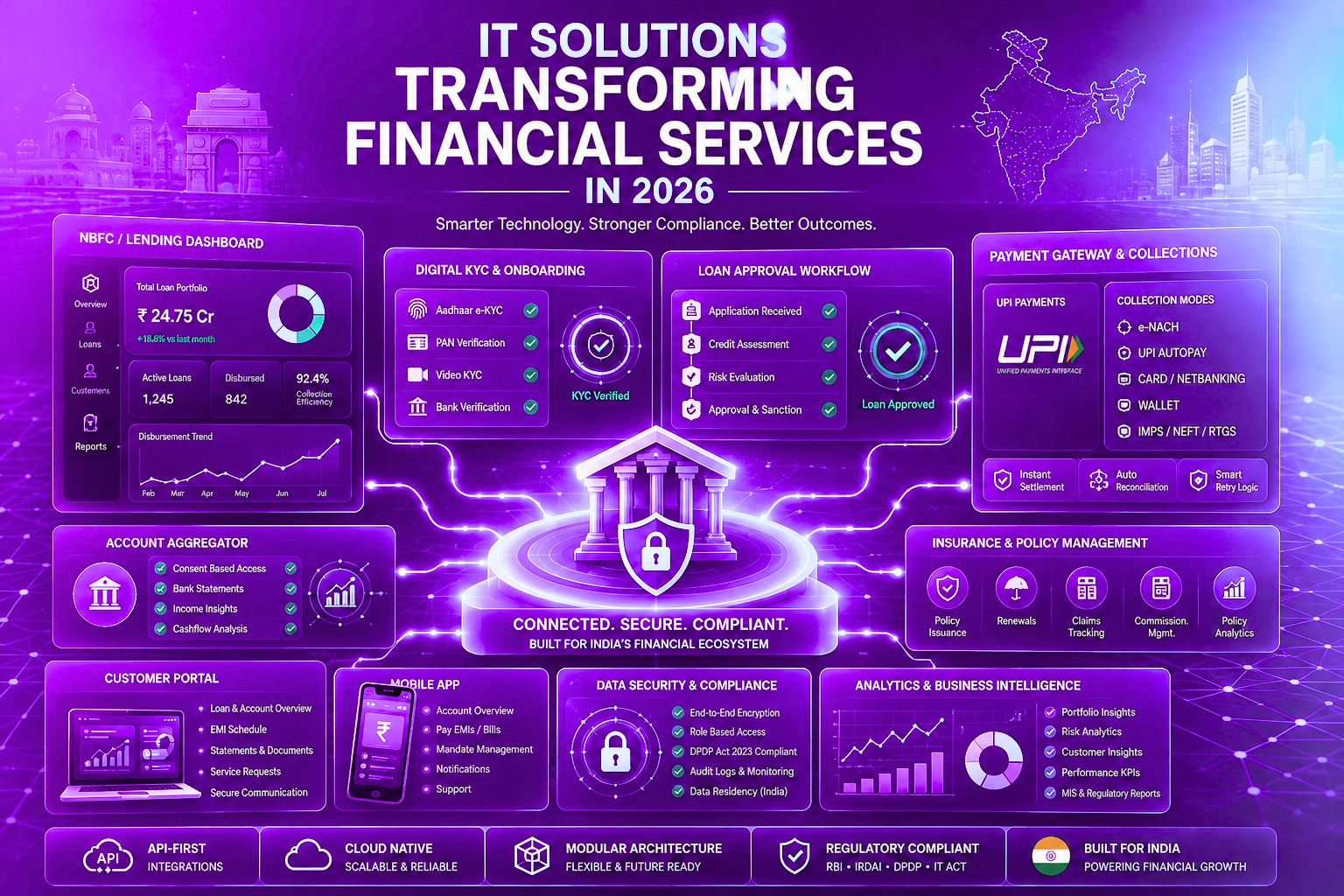
Top IT Solutions Transforming Financial Services in 2026
IT solutions for Indian NBFCs, lenders, insurers and fintech companies in 2026, covering KYC, lending software, payments, security, compliance and analytics.
 Technology
Website Speed & Core Web Vitals in India 2026: Why Your Site Is Slow and How to Fix It
A slow website quietly costs you customers and rankings, and in India it costs more. The practical guide to Core Web Vitals in 2026: LCP, INP, CLS, and the fixes.
TechnologyWhy Claude Is the LLM We Default to for Production Code in 2026 (Honest Comparison vs GPT-5 and Gemini)
We use Claude, GPT-5, and Gemini in production every week. After 40+ client projects, Claude wins most developer work, but not all. Here's where each is better.
TechnologyMCP (Model Context Protocol) for Indian Developers in 2026: What It Is, Why It Matters, and How We're Using It in Production
MCP is the most important developer integration of 2026 and 90% of Indian developers haven't touched it yet. It connects any LLM to your tools, databases, and APIs.
Technology75% of Developers Still Aren't Really Using AI. The Honest 2026 Adoption Numbers.
LinkedIn says AI replaced developers in 2024. Reality: 75% of Indian developers barely use it, 15% use free tools, only 10% are AI-first. Why the gap exists.