We build Next.js, Shopify, Laravel, Flutter, in Noida, India. Free 1-page audit, no obligation.
Get a free quote- Logo Design and Report Design: What Indian Businesses Get Wrong22 August 2026
- Manufacturing Software for Indian MSMEs Industry 4.0 GuideAugust 22, 2026
- Top Healthcare IT Solutions Improving Patient ExperienceAugust 12, 2026
- Top IT Solutions Transforming Financial Services in 2026August 10, 2026
- Real monthly salaries by stack + seniority (2026 INR)
- FTE vs Contractor vs Solo vs Agency, which to pick
- Where to find Indian developers in 2026
- The 5-step vetting process (30 min total)
- 6 red flags, walk away immediately
- City-specific notes for hiring
- Realistic timeline for hiring
- Outsourcing FROM abroad to India, special considerations
- Common mistakes by foreign clients hiring Indian developers
- What buildbyravirai does in this market
- TL;DR, Hiring Indian developers in 2026
 Guides
Hire Developers in India 2026: Complete Guide for Next.js, Flutter, PHP, Laravel & React (Cost, Process, Vetting)
If you're trying to hire developers in India in 2026, this guide covers everything you need to make the decision without getting burned. Real INR pricing by stack and seniority, 5-step vetting process, city-by-city quality differences, the 6 red flags to walk away from. We've hired 14 developers ourselves and helped 30+ clients shortlist Indian developers in the last 18 months. Numbers below come from that actual data, not industry reports.
“The 'hire developers in India' market in 2026 is a barbell. Top 10% of Indian developers cost the same as mid-tier US developers and ship faster. Bottom 50% cost what the listings suggest but produce work that needs to be redone within 6 months. Knowing how to tell them apart in 30 minutes is the single most valuable skill in this market.”
Real monthly salaries by stack + seniority (2026 INR)
These are FTE (full-time employee) monthly rates for Indian developers in 2026, based on what they actually accept (not LinkedIn salary expectations). Multiply ×1.5-2x for agency contractor rates, ×0.5-0.7x for moonlighting solo developers.
Next.js / React (front-end + full-stack)
- Junior (0-2 yrs): ₹40K-₹80K/month, can ship React UI from designs, basic API calls
- Mid (2-5 yrs): ₹80K-₹1.6L/month, can architect components, write tests, basic SSR
- Senior (5-8 yrs): ₹1.6L-₹3.2L/month, can lead architecture, performance optimization, mentor
- Staff/Lead (8+ yrs): ₹3.2L-₹6L/month, can own product, design systems, hire/manage
Flutter (mobile, cross-platform)
- Junior: ₹35K-₹70K/month
- Mid: ₹70K-₹1.5L/month
- Senior: ₹1.5L-₹3L/month
- Staff: ₹3L-₹5.5L/month
- Note: Flutter developers cost ~10% less than React/Next.js at every level (smaller talent pool, more specialized).
React Native (mobile)
- Same ranges as Flutter at every level
- Note: combined RN + Next.js developers (full-stack JavaScript) command 15-25% premium over RN-only specialists
PHP / Laravel (backend)
- Junior: ₹30K-₹60K/month
- Mid: ₹60K-₹1.2L/month
- Senior: ₹1.2L-₹2.5L/month
- Staff: ₹2.5L-₹4.5L/month
- Note: Laravel salaries trail React/Node by ~15%, bigger talent pool, more 'commodity' work
Node.js (backend + full-stack)
- Junior: ₹40K-₹80K/month
- Mid: ₹80K-₹1.7L/month
- Senior: ₹1.7L-₹3.5L/month
- Staff: ₹3.5L-₹6.5L/month
- Note: Highest demand in 2026. Premium developers can demand ₹5L+/month
FTE vs Contractor vs Solo vs Agency, which to pick
Hire as a Full-Time Employee (FTE)
- Best for: ongoing product development, building a long-term tech team, 6+ months of work
- Cost: monthly salary above + ~25% on top for PF, gratuity, leave, equipment, hiring cost
- Pros: lowest per-hour rate, dedicated focus, builds institutional knowledge
- Cons: 60-90 day notice periods, attrition risk (Indian senior devs change jobs every 2-3 years), HR overhead
Hire via dedicated developer/contractor (B2B agency)
- Best for: 3-12 month projects, when you need a senior dev without HR overhead
- Cost: ₹2-5L/month (mid), ₹4-8L/month (senior), 1.5-2x what you'd pay FTE
- Pros: faster to start (2-week ramp vs 60-day notice), agency handles HR/replacement risk
- Cons: ~50% margin to agency, dev's loyalty is split, switching cost is high
Hire as solo developer (independent)
- Best for: short-term well-scoped projects, specific deliverables
- Cost: ₹50K-₹3L for typical project, hourly rates ₹500-₹4,000/hour
- Pros: lowest commitment, fast start, no HR overhead
- Cons: highest disappearance risk, no replacement if they vanish, quality variance is enormous
Hire an agency (full team)
- Best for: complex multi-skill projects (frontend + backend + design + ops), defined scope
- Cost: flat-rate per project (see our Best Web Development Company India guide for exact numbers)
- Pros: end-to-end ownership, defined timeline, single contact
- Cons: most expensive per-hour, less control over individual team members
Where to find Indian developers in 2026
Best platforms (in 2026 order)
- 🥇 LinkedIn (90% of senior Indian devs are here), best for direct outreach to specific people
- 🥈 GitHub (look at contributions to relevant open source), best for senior+ technical filtering
- 🥉 Cutshort (Indian-specific, paid filter), best for mid-level FTE hires
- TopHire (Indian-specific, vetted), good for senior FTE, expensive
- AngelList (now Wellfound), good for startup-aligned devs
- Stack Overflow Jobs, quieter in 2026 but still works for niche stacks (OCPP, Web3, AI/ML)
- Hashnode + Dev.to, discover devs via their writing (signals seniority + communication skill)
Avoid (despite their marketing)
- Naukri / Monster / Shine, mostly bottom-50% candidates
- Upwork / Fiverr and bidding marketplaces, race-to-the-bottom pricing, mostly low-quality Indian solo developers
- Fiverr, designed for micro-tasks, not real development hiring
- TopTal, they vet well but their Indian devs cost as much as Eastern European (defeats the purpose)
The 5-step vetting process (30 min total)
Step 1, GitHub portfolio review (10 min)
Ask for their GitHub profile (any Indian dev who 'doesn't have GitHub' in 2026 is a serious red flag). Look for: real commits to real projects over the last 12 months, code that's not 'tutorial follow-along', README files written in coherent English, response to issues/PRs (signals collaboration skill). If they have <10 commits in the last year, they're either dormant or not actually shipping code daily.
Step 2, Live coding screen-share (15 min)
Pick a small task RELATED to your actual project (not LeetCode). Examples: 'Add a Razorpay payment button to this Next.js page', 'Write a Laravel migration for a multi-warehouse inventory table'. Watch them code. Look for: tooling fluency (do they use Cursor/Claude Code naturally?), Stack Overflow / docs habits (everyone Googles, but HOW they Google reveals seniority), willingness to push back on bad requirements ('actually, you might want to do this differently...').
Step 3, System design discussion (5 min)
One question: 'Walk me through how you'd architect a [system relevant to your project]'. Senior devs talk about trade-offs (consistency vs availability, ease vs flexibility). Junior devs jump straight to 'we'd use Mongo because it's NoSQL'. Mid-level devs talk specific technologies but skip the why. The difference is in 60 seconds.
Step 4, Reference call (post-interview, before offer)
Ask for 2 references, ideally a past manager + a past peer. Skip 'always positive' family-friend references. Real questions to ask references: 'What's the biggest mistake [candidate] made on your team and how did they handle it?' 'Would you hire them again? Why or why not?' Reference quality is the highest-signal vetting step but everyone skips it. Don't skip it.
Step 5, Paid 1-week trial (BEFORE the FTE offer)
Real work, real deadline, real money (₹15-50K depending on level). Watch them work, communicate, handle blockers. Almost all Indian senior devs accept paid trials happily; the ones who refuse are usually hiding something. The trial costs ₹15-50K and saves you the 3-month-replacement-cost of a bad hire (₹3-9L).
6 red flags, walk away immediately
- GitHub profile is empty, has only forked repos, or was created in the last 30 days
- They can't tell you WHO they currently work with by name (hide-the-employer is suspicious)
- They quote you a rate WAY below market (e.g., '₹15K/month for senior Next.js dev'), they're either lying about seniority or about being a senior
- They refuse the paid 1-week trial, almost certainly hiding gaps in their stated experience
- They show portfolio screenshots but no live URLs, those screenshots may be from other devs' work
- They sound 'too eager' / 'too desperate' / 'I'll do anything you need', actual senior devs have options and are choosy about projects
City-specific notes for hiring
Hire developers in Noida / Delhi NCR
Highest density of mid-to-senior PHP/Laravel/WordPress developers in India. NCR has been the WordPress capital of India for a decade. Senior Next.js / React talent pool is growing but still 30% smaller than Bangalore. Real estate close to startup hubs in Noida Sector 62 / Cyber Hub means in-office hybrid is feasible.
Hire developers in Bangalore
Highest density of senior product engineers in India. React + Node + Cloud + AI stack is overrepresented. Salary premium 20-40% over NCR for equivalent seniority. Best for funded startups; bootstrappers struggle to compete on TC.
Hire developers in Mumbai
Strong in fintech, ecommerce, D2C, finance-adjacent tech. Salaries comparable to Bangalore. Higher cost of living means devs expect higher TC. Look in Powai / Andheri for tech clusters.
Hire developers in Hyderabad
HITEC City has a strong product+SaaS dev pool. Lower TC than Bangalore for equivalent seniority. Strong .NET/Microsoft stack legacy means many devs there know enterprise patterns Bangalore devs skip.
Hire developers in Pune
Hinjewadi area has strong engineering culture (auto, manufacturing tech). Best for senior backend / cloud / DevOps. Lower TC than Bangalore (~15-20%) for similar seniority.
Hire developers in Chennai / Kochi / Ahmedabad / Indore
Lower TC (~30-40% below Bangalore) but smaller senior talent pool. Best for mid-level FTE. Senior+ hires from these cities often relocate to metros within 18 months, plan for it.
Realistic timeline for hiring
- Solo developer / contractor: 1-2 weeks from posting to start
- FTE through agency: 2-4 weeks (agency has bench)
- Direct FTE hire (LinkedIn outreach to passive candidates): 6-12 weeks (offers + 60-90 day notice periods)
- Senior+/Staff hire: 12-20 weeks (notice periods + counteroffers + onboarding)
Outsourcing FROM abroad to India, special considerations
If you're a US/UK/Canada/Australia client hiring Indian developers, additional considerations:
- Time zone overlap: India is GMT+5:30, overlaps 2-4 hours with US East, 4-5 hours with UK, 8 hours with Australia East
- Payment via Wise, Stripe Connect, or direct bank wire (PayPal works but adds 3-5% fees)
- 1099/contractor classification is legally fine for US clients; UK clients should consult IR35
- Many Indian developers have experience with foreign clients and can match working hours partially
- Premium for foreign-client work: ~15-25% over Indian rates because Indians know the higher rates abroad
Common mistakes by foreign clients hiring Indian developers
- Assuming all Indian developers are cheap, top 10% cost the same as US mid-tier
- Skipping the live coding interview because 'we're remote', never skip this
- Paying 100% upfront, split into milestones
- Not having a written contract, Indian courts CAN enforce, but only if you have paper
- Not asking about ongoing employer / moonlighting status, many Indian devs moonlight, which is fine if disclosed but a problem if not
- Expecting same-day response, Indians work hard but live at GMT+5:30; respect the time zone
What buildbyravirai does in this market
We don't run a 'staff augmentation' or 'dedicated developer' bench. We're a boutique agency (6-person senior team) that takes flat-rate projects. If you want to hire a single dedicated developer rather than a project team, we'll honestly recommend agencies that specialize in that (and we've referred clients there). If you want a complete project shipped end-to-end with a senior small team, we're a good fit.
We do offer a paid Hiring Audit (₹15,000 for a 90-min call): you describe your need, we tell you whether to hire FTE/contractor/solo developer/agency, recommend specific platforms + people, give you the exact interview questions for your stack, and review your shortlist of candidates. About 70% of clients who do this audit save more than its cost in time/avoided bad hires.
Hiring Indian developers and want an honest second opinion on your shortlist? 90-min Hiring Audit ₹15,000, flat fee, actionable written deliverable.
Book a hiring auditTL;DR, Hiring Indian developers in 2026
- Mid-tier Indian Next.js dev: ₹80K-₹1.6L/mo FTE, ₹1.6-3L/mo via agency, ₹500-2K/hour solo
- Senior Indian Flutter dev: ₹1.5-3L/mo FTE, ₹3-5L/mo via agency
- Senior Indian Laravel/PHP dev: ₹1.2-2.5L/mo FTE, 15% cheaper than React/Node equivalents
- Find them on: LinkedIn (90% of senior devs), GitHub (top technical filter), Cutshort (Indian-specific)
- Avoid: Naukri, Upwork, Fiverr, race-to-bottom pricing attracts wrong candidates
- 5-step vetting: GitHub review (10min) → live coding (15min) → system design (5min) → reference call → paid 1-week trial
- Best cities by stack: NCR (PHP/Laravel/WordPress), Bangalore (React/Node/SaaS), Mumbai (fintech), Hyderabad (enterprise)
- Foreign clients: top Indian devs cost same as US mid-tier, never assume cheap = available
- Don't skip the paid trial, ₹15-50K spent on a trial saves ₹3-9L from a bad hire
Founder of buildbyravirai, a web development agency based in Noida, India. 5+ years shipping Next.js, WordPress, Shopify, and Laravel projects for clients in India, USA, Canada, and the UK.
Working with us in your city
Keep Reading
 Mobile
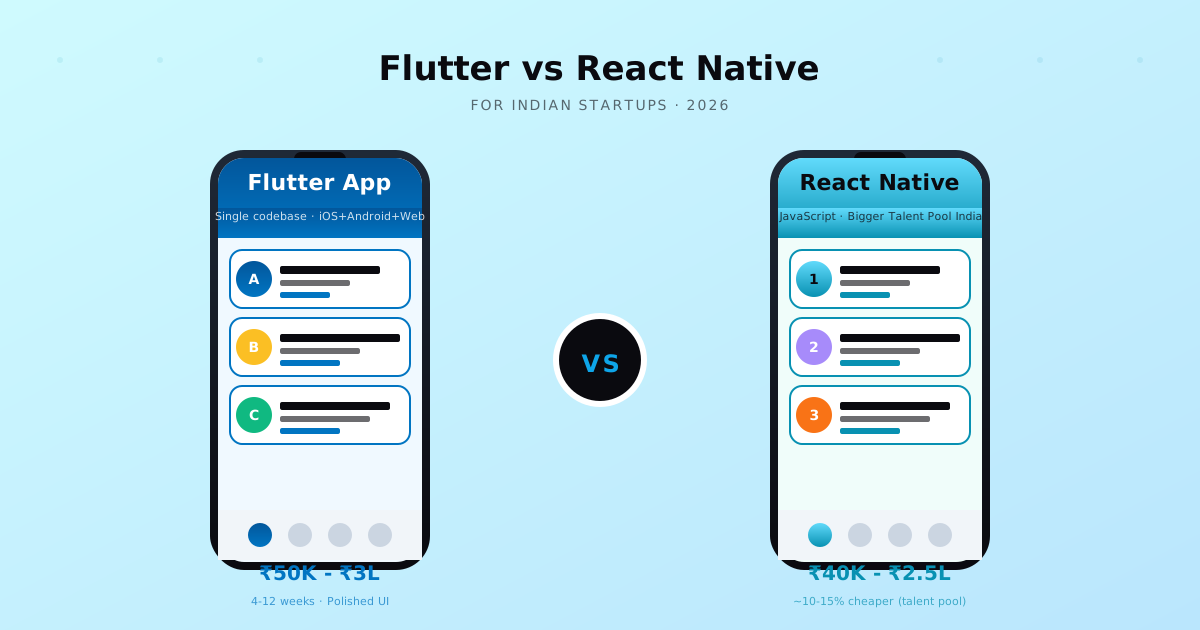
Flutter vs React Native for Indian Startups in 2026: Real Build Costs, Maintenance Reality, and When Each Stack Wins
Indian founders keep getting confused between Flutter and React Native. The honest 2026 comparison: INR build costs (₹40K-3L), talent, and when each stack wins.
GuidesHow to Choose the Right Tech Stack for Your Startup in India 2026 (A No-Hype Guide)
The no-hype guide to choosing your tech stack for Indian founders in 2026: the five questions that decide your stack, and the right default for each project.
GuidesTop 10 Web Developers in India 2026: The Honest Criteria + How to Actually Pick One (Not Just a Listicle)
Most 'Top 10 Web Developers in India' lists are paid placements. The honest version: 7 criteria separating top-tier shops, 5 categories, 4 disqualifying questions.
 Guides
Outsourcing Web Development to India in 2026: The Honest Guide for US, Canadian & UK Startups (Real USD Costs + 9 Risks)
US founders pay $150-300/hr, UK agencies £100-200/hr, Indian senior devs $30-60/hr. The savings are real, so are the 9 hidden risks. Honest 2026 USD pricing inside.
GuidesBest Web Development Company in India 2026: An Honest Buyer's Guide (Not a Sales Pitch)
Every 'best web development company in India 2026' list is a sponsored ranking. This one isn't. How to actually pick, what to ask, and what to walk away from.