We build Next.js, Shopify, Laravel, Flutter, in Noida, India. Free 1-page audit, no obligation.
Get a free quote- Logo Design and Report Design: What Indian Businesses Get Wrong22 August 2026
- Manufacturing Software for Indian MSMEs Industry 4.0 GuideAugust 22, 2026
- Top Healthcare IT Solutions Improving Patient ExperienceAugust 12, 2026
- Top IT Solutions Transforming Financial Services in 2026August 10, 2026
- The honest founder question, "Which stack for my ₹2-5L MVP?"
- The 30-second answer
- What Flutter actually gives you in 2026
- What React Native actually gives you in 2026
- Pricing reality for Indian startups in 2026
- Talent reality in India, who can you actually hire?
- Performance reality, does it matter for your app?
- Decision matrix by app type
- Decision matrix by team type
- What can go wrong with each
- Integration ease, Razorpay, Stripe, Firebase, push notifications
- Maintenance reality at year 2
- Indian agency reality, what you'll actually find
- FAQ
- Final word, pick the stack your team can ship, not the one Twitter likes
 Mobile
Flutter vs React Native for Indian Startups in 2026: Real Build Costs, Maintenance Reality, and When Each Stack Wins
Every week, an Indian founder messages me asking the same question: "I've got ₹2-5 lakhs to build my MVP. Flutter or React Native?" The answer they get usually depends on which agency they asked, Flutter shops sell Flutter, React Native shops sell React Native, and full-service agencies pick whichever team has bench capacity that month. None of that helps a founder make the actual right call.
I run buildbyravirai, a Noida-based dev shop that's shipped apps in both stacks for Indian D2C brands, edtech, and B2B platforms. This guide is what I tell every founder before they sign a mobile contract. No stack bias, no "it depends" cop-out, just the honest 2026 picture with real INR numbers.
The honest founder question, "Which stack for my ₹2-5L MVP?"
Let's be specific about the question being asked. The typical Indian startup founder in 2026 is sitting on ₹2-5 lakhs of pre-seed or bootstrapped capital, needs an iOS + Android MVP in 6-10 weeks, has either a web team already (React/Next.js) or no team at all, and wants to ship something that doesn't embarrass them at the first investor demo. That's the real question, not"which framework is theoretically better", but "which one survives my actual constraints".
If you're building a desktop SaaS dashboard and porting to mobile later, this guide isn't for you, read our Next.js production lessons instead. This is for founders who know mobile is the primary product and need to ship cross-platform fast.
The 30-second answer
If you only read one section, read this one. After 4 years of shipping both stacks for Indian clients, here's the compressed answer:
- Choose Flutter if: you care deeply about UI polish, animations, and a consistent "feels native on both platforms" experience. Your product is design-driven (edtech, healthcare, social, content apps). You have a small team and you're OK with a smaller talent pool in India.
- Choose React Native if: you already have a React/Next.js web team and want them to work on mobile too. You need to hire fast in India, RN developers are 3-4x more plentiful. Your product is iteration-heavy (marketplace, food delivery, B2B tools) where ecosystem maturity matters more than UI polish.
- Choose neither (go native) if: you're building a heavy gaming experience, AR/VR, or need deep OS integration (CarPlay, Android Auto, watchOS), but that's <5% of Indian startup mobile builds.
What Flutter actually gives you in 2026
Flutter in 2026 is a mature, Google-backed framework that compiles Dart to native ARM code for iOS and Android (and increasingly web + desktop + embedded). Here's what you actually get:
- Single codebase, iOS, Android, web, macOS, Windows, Linux, even embedded (Toyota uses Flutter for in-car displays). The dream of one codebase is closer in Flutter than in any other framework.
- Dart language, opinionated, strongly typed, sound null safety. Easier than Swift, similar to TypeScript. The learning curve is 2-4 weeks for an experienced JS/TS developer.
- Material 3 + Cupertino widgets, out-of-the-box widgets that match Google's and Apple's design systems. Your app actually looks native on both platforms without effort.
- Skia / Impeller rendering, Flutter draws its own pixels using Skia (and the newer Impeller engine on iOS), bypassing native UI. This is why Flutter wins for animation-heavy apps, you get true 60-120fps animations with zero jank.
- Hot reload, sub-second state-preserving reload during dev. Genuinely magical compared to native iOS/Android dev cycles.
- Google backing, Flutter is built and maintained by Google. Stadia was killed; Flutter wasn't. It powers Google Pay, parts of Google Classroom, and YouTube Create.
The performance edge in animation and complex UI is real. If your app has a lot of custom motion, hero transitions, gesture-driven UI, or pixel-perfect brand requirements, Flutter is genuinely better. Apps like Reflectly, Google Pay India, and Nubank's onboarding flows are Flutter and feel buttery.
What React Native actually gives you in 2026
React Native in 2026 is the Meta-backed cross-platform framework that's finally crossed its rebuild milestone, the New Architecture (Fabric renderer + TurboModules) is stable and most major libraries have migrated. Here's what RN actually gives you in 2026:
- JavaScript / TypeScript, the single most common language stack in Indian tech. Every React developer in India can pick up RN in 2-3 weeks. Every Next.js developer can ship RN features without re-learning a language.
- Expo, Expo Application Services (EAS) in 2026 is the gold standard for shipping RN apps. OTA updates, managed builds, push notifications, deep linking, Expo handles it. You can ship your first RN app to TestFlight in 48 hours with Expo.
- Web team reuse, if you have a Next.js team in Bangalore or a React team in Pune, they can ship RN features within weeks. This is the biggest practical advantage for Indian startups with existing web product.
- Meta backing, RN powers Facebook, Instagram (parts of it), Shopify mobile, Discord (iOS), Tesla's mobile app, Walmart, and Microsoft Office mobile. It's not going anywhere.
- New Architecture stable, Fabric (the new renderer) and TurboModules (the new native module system) shipped properly in 2024-2025 and are stable in 2026. Performance gaps with Flutter have largely closed.
- Massive ecosystem, npm has 2M+ packages, and the RN community has wrappers for almost everything. Razorpay, Stripe, Firebase, AWS Amplify, RevenueCat, all first-class.
Pricing reality for Indian startups in 2026
Real INR numbers from actual Indian agency engagements in 2026. These are the ranges you should see, anything 2x higher than this is either premium positioning or padded scope; anything significantly lower is either a junior solo developer or a project headed for rebuild.
Flutter, 2026 INR pricing
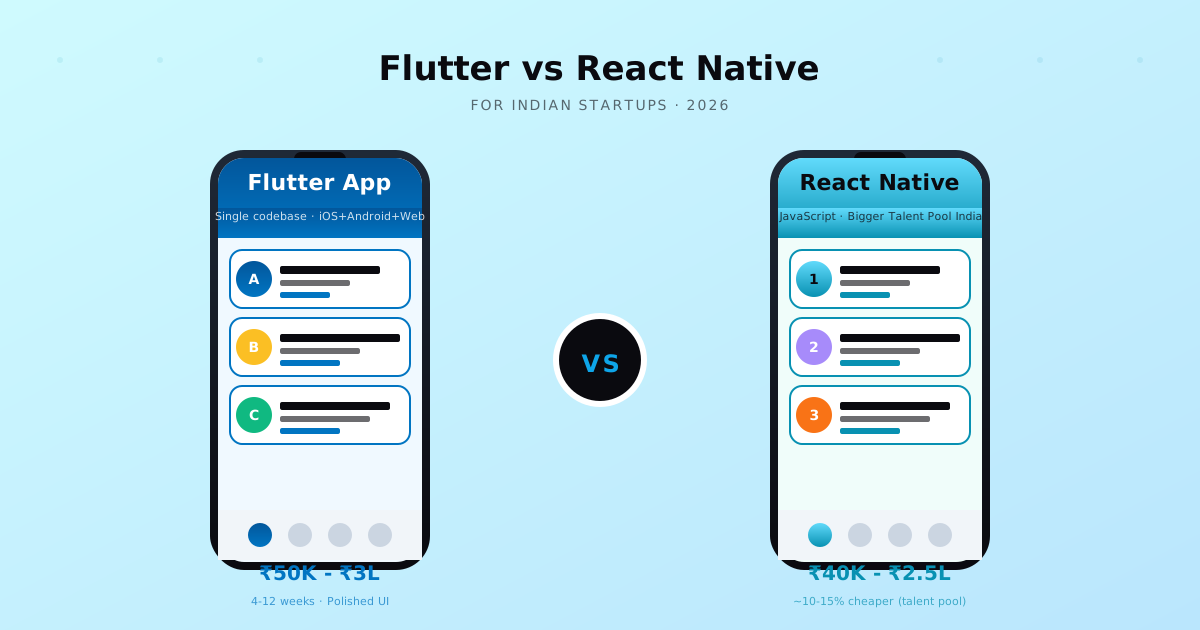
- MVP (4-8 weeks): ₹50,000 - ₹1,50,000 for a 5-8 screen app with auth, basic CRUD, push notifications, and one payment integration
- Production app (10-16 weeks): ₹1,00,000 - ₹3,00,000 for a full app with 15-25 screens, multiple integrations, analytics, and proper state management
- Maintenance retainer: ₹25,000 - ₹50,000/month for bug fixes, OS version updates, minor features, store submissions
React Native, 2026 INR pricing
- MVP (4-8 weeks): ₹40,000 - ₹1,20,000 for the same scope
- Production app (10-16 weeks): ₹1,00,000 - ₹2,50,000
- Maintenance retainer: ₹20,000 - ₹45,000/month
React Native works out roughly 10-15% cheaper for the same scope in India, purely because the talent pool is deeper and competition is higher. This isn't a quality difference; it's a supply-and-demand reality. If you're hiring solo, you'll see similar numbers, see our solo web developer guide for the broader picture on Indian solo developer rates.
Talent reality in India, who can you actually hire?
This is the single biggest practical factor that founders underweight. The decision matrix changes dramatically when you ask "can I hire 3 more developers within 60 days if we close our seed round?"
- React Native developers in India: roughly 50,000+ with 1+ years experience. Massive pool in Bangalore, Hyderabad, Pune, Gurugram, Chennai. Average mid-level salary ₹8-15L/year, senior ₹18-30L/year.
- Flutter developers in India: roughly 15-20,000 with 1+ years experience. Smaller pool but growing. Concentrated in Bangalore, Pune, and tier-2 cities (Indore, Coimbatore, Kochi). Average mid-level ₹9-14L/year, senior ₹16-26L/year.
- Quality observation: Flutter dev quality in India is sometimes higher per-capita, the pool is self-selected (you have to specifically choose Dart, which isn't a default language), so dabblers are filtered out. RN attracts JS devs who just "tried mobile", quality variance is wider.
Practical takeaway: if you're a Bangalore or Pune startup planning to hire 3-5 mobile engineers in the next 12 months, React Native is operationally easier. If you're hiring one senior who'll own mobile, Flutter is just as feasible.
Performance reality, does it matter for your app?
The internet has spent 5 years arguing about Flutter vs RN performance. In 2026, the honest answer is: for 90% of apps, you won't notice the difference. Here's what's actually true:
- Startup time: Flutter slightly faster cold-start (300-600ms) vs RN (500-900ms with Hermes JS engine). User-visible? Marginally.
- First-frame render: Flutter wins by ~100-200ms. Mostly invisible on modern phones.
- 60fps UI: Both ship 60fps for normal scrolling, lists, navigation. Flutter ships 120fps more reliably for animation-heavy screens.
- Animation-heavy / custom motion: Flutter wins clearly. Skia/Impeller rendering is faster than RN's bridge-to-native approach even with Fabric.
- Memory: Roughly equivalent. Flutter apps tend to be 5-10MB larger in install size due to embedded engine.
- Battery: No meaningful difference for typical apps.
If your product strategy is "buttery animations and pixel-perfect motion as a differentiator", Flutter. If it's "ship features fast, iterate based on user feedback", RN's ecosystem maturity wins more often than its performance loses.
Decision matrix by app type
Below is the pattern I see across 50+ Indian mobile builds. Not gospel, but a useful default when you're choosing the stack in week 1 with no other information.
- Edtech app (Byju's-style, Vedantu-style): Flutter. Animation, polish, and brand consistency matter to parents/students. Stable, content-heavy, design-driven.
- Food delivery (Swiggy/Zomato clone, dark-store grocery): React Native. Fast iteration, deep ecosystem (mapping, payments, push), web-team-reuse for the partner dashboard.
- Fintech (neobank, lending, investment): Either, depending on team. RN if you have a Next.js web team. Flutter if greenfield and design-driven.
- Healthcare booking (telemedicine, lab tests): Flutter, UI polish for elderly users matters, accessibility widgets in Flutter are excellent in 2026.
- B2B internal tools / sales-team apps: React Native. Web team reuse, no need for pixel polish.
- Gaming / animation-heavy / AR-lite: Flutter. Or go native if you're shipping serious 3D.
- Marketplace / classifieds (OLX-style): React Native. Ecosystem depth, fast iteration.
- Social / content-creator app: Flutter. Polish is a competitive moat in this category.
Decision matrix by team type
Team composition often decides this more cleanly than product category. If you're weighing options:
- Existing React/Next.js web team in India: React Native. Period. You'll save 6-12 months of hiring and onboarding by reusing your existing team.
- Greenfield startup, no team yet, design-driven product: Flutter. Hire one senior Flutter dev, ship faster than you would with two mid-level RN devs.
- Tight budget, need to scale team fast across India: React Native. Talent pool depth is your friend in Pune, Hyderabad, Bangalore.
- Need iOS + Android + web + desktop with one codebase: Flutter. RN's web story (React Native Web) works but isn't comparable to Flutter Web.
- Founder-developer team where the founder will code: Whichever the founder is more comfortable in. Velocity beats stack choice.
What can go wrong with each
Flutter, the gotchas
- Smaller plugin ecosystem, some Indian-specific integrations (older Razorpay flows, NSDL e-sign, India-specific KYC SDKs) need custom platform-channel work. Budget 2-4 weeks for any unusual integration.
- Web and desktop builds are slower to compile, fine for production, occasionally annoying in dev.
- Hiring lag, if your Flutter dev leaves, replacing them in India takes 4-8 weeks vs 2-4 weeks for RN.
- App size penalty, Flutter apps are 5-10MB larger. Matters slightly for tier-2/tier-3 India users on 2G/3G or low-storage phones.
React Native, the gotchas
- New Architecture migration pain, if your app was started on RN 0.68 or earlier (old bridge architecture), migrating to Fabric/TurboModules can be a 4-8 week project. Greenfield 2026 builds skip this entirely.
- Third-party library compatibility, when you upgrade RN versions, expect 2-4 of your dependencies to break. Plan for it.
- Hermes vs JSC, Hermes is default and recommended, but some libraries still assume JSC. Read release notes.
- Native module debugging, when something breaks at the native bridge layer, you need someone who can read Swift/Objective-C and Kotlin/Java. Pure-JS devs hit a wall here.
Integration ease, Razorpay, Stripe, Firebase, push notifications
Both stacks integrate with all the standard SDKs Indian startups need. Quick reality check on each:
- Razorpay: Official SDKs for both Flutter and RN. Both work well. RN has more community wrappers for edge cases.
- Stripe: First-class on both. Stripe's Flutter SDK is genuinely excellent (one of the best Flutter SDKs in any category).
- Firebase: First-class on both. Flutter's FlutterFire is well-maintained by Google itself. RN's react-native-firebase by Invertase is the standard.
- Push notifications (FCM, APNs): Both stacks handle this cleanly. Expo wraps it nicely for RN. Flutter requires slightly more setup but well documented.
- Analytics (Mixpanel, Amplitude, Posthog): Both have first-class SDKs.
- Indian-specific (DigiLocker, Aadhaar e-KYC, UPI deep links): Slight RN edge due to community wrappers. Flutter usually requires platform-channel custom code.
Net assessment: slight edge to React Native for ecosystem breadth, slight edge to Flutter for SDK code quality where SDKs exist. Neither is a blocker.
Maintenance reality at year 2
The conversation founders never have in month 1 is: "what does this app cost to keep alive in year 2 and year 3?" Here's the honest answer:
- Flutter major version upgrades, Flutter 3 → Flutter 4 (whenever it ships) will require some breaking-change work. Plan 2-4 weeks of dev time per major upgrade.
- React Native major version upgrades, RN 0.74 → 0.78 (or whatever 2026 brings) requires testing every dependency. Plan 2-4 weeks too. The pain is roughly equivalent.
- iOS/Android OS upgrades, every year Apple/Google ships new versions that break things. Both stacks need 1-2 weeks of testing each fall.
- Annual maintenance budget rule: 10-15% of original build cost per year. For a ₹3L build, expect ₹30-45K/year minimum just to keep the app working, before any new features.
Indian agency reality, what you'll actually find
If you're shopping for an agency in India in 2026, here's what the market actually looks like:
- Most Indian agencies bias toward React Native, pool depth, easier hiring, web-team-reuse. About 65-70% of multi-service agencies will quote you RN by default.
- Senior agencies (₹10L+/project) usually have both teams. Ask explicitly: "how many of each have you shipped in the last 12 months?", if they say "we're comfortable with both" but can't name 3 Flutter projects, they're an RN shop.
- Solo developers in India, roughly 70/30 React Native to Flutter. Flutter-only solo developers exist (smaller, often higher quality) but are harder to find on Upwork/Toptal. LinkedIn search works better.
- Boutique Flutter-specialist agencies, small but growing in Pune, Bangalore, Indore. Usually 5-15 people, charge 10-20% premium over RN agencies.
If you want to compare cities for sourcing, browse our Indian cities page, we have city-specific dev pages for Bangalore, Hyderabad, Pune, Noida, and more.
FAQ
Can I migrate from one stack to the other later?
Practically, no, it's a full rebuild. Your data layer (backend, API) carries over, but the entire app code does not. Budget a full new build (₹1-3L) if you're switching stacks. This is why the stack choice in month 1 matters.
What about Kotlin Multiplatform (KMP) for cross-platform?
KMP is interesting and 2026 saw it mature significantly (Compose Multiplatform is stable). But for Indian startups, the talent pool is tiny (maybe 1-2,000 KMP developers in India), tooling is still rougher than Flutter/RN, and you're a guinea pig if something goes wrong. Wait until 2027-2028 to evaluate seriously unless you have a senior Kotlin engineer leading the build.
Is KMP production-ready in 2026?
For Kotlin-first teams already on Android, yes, KMP for shared business logic is production-ready (JetBrains uses it, McDonald's uses it). For full-stack UI cross-platform with Compose Multiplatform on iOS, still early. Not the default choice for an Indian startup MVP.
How does the Indian App Store / Play Store submission work?
No difference between Flutter and RN here. You need a $99/year Apple Developer account (~₹8,300) and a one-time $25 Google Play account (~₹2,100). Both stacks ship a signed IPA / AAB just fine. First-time submission to Apple usually takes 24-72 hours; Google Play is faster (1-24 hours). Expect 1-2 rejections, privacy policy, missing screenshots, or unclear app description are the usual culprits.
What about Indian-specific requirements like UPI deep links or Aadhaar e-KYC?
Both stacks can handle these, usually through platform-channel (Flutter) or native modules (RN). RN has slightly more community packages for Indian-specific integrations. If your app is fintech or government-adjacent, ask the agency specifically how many UPI/Aadhaar/DigiLocker integrations they've shipped, this is where junior teams break.
Should I just hire a solo developer instead of an agency?
For ₹50K-1.5L MVPs, a senior solo developer often beats an agency on velocity and price. For ₹3L+ production apps with multiple integrations, an agency's redundancy (2-3 devs, designer, QA) is usually worth the premium. We covered the broader solo developer vs agency decision for web, most of it applies to mobile too.
Final word, pick the stack your team can ship, not the one Twitter likes
After 4 years of shipping both stacks for Indian clients, the pattern is clear: founders who agonized over the choice for 4 weeks usually picked wrong. Founders who picked based on team composition and shipped in week 2 usually picked right. The stack matters less than the velocity it enables in your specific team.
If you have a React/Next.js team, React Native, no debate. If you're greenfield and design-driven, Flutter. If you're neither and have ₹3L+ and 3 months, flip a coin, then commit. Both stacks will ship a good app in 2026; only one of them will ship YOUR app fast enough to matter.
Building a Flutter or React Native MVP in India? We ship [mobile and cross-platform builds](/services/flutter-react-native-development/) from [Noida](/web-developer-noida/) and across [Indian cities](/web-development-agency/), both stacks, honest scoping, no padded estimates.
Get a free mobile MVP scoping callFounder of buildbyravirai, a web development agency based in Noida, India. 5+ years shipping Next.js, WordPress, Shopify, and Laravel projects for clients in India, USA, Canada, and the UK.
Working with us in your city
Keep Reading
 Mobile
React Native vs Flutter in India 2026: Which to Pick for Your Mobile App
Honest comparison for Indian founders: React Native vs Flutter on cost, dev talent pool, performance, and real app-store experience, with a pick for each case.
 Guides
Hire Developers in India 2026: Complete Guide for Next.js, Flutter, PHP, Laravel & React (Cost, Process, Vetting)
Hire dedicated Next.js, Flutter, PHP, Laravel, or React developers in India in 2026 without getting burned. Real INR pricing, 5-step vetting, and the 6 red flags.
GuidesWe Build FREE Websites for Indian Small Businesses in 2026, Here's Exactly How It Works (and What Costs Money)
Yes, we genuinely build free websites for Indian small businesses. No tricks. A real 5-page site on real hosting. What's free, who qualifies, and how to apply.
BusinessHow to Build a SaaS MVP in India 2026: Cost, Stack, and Timeline
The founder-honest guide to SaaS MVP development in India 2026: what to build and what to cut, the stack we use, real INR cost and timeline, build versus no-code.
 Guides
Outsourcing Web Development to India in 2026: The Honest Guide for US, Canadian & UK Startups (Real USD Costs + 9 Risks)
US founders pay $150-300/hr, UK agencies £100-200/hr, Indian senior devs $30-60/hr. The savings are real, so are the 9 hidden risks. Honest 2026 USD pricing inside.