We build Next.js, Shopify, Laravel, Flutter, in Noida, India. Free 1-page audit, no obligation.
Get a free quote- Logo Design and Report Design: What Indian Businesses Get Wrong22 August 2026
- Manufacturing Software for Indian MSMEs Industry 4.0 GuideAugust 22, 2026
- Top Healthcare IT Solutions Improving Patient ExperienceAugust 12, 2026
- Top IT Solutions Transforming Financial Services in 2026August 10, 2026
- The Indian SMB CRM trap
- What an Indian SMB actually needs from CRM in 2026
- Real INR pricing for custom CRM in 2026
- When custom CRM beats SaaS, 5 verticals where it's a no-brainer
- When SaaS CRM still wins (be honest)
- The 8-step custom CRM build process (so you know what to expect)
- Common questions Indian founders ask before buying a custom CRM
- Honest summary
 Guides
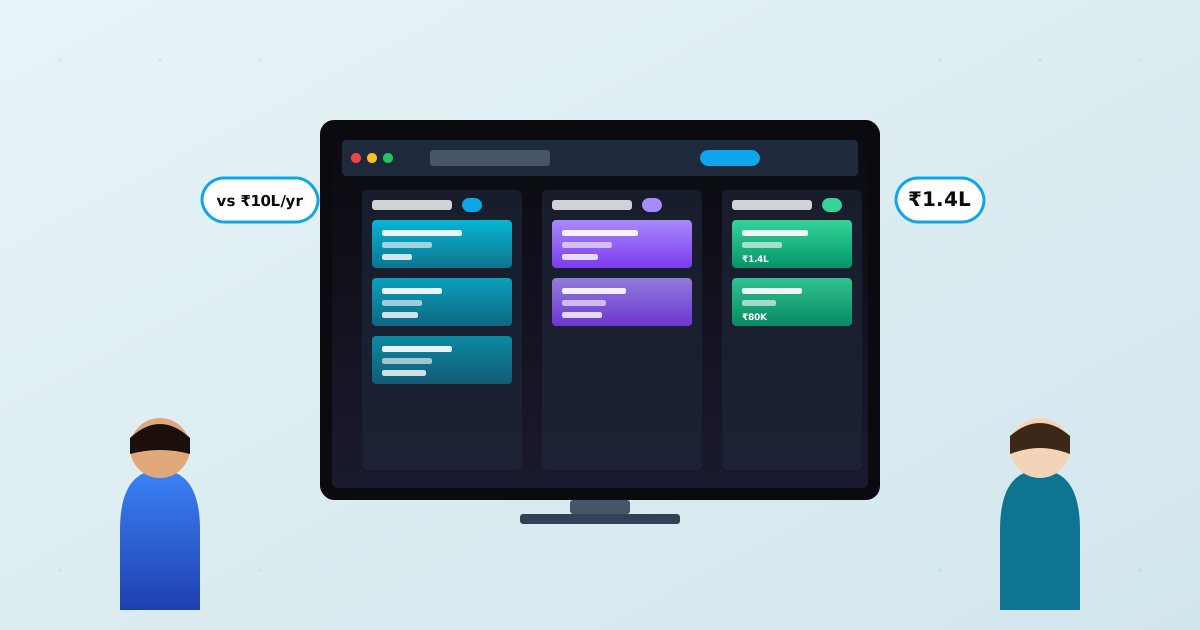
Custom CRM Development in India 2026: Why a ₹40K-1.5L Build Beats Salesforce + HubSpot for Most Indian SMBs
Most Indian SMB founders I talk to fall into one of three CRM camps. Camp 1: paying ₹3-8 lakh per year for Salesforce / HubSpot and using 5% of the features. Camp 2: using Google Sheets + WhatsApp + memory and losing leads every week. Camp 3: stuck on Zoho because it's "Indian and cheap" but fighting its 2014 UI every day.
There's a fourth option that most founders don't consider until someone shows them the math: a custom-built CRM for ₹40K-1.5L one-time + ₹15-30K/month maintenance. It does exactly what your business actually needs, no more, no less, and you own the data and the code. For a 10-50 person Indian sales team, it pays back in under 6 months.
I've built ~20 of these for Indian businesses since 2021, real estate brokers, coaching institutes, multi-clinic healthcare, B2B service shops, D2C brands with offline bulk orders. This is the founder-honest math on when custom beats SaaS.
The Indian SMB CRM trap
Salesforce, HubSpot, Pipedrive, and Zoho all price in USD per user per month. Salesforce Essentials is $25/user/month. HubSpot Sales Hub Professional is $100/user/month. Pipedrive Professional is $49/user/month. For a 10-person Indian sales team, that's:
- Salesforce Essentials: ₹2.5L/year
- HubSpot Sales Pro: ₹10L/year (and you'll outgrow Essentials in 6 months)
- Pipedrive Pro: ₹5L/year
- Zoho One: ₹4.3L/year (the "cheap" option still costs ₹4L+/yr)
These prices were designed for Western businesses where $30K/year fully-loaded for a CRM is loose change. For an Indian SMB with ₹5cr revenue and 15% margins, ₹3-8L/year on CRM is 4-10% of profit. Forever. Increasing every year.
And here's what nobody tells you in the SaaS sales pitch: 80% of those features were built for US sales teams selling to US enterprises. WhatsApp Business workflows? Bolt-on. Razorpay-based deposit collection? Bolt-on. Hindi/Tamil/Marathi UI for your field-sales team? Bolt-on. GST-invoice triggers when deal closes? Bolt-on. Most Indian businesses end up using 5-10% of what they pay for.
What an Indian SMB actually needs from CRM in 2026
After building these for ~20 Indian businesses, the must-have list is shockingly consistent. Almost no Indian SMB needs the lead-scoring AI Salesforce charges for. Almost every Indian SMB needs these 7 things:
- WhatsApp Business API integration, leads come from WhatsApp 60-80% of the time in India. Your CRM must auto-log every WhatsApp conversation, sync templates, and handle the 24-hour session window correctly.
- Razorpay / PayU / Cashfree payment-link generation, sales team needs to send payment links inside the CRM and have the payment status auto-sync to the deal stage.
- GST-compliant invoice generation, when deal moves to "Closed Won", the CRM should generate a GSTIN-compliant invoice with IGST/CGST/SGST splits, sequential numbering, and PDF + WhatsApp delivery.
- Multi-language UI, field sales / call-center team needs Hindi (or Tamil, Marathi, Telugu, Bengali) at minimum. Sometimes English-only is fine if your team is white-collar; for field sales / D2C bulk orders / real estate, multi-language is mandatory.
- Lead-source tracking from Google Ads + Facebook Ads + Instagram + JustDial + IndiaMart, Indian lead-gen is multi-channel. Your CRM must auto-capture from each with proper attribution, not generic "web form" tags.
- Field-sales mobile app with offline mode, sales reps are in coverage-poor areas (small towns, factory visits, real-estate site walkthroughs). The app must queue updates and sync when network returns.
- Manager dashboards with funnel-stage conversion + agent leaderboard, Indian sales-team management is high-touch. Daily / weekly leaderboards drive results. Most international CRMs make this expensive or impossible without custom work.
Look at any "CRM features" list from Salesforce or HubSpot, these 7 are buried or unavailable on the cheaper tiers. To get all 7 from HubSpot you need Sales Hub Enterprise at $150/user/month = ₹15L/year for 10 users. Or you get a custom build for ₹1-1.5L total + ₹20K/month that ships exactly these 7 first.
Real INR pricing for custom CRM in 2026
Tier 1, Basic CRM (₹40K-80K, 6-8 weeks)
What you get: lead capture (web form + Google Ads + Facebook + WhatsApp), deal pipeline with 4-6 stages, contact management, basic email + WhatsApp templates, simple reports, single-language UI (Hindi or English). Stack: Laravel + Filament admin OR Next.js + Supabase. 5-15 users included. Self-hosted on your domain.
Good for: real estate broker with 1-5 agents, small coaching institute, single-location clinic, B2B services with 2-5 sales people, D2C brand starting CRM journey.
Tier 2, Standard CRM (₹80K-1.5L, 8-12 weeks)
Everything in Tier 1, plus: WhatsApp Business API full integration (templates, session handling, broadcast), Razorpay/Cashfree payment-link automation, GST invoice generation, multi-language UI (Hindi + English + 1 regional), field-sales mobile app with offline queue, manager dashboards with funnel + leaderboard, role-based access (admin/manager/agent/viewer), audit logs. 15-50 users included.
Good for: multi-location real estate, coaching institute with multiple counselors, multi-clinic chain, B2B services with 10-30 sales team, D2C with bulk-order workflow.
Tier 3, Enterprise-grade Custom CRM (₹1.5L-3L+, 12-20 weeks)
Everything in Tier 2, plus: deep integrations with your existing accounting (Tally / Zoho Books / Vyapar), ERP sync, multi-currency for export businesses, advanced reporting + cohort analysis, AI-driven lead scoring (using OpenAI API), automated follow-up sequences with branching logic, customer portal where buyers self-serve, mobile apps for both sales team AND end customers. 50+ users.
Good for: established Indian businesses with ₹10-50cr revenue, real-estate developers, large coaching chains, B2B firms with field-sales operations, D2C brands with bulk + retail mix.
Monthly maintenance retainer
₹15-30K/month covers: server + hosting (Vercel + Supabase or DigitalOcean droplet, included), security patches, WhatsApp API token rotation, small feature additions (1-2 per month), bug fixes, monthly performance audit. Larger retainers (₹40-80K/mo) include faster SLA + dedicated capacity for ongoing feature additions.
Total 12-month cost for a Tier 2 build: ₹80K-1.5L initial + (₹20K x 12) = ₹3.2L-3.9L. Compare to HubSpot Sales Pro for 10 users at ₹10L/year, you pay back the custom build in year 1 and save ₹6L+ in year 2 onwards. By year 5 you've saved ₹30L+.
When custom CRM beats SaaS, 5 verticals where it's a no-brainer
1. Real estate brokerage
Property-specific fields (RERA number, floor plan PDFs, possession date, BHK + carpet area, locality, builder). Site-visit scheduling with team calendar. Buyer-broker-builder 3-way deal flow. CIBIL pre-check via API. Channel partner commission tracking. No SaaS CRM does this natively without ₹50K/month of customization. Custom build: ₹1-1.5L.
2. Coaching + edtech institutes
Counselor-to-student lead nurturing flows. Demo-class scheduling. Course catalog + batch management. Fee installment tracking with Razorpay payment links. Parent + student dual-WhatsApp lines. Drop-out alerts. Refer-a-friend tracking. Custom build covers this in ₹80K-1.2L. Salesforce wouldn't even know what to do with batch management.
3. Multi-location clinics + healthcare
Patient records (HIPAA-style PII handling), doctor calendars, appointment booking with WhatsApp + SMS confirmations in regional language, treatment package billing, follow-up automation, multi-clinic inventory sharing, RxNorm-compatible prescription tracking. Internal-link to our hire-web-developer page for the engagement model. ₹1-1.5L for Tier 2 build.
4. B2B services with field sales
Industrial supply, building materials, IT services reselling, packaging, these need quote-to-PO workflows, GSTIN-verified buyer profiles, credit-limit tracking, bulk-pricing tiers, dispatch + delivery integration with logistics partners. SaaS CRMs treat every sale as a credit-card B2C transaction. ₹80K-1.5L custom build maps to your real business flow.
5. D2C with bulk + retail mix
Most D2C Shopify stores need a CRM that sits ALONGSIDE Shopify, not inside it. Wholesale buyers, B2B accounts, influencer partnerships, retainer subscriptions. We often build a Next.js CRM that talks to Shopify via webhooks + Storefront API. ₹1.2-2L depending on scope. Covered partially in our headless Shopify migration guide.
When SaaS CRM still wins (be honest)
- Very small (under 5 leads/month): Just use Google Sheets + WhatsApp. CRM is overkill. Revisit when you hit 30+ leads/month.
- Very large enterprise (₹100cr+ revenue): You probably already have Salesforce + a dedicated admin team. Migration cost > benefit. Stay there.
- Heavily-regulated industries (banking, insurance, pharma) that need vendor certifications: Salesforce/Microsoft Dynamics have compliance certifications that take years to build into a custom CRM.
- You expect to grow 10x in 12 months and don't want to think about it: SaaS scales without engineering involvement. Custom CRM needs maintenance work as you grow.
- You need 100+ third-party integrations out of the box: HubSpot has 1000+ pre-built integrations. Custom CRM builds them as you need them, slower but cleaner.
The 8-step custom CRM build process (so you know what to expect)
- Week 1, Discovery: We sit with your sales team for 2-3 days, watch them work, identify the actual workflow (not the idealized one). Document lead-source mix, current tools, deal stages, friction points.
- Week 2, Spec + design: We deliver a Figma mockup of every screen, a database schema, an API spec, and a written 1-pager of the workflow. You approve before code is written.
- Week 3-5, Backend: Laravel API (or Next.js API routes), Postgres database, auth, role-based access, audit logs. WhatsApp Business API + Razorpay integration. Daily standup updates.
- Week 5-7, Frontend: React (or Next.js) admin panel. Filament for fast iteration on simpler builds. Field-sales mobile app via Flutter or React Native if scoped.
- Week 7-8, Integration + GST: GST invoice templates, lead-source UTM capture, ad-platform webhooks, email + SMS templates.
- Week 9, Training: 2 sessions with your sales team (1 hr each) + a 5-min video for each module they'll use. Cheat sheet PDF in Hindi/English.
- Week 10, Soft launch: One sales rep uses it for a week, we monitor + fix friction.
- Week 11-12, Full launch + retainer kicks in: Everyone migrated, old tool retired (after 30-day overlap), monthly maintenance starts.
Common questions Indian founders ask before buying a custom CRM
What happens if my dev team disappears?
Fair concern. Mitigation: (a) code lives in YOUR GitHub repo from day one, not ours, (b) we document the architecture in a single-page Notion / Markdown doc, (c) the stack we use (Laravel + Next.js + Postgres) has the deepest hiring pool in India, replacement takes 2 weeks, not 6 months, (d) we keep your CRM running on a maintenance retainer; if you ever want to switch agencies, the next agency picks up the code in 1 day.
Can we start with Tier 1 and upgrade later?
Yes, this is the most common path. Tier 1 build is architected so that Tier 2 features bolt on without rewriting. WhatsApp integration, GST invoicing, mobile app, these get added in months 4-6 once the core workflow is proven. Total spend stays close to a direct Tier 2 build, just spread out.
Do you build with Filament or build fully custom?
Both, depending on the project. Filament (Laravel admin framework) is fast, full CRUD + tables + forms in 1-2 weeks. Best for Tier 1 builds where the admin UI doesn't need a custom look. Fully custom React/Next.js front-end is for Tier 2-3 where the sales team uses the UI 6 hours/day and ergonomics matter. We default to a Filament-based architecture and migrate to custom React only where it earns its keep.
Can we integrate with our existing Tally / Zoho Books?
Yes. Tally has TDL scripts + Tally Server gateway. Zoho Books has a clean REST API. Both can sync customers, invoices, and payments bidirectionally. Tier 2-3 builds include this. Budget ₹15-30K extra for each accounting integration.
What about WhatsApp Business API costs?
WhatsApp Business Platform (the API) charges per conversation, not per message, ~₹0.30-0.90 per conversation for India in 2026. For a 1000-lead/month business, that's ₹500-1500/month in conversation fees. We bake the API integration into the build but you pay Meta directly for usage.
Will the CRM work for our Tier-2 / Tier-3 city field team?
Yes, that's actually where custom CRM shines. Standard SaaS CRMs assume always-on broadband. We build offline-first mobile apps that queue updates and sync when 4G returns. Field sales in Kanpur, Madurai, Patna, Bhubaneswar tested. Internal-link: Tier-2 city pages for context on the markets we've worked in.
What if my business workflow is totally unique?
That's exactly when custom CRM beats SaaS, unique workflow has no off-the-shelf solution. Send us a WhatsApp message with your business model, we'll respond within 24 hours with a rough scope + INR estimate.
Honest summary
Custom CRM in India in 2026 is the right answer for the middle 70% of Indian SMBs: too big for spreadsheets, too small for Salesforce's pricing model. ₹40K-1.5L upfront + ₹15-30K/month maintenance buys you a system designed for YOUR workflow, your language, your payment rails, your invoice format, and you own the code.
The trade-off you accept: you depend on a competent dev team for changes, you don't get every shiny AI feature out-of-the-box, and you have to invest 2-3 days in the discovery process. For most Indian SMBs, those trade-offs are worth saving ₹30L+ over 5 years.
If you're currently paying for Salesforce / HubSpot / Pipedrive and only using a fraction of it, run the math on a custom rebuild, the cost calculator gives a starting estimate, or send us a WhatsApp message with your current setup and team size. We respond with a written proposal within 24 hours.
Want a CRM built around YOUR sales workflow, not designed for US enterprises? We build custom CRMs in Noida for Indian businesses. Tier 1 from ₹40K (6-8 wks), Tier 2 from ₹80K (8-12 wks), Tier 3 from ₹1.5L (12-20 wks). WhatsApp + Razorpay + GST + multi-language baked in.
Get a CRM scoping callFounder of buildbyravirai, a web development agency based in Noida, India. 5+ years shipping Next.js, WordPress, Shopify, and Laravel projects for clients in India, USA, Canada, and the UK.
Working with us in your city
Keep Reading
 Guides
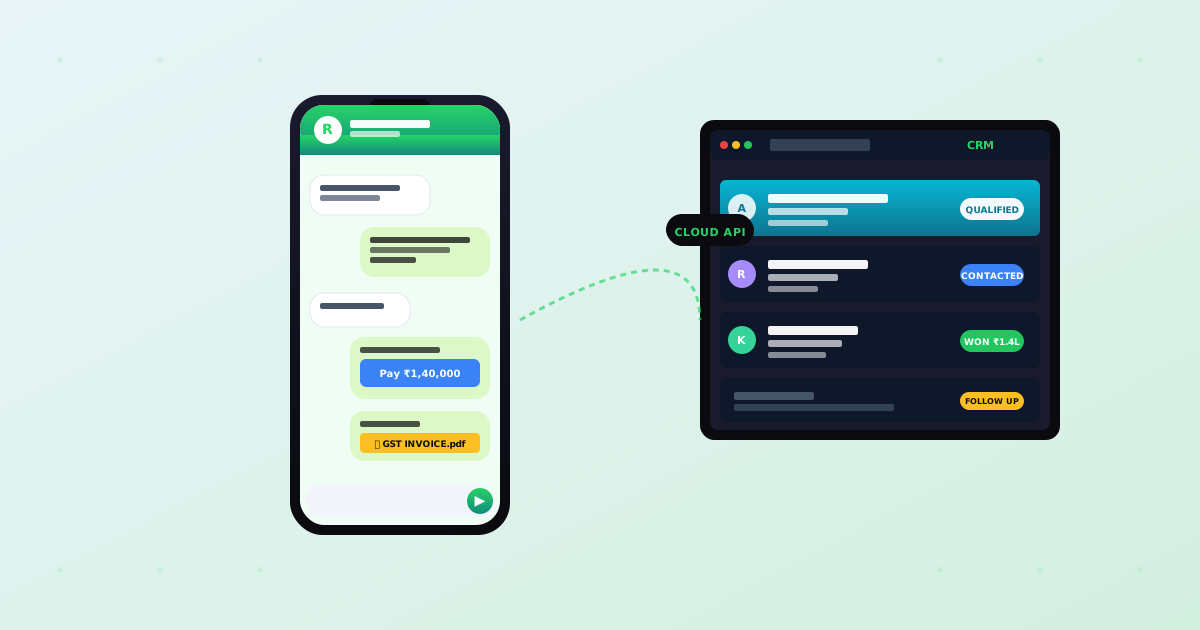
WhatsApp CRM for Indian SMBs in 2026: Why 70% of Your Leads Need It (and How to Set It Up for ₹50-80K)
70% of leads in India come via WhatsApp, yet most SMBs lose 20-30% in chat chaos. What a proper WhatsApp CRM does, INR pricing, build vs buy, 8 must-have features.
 Business
Your Business Is Leaking Money Through the Cracks in Your Spreadsheet. Here's the CRM We'd Build You.
The straight case for why a growing Indian business should stop running sales on WhatsApp, Excel and memory, and what a custom CRM built for how you work changes.
 Guides
Outsourcing Web Development to India in 2026: The Honest Guide for US, Canadian & UK Startups (Real USD Costs + 9 Risks)
US founders pay $150-300/hr, UK agencies £100-200/hr, Indian senior devs $30-60/hr. The savings are real, so are the 9 hidden risks. Honest 2026 USD pricing inside.
 Guides
Hotel Website Development in India: What Booking Features, OTA Integrations, and 2026 Pricing Actually Look Like
Indian hotels leak 30-50% of direct bookings to OTAs because their websites can't handle real-time availability or channel sync. Real 2026 pricing (₹40K-8L).
GuidesShopify Development Cost in India 2026: Real INR Pricing for Stores, Apps, Themes & Monthly Maintenance
What a Shopify build actually costs in India in 2026, by store type, app development, custom themes, and monthly costs, from 12 stores we've shipped.