We build Next.js, Shopify, Laravel, Flutter, in Noida, India. Free 1-page audit, no obligation.
Get a free quote- Logo Design and Report Design: What Indian Businesses Get Wrong22 August 2026
- Manufacturing Software for Indian MSMEs Industry 4.0 GuideAugust 22, 2026
- Top Healthcare IT Solutions Improving Patient ExperienceAugust 12, 2026
- Top IT Solutions Transforming Financial Services in 2026August 10, 2026
- Why most Indian hotel websites are leaking 30-50% of direct bookings to OTAs
- What a working hotel website must have in 2026
- OTA + PMS integration realities (the part nobody explains)
- 2026 hotel website pricing tiers (real numbers, not marketing fluff)
- Tech stack, what to actually build with in 2026
- The 5 most common hotel website mistakes (we've seen all of them)
- City-specific considerations (it's not one-size-fits-all)
- Multi-language requirements (what to actually translate)
- GST + tax compliance for Indian hotels (the boring but critical part)
- Abandoned-booking recovery flow (the highest-ROI feature)
- Realistic timelines for hotel website development
- 8 questions to ask before hiring a hotel website developer
- FAQ
- Final word, your website is your highest-margin sales channel
 Guides
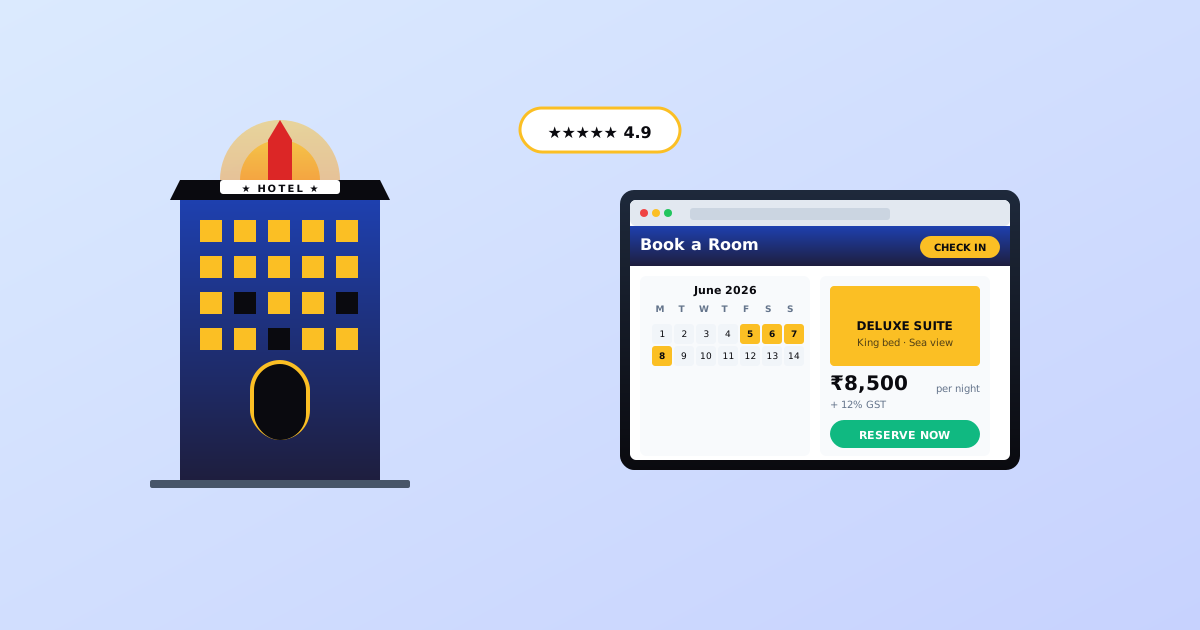
Hotel Website Development in India: What Booking Features, OTA Integrations, and 2026 Pricing Actually Look Like
Most hotel owners in India don't realise this until they look at their own numbers: 30-50% of bookings that should come direct (zero commission) are leaking to Booking.com, MakeMyTrip, Agoda, and Goibibo, paying 15-25% commission per night, because the hotel's own website can't hold the booking. The room rate looks right. The photos look fine. But the moment a guest tries to book, the experience falls apart: no real-time availability, no instant confirmation, no multi-currency, no GST invoice, no WhatsApp follow-up. The guest gives up and books on an OTA where the flow just works.
I run buildbyravirai, a Noida-based web dev agency. We've built and rescued hotel websites across Jaipur, Agra, Goa, Varanasi, and Kerala. This guide is what we wish every hotel owner read before they signed a ₹50,000 contract with a generalist developer who'd never integrated a PMS or channel manager in their life.
Why most Indian hotel websites are leaking 30-50% of direct bookings to OTAs
Take a 40-room boutique hotel in Udaipur doing ₹4.2 crore/year in revenue. Industry data says 65-80% of bookings come through OTAs (Booking.com, MakeMyTrip, Agoda). At an average 18% commission, that's ₹49-60 lakhs per year going to OTAs. Of that, conservatively 30-50% would have come direct IF the hotel website actually worked, meaning ₹15-30 lakhs/year of pure margin being lost to a website that costs ₹1-3 lakh to fix once.
The math is so obvious that it's painful. And yet 80% of independent Indian hotels still run on a WordPress site from 2019 with a contact form labelled "Enquire Now" instead of an actual booking engine. The same hotel will happily pay ₹50,000/month to MakeMyTrip in commissions, but balks at a one-time ₹2 lakh investment to capture those bookings direct.
What a working hotel website must have in 2026
If you're building or rebuilding a hotel website in 2026, this is the non-negotiable feature list. Anything less and you'll keep funnelling bookings to OTAs.
- Direct booking engine, real-time availability, instant confirmation, no "we'll get back to you in 24 hours" nonsense. Guests expect Booking.com-level UX on your site too.
- OTA + channel manager sync, when a room sells on Booking.com, your website availability updates within 60 seconds. When a room sells on your website, OTAs update too. Without this you will double-book within 30 days.
- Multi-currency display, USD/EUR/GBP/AED at minimum for international guests. Payment still in INR but display in their currency for psychological comfort.
- GST-compliant invoicing, auto-generated GST invoice with correct IGST or CGST/SGST split, sequential invoice numbering, GSTIN displayed prominently.
- WhatsApp inquiry + booking confirmation, domestic guests still want WhatsApp confirmation. Twilio or MSG91 + WhatsApp Cloud API handles this.
- Room-rate calendar, guests browse by date, see seasonal pricing (Diwali, NYE, monsoon discounts) without calling the front desk.
- Virtual tours + high-quality media, 360-degree room views, drone shots for resorts, properly compressed (under 200KB per image) so the site stays fast.
- Cross-sell add-ons, F&B packages, spa appointments, airport transfers, local tour bookings at checkout. This is where premium hotels make 20-30% extra revenue per booking.
- Abandoned-booking recovery, guest started a booking, didn't finish. Email/WhatsApp follow-up within 4 hours with a small incentive to complete.
- Mobile-first design, 70%+ of Indian hotel bookings happen on mobile. If your site isn't Lighthouse 90+ on mobile, you're losing bookings.
OTA + PMS integration realities (the part nobody explains)
Here's where most hotel website projects go sideways. The owner thinks "build me a website with online booking". The developer builds a beautiful site. Then someone asks "wait, how does this stay in sync with Booking.com?", and nobody has an answer. Three months later the hotel is double-booking guests because the website and Booking.com don't talk.
PMS (Property Management System), what it is
Your PMS is the operational system the front-desk staff uses, check-in, check-out, room assignment, housekeeping status, F&B billing. Common Indian/global PMS options: Hotelogix, eZee Absolute, Cloudbeds, Mews, Little Hotelier, Stayflexi, RoomKey. If you're a 20+ room hotel without a PMS, fix that BEFORE you fix the website.
Channel manager, what it does
A channel manager sits between your PMS and every OTA (Booking.com, Agoda, MakeMyTrip, Goibibo, Expedia, Airbnb). When a room sells anywhere, the channel manager pushes the inventory update to all other channels within 60-120 seconds. Common channel managers in India: STAAH, RateGain, eZee Channel Manager, SiteMinder, MyBookings. Subscription cost: ₹3,000-15,000/month depending on rooms + OTA count.
How the sync actually works
Your hotel website's booking engine talks to your channel manager via API (most channel managers expose a REST or SOAP API). The channel manager talks to all OTAs and to your PMS. So the flow is: guest books on your website → website hits channel manager API → channel manager updates PMS + all OTAs → confirmation email sent → housekeeping notified. If any link in this chain is broken, you get double-bookings or stale inventory. We've seen hotels where the website "had" a booking engine but it just emailed the front desk, who manually entered the booking, that's not a booking engine, that's a contact form with extra steps.
Common breakage points
- Channel manager API rate limits, if your site is hammering the API on every page load, you'll get throttled and show stale availability.
- Timezone mismatches, channel manager runs UTC, PMS runs IST, your site renders in guest's local time. One mistake here and you'll show wrong dates.
- Cancellation policy mismatch, your website says "free cancellation up to 24 hours" but the OTA has a different policy. Guests will exploit the gap.
- Payment failure → inventory not released, guest fails payment, but the room is still "held" in the channel manager. Inventory needs explicit release within 15 minutes.
- OTA promotional rates leaking back, Booking.com has a flash sale, your site doesn't know, guests price-shop and book on OTA.
2026 hotel website pricing tiers (real numbers, not marketing fluff)
Tier 1, Basic brochure site (₹40,000-80,000)
Good for: 5-15 room homestays, B&Bs, very small heritage properties that want a presence but bookings still happen via WhatsApp/phone. What you get: WordPress or Next.js site, 6-10 pages, contact form with email integration, basic SEO, mobile responsive, photo gallery. What you DON'T get: real-time booking, channel manager sync, multi-currency, GST invoicing. Limitation: you'll still lose 90% of bookings to OTAs because guests won't fill out a contact form when they can book instantly on Booking.com.
Tier 2, Booking engine + channel manager (₹1,00,000-3,00,000)
Good for: 15-60 room independent hotels, boutique properties, resorts, business hotels. What you get: Next.js or React frontend, integration with channel manager (STAAH, RateGain, eZee, SiteMinder), multi-currency display, GST-compliant invoicing, payment gateway (Razorpay/Stripe), WhatsApp booking confirmations, room-rate calendar, basic cross-sell. This is where 80% of independent Indian hotels should sit. Recoup the cost in 4-8 months through saved OTA commissions.
Tier 3, Full direct-booking platform + mobile app + loyalty (₹3,00,000-8,00,000)
Good for: hotel chains, large resorts, properties doing ₹5+ crore/year. What you get: everything in Tier 2 plus, native mobile app (iOS + Android via React Native or Flutter), loyalty program with points + tier system, abandoned-booking recovery (email + WhatsApp + Meta retargeting), F&B/spa add-on engine, multi-property support, advanced analytics dashboard, custom CMS for marketing team, multi-language (English + Hindi + 2-3 international). For chains running 3+ properties, the per-property cost drops significantly.
Ongoing costs (not one-time)
- Channel manager subscription: ₹3,000-15,000/month
- Hosting (Vercel/AWS): ₹2,000-10,000/month depending on traffic
- Payment gateway fees: 2.0-2.5% per transaction (Razorpay), 2.9% + ₹3 for Stripe (international cards)
- WhatsApp Cloud API: ₹0.40-1.00 per conversation (negligible)
- Maintenance + updates: ₹10,000-40,000/month for an active property
- PMS subscription: ₹2,000-12,000/month depending on rooms
Tech stack, what to actually build with in 2026
After 5 years of building hotel websites, here's the stack that just works. Variations are fine, but the principles hold.
- Frontend: Next.js (App Router), server-side rendering for SEO, fast page loads, great mobile performance. Avoid WordPress for serious hotel sites in 2026.
- Payments: Razorpay (domestic) + Stripe (international cards). Don't pick one, guests pay in different currencies through different methods.
- SMS + WhatsApp: Twilio (global) or MSG91 (India-focused, cheaper for domestic SMS) + WhatsApp Cloud API directly.
- CMS for content: Sanity or Strapi (headless), marketing team edits content without touching code. Avoid "hotel CMS" products that lock you in.
- Media: AWS S3 + CloudFront, or Cloudinary for image optimization. Hotel sites die on heavy images, compress aggressively.
- Booking engine: DO NOT build your own. Integrate with the channel manager's booking widget OR use a booking engine that's API-first (Stayflexi, Cloudbeds Engine, eZee Reservation).
- Analytics: GA4 + booking-funnel events tracked in Mixpanel or PostHog. Standard GA4 doesn't capture booking-flow drop-off well.
- Email: Resend, Postmark, or SendGrid for transactional booking confirmations. Mailchimp/Klaviyo for marketing.
The 5 most common hotel website mistakes (we've seen all of them)
1. Slow image loading kills mobile bookings
Hotel sites are media-heavy by nature. We've audited hotel sites loading 28MB of images on the homepage. On a 4G connection in tier-2 India, that's a 14-second load. Guest is gone by second 4. Compress to WebP, lazy-load below the fold, use CDN, get Lighthouse mobile score above 85.
2. No mobile optimization for the booking flow
Site looks fine on desktop. Booking flow has a date picker that overflows the mobile screen. Guest can't even pick a check-out date. Goes to Booking.com instead. Test your booking flow on a real 5-inch Android phone, not just Chrome DevTools.
3. No real-time availability (the "contact form" trap)
Guest fills inquiry form. Front desk replies 6 hours later. By then guest has booked on Booking.com. This is the single biggest reason hotel websites under-perform, no real-time inventory check + instant confirmation = no booking.
4. GST + tax calculations done wrong
Tax breakup hidden until checkout. GST shown as 18% on rooms above ₹7,500 when it should be 18% only on the room portion, with food/spa add-ons at their own GST slabs. Foreign guests confused by "CGST + SGST" instead of just IGST. Result: chargebacks, refund disputes, accounting nightmares.
5. No abandoned-booking recovery
Industry average: 70-80% of hotel bookings are abandoned mid-flow. Of those, 25-40% can be recovered with a single email/WhatsApp follow-up within 4 hours. Most hotel sites do nothing. Money on the table.
City-specific considerations (it's not one-size-fits-all)
Heritage hotels, Jaipur, Agra, Udaipur, Varanasi
60-80% international guests. Multi-language essential (English primary + French/German/Japanese/Italian for European/Asian tourist markets). Multi-currency mandatory. Photography is the entire pitch, invest 30-40% of the budget in professional photo/video. Heritage storytelling matters, guests are buying experience, not rooms. We've built and consulted on properties in Jaipur, Agra, and Varanasi, the playbook is different from business hotels.
Beach resorts, Goa, Kerala, Andaman
60% domestic, 40% international. Goa especially is heavy on Russian + Israeli + UK tourists in season, multi-currency + multi-language needed. Seasonality is brutal (October-March peak, monsoon dead). Dynamic pricing essential. F&B/spa/water sports cross-sell drives 30-40% of revenue. We've done resort builds in Goa where the cross-sell engine alone added ₹12 lakh/season.
Business hotels, NCR, Mumbai, Bangalore, Hyderabad
Mostly domestic corporate travel. GST invoicing is non-negotiable (companies need GST for reimbursement). Bulk-booking portal for travel desks. Loyalty program for frequent business travellers. WhatsApp confirmations + check-in instructions matter. Lower seasonality means more predictable revenue but lower margin per room.
Pilgrimage hotels, Varanasi, Haridwar, Tirupati, Amritsar, Shirdi
Very price-sensitive market. 95% domestic. Hindi-first language. WhatsApp booking is everything, many guests don't use email. UPI as primary payment. Group bookings (families, pilgrim groups) common, bulk-pricing engine valuable. Haridwar and Varanasi projects we've worked on look very different from a Goa resort, much simpler, Hindi-first, mobile-only effectively.
Multi-language requirements (what to actually translate)
Don't translate everything. Translate strategically.
- Hindi: mandatory for domestic-heavy properties (pilgrimage, tier-2/3 city hotels). Optional for international-tourist-heavy properties.
- English: default for all properties, non-negotiable.
- French/German: heritage hotels in Rajasthan, Agra, Kerala, European tourists prefer mother-tongue browsing.
- Japanese: Agra and Jaipur specifically, Japanese tour groups are large and price-insensitive.
- Russian: Goa specifically, Russian tourists are 15-20% of Goa's international arrivals in season.
- Arabic: Kerala (Ayurveda tourism), high-end Delhi/Mumbai properties, GCC tourists.
Use Next.js i18n routing (/en/, /hi/, /fr/, etc.), gives you SEO benefits per language. Don't use Google Translate widgets, they kill SEO and produce ugly translations. Hire human translators for the 50-60 strategic pages, machine-translate the rest with disclosure.
GST + tax compliance for Indian hotels (the boring but critical part)
Get this wrong and you'll have refund disputes, chargebacks, and an angry CA at year-end.
- Room tariff under ₹7,500/night: 12% GST (6% CGST + 6% SGST, or 12% IGST for inter-state).
- Room tariff ₹7,500+/night: 18% GST (9% CGST + 9% SGST, or 18% IGST).
- F&B (restaurant within hotel): 18% GST if room tariff is 7,500+. 5% otherwise (no ITC).
- Spa/wellness: 18% GST regardless of room tariff.
- Foreign guest paying via international card: IGST applies (treated as inter-state).
- Indian guest in same state: CGST + SGST split.
- GSTIN display: mandatory on every invoice + on the website footer.
- Invoice numbering: must be sequential, no gaps, separate series for different invoice types.
- E-invoicing: mandatory if your annual turnover crosses ₹50 crore. Integrate with GSP (GST Suvidha Provider) for automated generation.
Abandoned-booking recovery flow (the highest-ROI feature)
If your booking engine doesn't capture email/phone in step 1 of the flow (BEFORE payment), you can't recover abandons. Capture early.
- Step 1, capture contact: guest enters check-in/check-out dates + email/phone before seeing detailed room options. Standard pattern in Booking.com flow.
- Step 2, track drop-off: if guest leaves without completing payment, fire abandon event to your analytics + CRM.
- Step 3, first follow-up (15 min): WhatsApp message: "Your room is still available, complete booking in next 30 mins to lock these dates." No discount yet.
- Step 4, second follow-up (4 hours): Email + WhatsApp with a small incentive: 5% off, free breakfast, free airport pickup.
- Step 5, meta retargeting (24 hours): custom audience from booking-flow drop-offs, retargeting ad with the hotel and a soft offer.
- Step 6, final touch (3 days): if still no booking, one last email, "dates are filling up" with social proof (recent bookings, reviews).
Realistic timelines for hotel website development
- Tier 1 (basic brochure): 4-6 weeks. Design + copy + dev + content load.
- Tier 2 (booking engine + channel manager): 10-14 weeks. Add 2-3 weeks for channel manager onboarding (their team needs to map your rooms + rate plans).
- Tier 3 (full platform + mobile app): 16-20 weeks. App store review alone adds 2 weeks for iOS.
Common delay sources: PMS provider takes 3-4 weeks to enable their API. Channel manager onboarding takes 2-3 weeks. Photo/video shoot scheduling at the hotel. GSTIN documentation for payment gateway approval (Razorpay/Stripe ask for incorporation + GST + bank docs). Budget realistically.
8 questions to ask before hiring a hotel website developer
- "Have you integrated with PMS X (Hotelogix/eZee/Cloudbeds/Mews)?", if no, expect 2-3 week learning curve on top of your project timeline.
- "Which channel managers have you integrated with, STAAH, RateGain, SiteMinder, eZee?", names matter. "We can integrate with any" is a junior answer.
- "How do you handle GST invoicing, IGST vs CGST/SGST split, sequential numbering, e-invoicing?", if they go blank, they've never built a real hotel site.
- "Multi-currency, do you display in guest currency but charge in INR, or actually charge in foreign currency?", different payment gateway setup. Senior devs know.
- "Show me a hotel site you built with mobile Lighthouse score above 85.", if they can't produce one, they don't prioritize performance.
- "What's your abandoned-booking recovery flow?", if the answer is "we send an email", that's tier-1 thinking. Real flow is 6-step.
- "Who owns the code, domain, hosting, and payment gateway accounts after launch?", you own all of them. Get it in writing.
- "What's the post-launch maintenance retainer + SLA?", hotel sites break in production. You need someone on-call. Senior devs include this; junior ones disappear after invoice.
FAQ
How much commission can I actually save by moving bookings to direct?
If you're currently 70% OTA / 30% direct, and you move to 50% OTA / 50% direct over 12 months, you save 20% of your OTA-going bookings worth of commission. For a hotel doing ₹3 crore/year, that's ₹3-5 lakhs/year in saved commissions, recouping a ₹2 lakh website investment in 5-8 months.
Should I stop using OTAs entirely once my website works?
No. OTAs are still ~40-50% of optimal mix for most independent hotels, they bring discovery traffic you can't replicate. The goal is to shift from 80/20 OTA-to-direct to roughly 50/50, not to eliminate OTAs. Use OTAs for discovery, your website for repeat + direct-search bookings.
Do I need a mobile app, or is a PWA enough?
For most independent hotels, a PWA (Progressive Web App) is enough, push notifications, offline support, home-screen install. Native mobile app makes sense only if you're a chain with 3+ properties, run a loyalty program, or have 30%+ repeat-customer rate. Building a native app for a 25-room boutique hotel is overkill, you'll spend ₹3-5 lakhs and 20 people will install it.
What does a channel manager subscription actually cost?
Indian channel managers (STAAH, eZee, RateGain India): ₹3,000-8,000/month for 20-50 rooms with 5-8 OTA connections. Global tools (SiteMinder, Cloudbeds): ₹8,000-18,000/month for equivalent setup. Add per-OTA connection fees in some cases. Worth every rupee, manual updates across 6 OTAs is impossible at scale.
Which payment gateway for international bookings, Razorpay or Stripe?
Both. Razorpay for domestic UPI/cards/netbanking (2.0-2.5% fee, instant settlement). Stripe for international cards (2.9% + ₹3, supports 135+ currencies, better UX for foreign guests). Run them in parallel, guest sees relevant payment options based on their location. Adding both is 2-3 days of dev work, pays for itself fast.
Can I just use a hotel website template from Booking.com or Cloudbeds?
You can, Cloudbeds, Stayflexi, Hotelogix all offer template-based sites bundled with their PMS/booking engine. They work, but they look like every other hotel site (templates have a ceiling). For boutique/premium positioning, you need a custom site. For budget properties under 15 rooms, templates are fine, just don't expect them to differentiate you in a crowded OTA listing.
Final word, your website is your highest-margin sales channel
Every ₹1,000 you save on commissions by moving a booking from MakeMyTrip to your own website is pure margin. A working hotel website pays for itself in 6-12 months and then prints money for the next 5 years. The hotels that figured this out in 2020-2022 are running 50-60% direct-booking ratios in 2026, and their P&L looks dramatically different from competitors stuck at 20% direct.
If you're running an Indian hotel in 2026 and your website is still "a brochure with a contact form", you're subsidizing OTAs every month. Fix the website, integrate the channel manager, fix the GST flow, add abandoned-booking recovery, and watch your margin recover in 2-3 quarters.
Building or rebuilding a hotel website? We've shipped booking platforms for properties in [Jaipur](/web-developer-jaipur/), [Agra](/web-developer-agra/), [Goa](/web-developer-goa/), and [Varanasi](/web-developer-varanasi/), channel manager, GST, multi-currency, the whole stack. Browse our [city pages](/web-development-agency/) or talk to us.
Get a hotel website quoteFounder of buildbyravirai, a web development agency based in Noida, India. 5+ years shipping Next.js, WordPress, Shopify, and Laravel projects for clients in India, USA, Canada, and the UK.
Working with us in your city
Keep Reading
 Guides
Website Maintenance & AMC Cost in India 2026: What You Actually Pay For
A website is not a one-time purchase. The honest guide to what website maintenance and an AMC cost in India in 2026, what is included, and when you need a plan.
GuidesShopify Development Cost in India 2026: Real INR Pricing for Stores, Apps, Themes & Monthly Maintenance
What a Shopify build actually costs in India in 2026, by store type, app development, custom themes, and monthly costs, from 12 stores we've shipped.
GuidesMobile App Development Cost in India 2026: Real INR Pricing by App Type, Stack, and Complexity
What does mobile app development actually cost in India in 2026? Real INR pricing for native, Flutter, React Native, and PWA, from 22 apps we've shipped.
 web development
Website Development Cost in India in 2026 | Complete Pricing Guide
Planning to build a website for your business? Explore website development costs in India, understand what affects pricing, and choose the right solution for your needs.
 Guides
Website Security for Indian Businesses 2026: The Basics That Actually Stop Most Attacks
The plain-language guide to website security basics for Indian business owners in 2026: what actually attacks your site, and the few things that protect it.