We build websites, web apps and mobile apps in Next.js, NestJS, Shopify and Flutter for businesses across India. Free 1-page audit, no obligation.
Get a free quote- How to Get Google Reviews for Your Business in India (2026)October 17, 2026
- Payment Gateway Rejected Your Website? 5 Pages to Add (2026)October 16, 2026
- How Clients Judge Your Business Name Before They Ever See Your WorkOctober 15, 2026
- EV Charging Rules Every Indian Company Has to Follow in 2026 (And the Software That Proves It)October 13, 2026
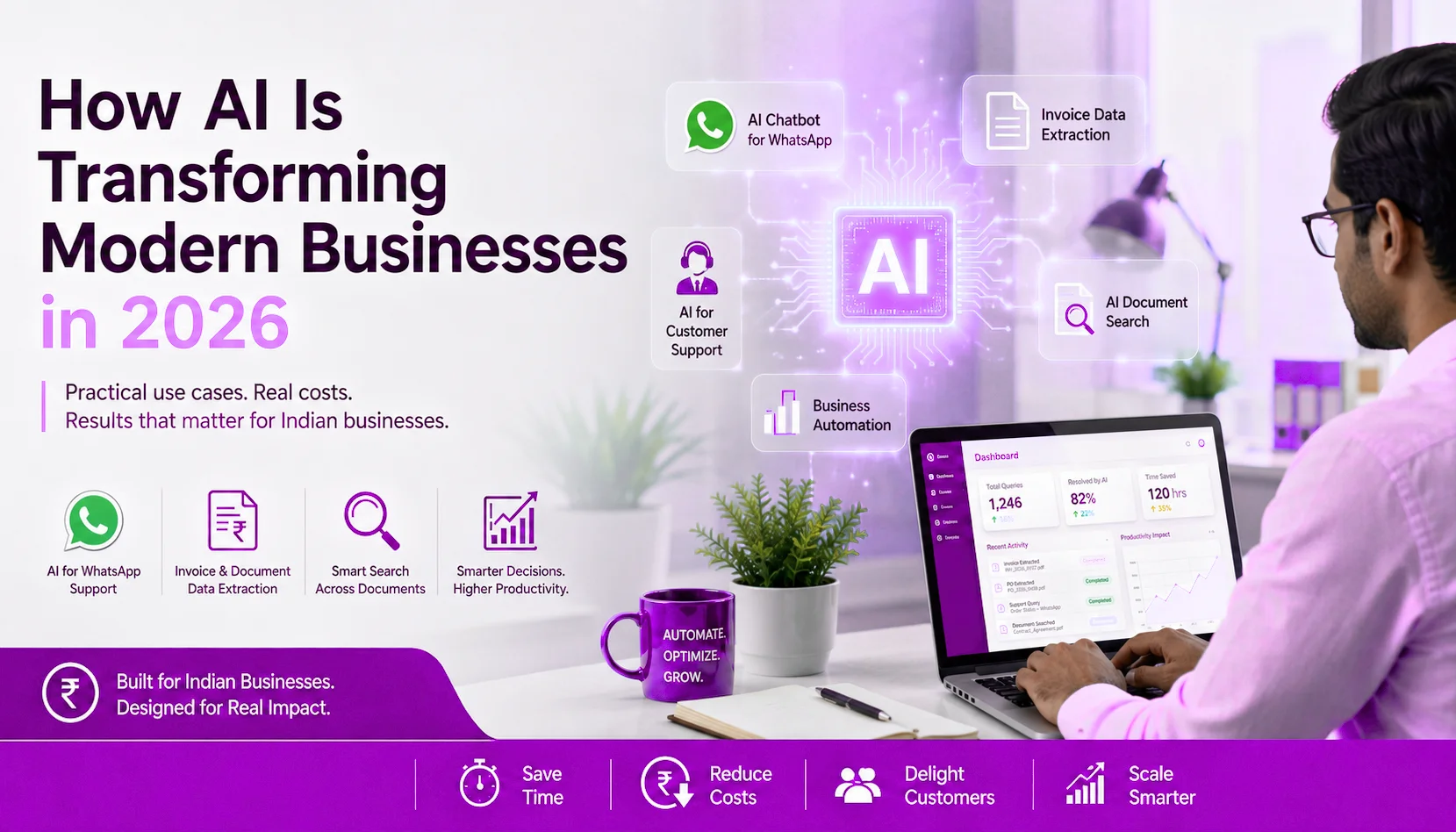
How AI Is Transforming Businesses in India in 2026
Every business owner we meet has been told that AI will change their company this year. Most of that advice comes from people who have never shipped an AI feature into a business that has actual customers waiting on WhatsApp. We write this software for a living, so here is the version without the sales pitch.
The short answer is that a small set of use cases now save real hours, and a much larger set will quietly waste your money. Telling those two apart is worth more than any tool recommendation you will read this year.
What Actually Changed, and What Did Not
Language models got genuinely good at reading and writing text, and they got cheap enough that running one on every incoming customer message is no longer a line item anyone argues about. A task that used to need a person reading a paragraph and typing a reply can now be drafted in about a second for a fraction of a rupee.
What did not change is everything around the model. Your vendor invoices still arrive as blurry photos. Your customer records still live in three places that disagree with each other. Your sales team still works out of a diary and will not open a new dashboard. That gap is where AI projects die, because the model is now the easy part and the plumbing on either side of it is the actual project.
What Actually Works for an Indian SMB Today
The use cases below pay for themselves within a few months when they are built properly. They all share a shape. The input is text or a document, the task repeats many times a day, and a human can spot a wrong answer in seconds.
Support triage and drafting replies on WhatsApp
Most Indian businesses run support on WhatsApp, and most of those messages are the same twenty questions about price, stock, order status and returns. A model can read the message, pull the relevant fact from your system, and put a draft reply in front of your agent to send with one tap.
Keep a person in that loop for the first few months. The win is not that nobody reads the message, it is that one agent now handles eighty conversations instead of thirty. This also solves the language mess better than any older keyword bot ever did, because customers write in Hindi, in English, and in Hinglish typed on an English keyboard, often inside the same sentence.
Pulling data out of invoices, purchase orders and challans
If somebody in your office types numbers off a PDF into Tally or a spreadsheet, that job is now mostly automatable. Vendor invoices, purchase orders, delivery challans and bank statements all extract reasonably well, including scanned and photographed ones.
Expect accuracy in the low to mid nineties on messy scans, not perfection, and design for that from day one. Auto accept the fields the system is confident about, flag the rest, and always make a human confirm totals and GSTIN before anything posts to your books.
Search across your own documents
Companies pile up contracts, SOPs, price lists, product specs and old proposals across Drive folders and email until nobody can find anything. A search layer over that content, one that answers in a sentence and links back to the source file, is the least glamorous thing we build and one of the most used. Insist on that source link, because without it people stop trusting the answers within a week.
- What is the notice period in the agreement we signed with this vendor
- Which grades of this product do we stock, and at what price
- What did we quote this client last year, and what changed
- What is our process when a shipment reaches the customer damaged
Transcribing and summarising calls
Sales and support calls in Hindi and English transcribe well enough to be useful, and what your sales head actually wants is the summary, the objections raised and the follow up date, not a full transcript. This is a cheap win because it needs almost no integration work. Test it on your own recordings first though, since a noisy shop floor and a heavy regional accent still produce transcripts you would not want to act on.
Product listings and lead qualification
Sellers with thousands of SKUs get real value from generating descriptions, titles and marketplace attributes from a spec sheet, with a person reviewing only the top sellers. On the sales side, enquiries from ads and forms can be read, scored and routed within a minute, so the serious buyer gets a call while the junk gets filtered. Response speed beats most sales training, and a machine does not sleep at 11 pm.
What Usually Fails
We turn down more AI work than we accept, mostly because the requested thing has been attempted by enough companies for the pattern to be obvious.
Training your own model
Almost no small or mid sized company needs this. It costs lakhs, needs thousands of clean labelled examples that you do not have, and usually produces something worse than a general model that is simply given your documents at the moment of the question. If a vendor proposes a custom trained model, ask exactly which problem it solves that a good prompt plus your own data does not.
A chatbot as the front door
The classic mistake is buying a website chatbot first. If your pricing is unclear, your phone rings out and your WhatsApp replies take a day, a bot on the homepage does not fix the funnel, it just irritates a visitor who wanted a phone number. Fix response time on the channel your customers already use, then consider a bot.
Replacing staff
Every project we have seen that opened with a headcount reduction target went badly, usually because the people who understood the process were the ones being asked to automate themselves out of a job. The realistic outcome is the same team absorbing more volume, so you do not hire four more people for the next growth phase.
Anything that needs clean data you do not have
A model cannot answer stock questions when your stock figures are wrong, and it cannot qualify leads when half your CRM rows have no phone number. Bad input still produces bad output, only faster and in more confident language. Check whether any of these describe your business.
- Stock or price data lives in one person's personal spreadsheet
- The same customer exists three times under different spellings
- Important commitments are agreed in WhatsApp and never recorded anywhere
- Nobody agrees on what a field like status or closed actually means
The dashboard nobody opens
If the output of your new system requires a salesperson to log into another web app, adoption drops to near zero inside a month. Push results to where the work already happens, into WhatsApp, into the CRM they already use, into the ERP screen they stare at all day. This single decision separates the systems that survive from the ones that get quietly abandoned.
The model is almost never the expensive part of an AI project. Integration and data cleanup are.
Weighing this up for your own business? Send us the scope and you get a written scope and a fixed quote back within 24 hours.
Get a fixed-price quoteWhat This Costs in India in 2026
There are two separate costs here and vendors blur them on purpose. There is what you pay to use a model month after month, and there is what you pay once to build the thing around it.
Running cost
Model usage is billed by volume of text processed, and for the work described above it stays small. A support desk drafting replies across a few hundred conversations a day usually lands between ₹3,000 and ₹15,000 a month, and extraction across a few thousand invoices sits in a similar band. Add roughly ₹2,000 to ₹10,000 a month for hosting and monitoring. These bills only turn frightening when someone loops a model over an entire database on every page load, which is a design mistake rather than a pricing problem.
Build cost
The build is where the budget actually goes. Realistic 2026 ranges in India, for work done with proper testing, error handling and handover:
- Call transcription and summaries pushed into your CRM: ₹80,000 to ₹2,50,000
- Reply drafting inside WhatsApp or your existing helpdesk: ₹1,50,000 to ₹4,00,000
- Invoice and purchase order extraction with a human review screen: ₹2,00,000 to ₹6,00,000
- Search across your internal documents with source citations: ₹2,50,000 to ₹7,00,000
- Lead scoring and routing wired into your CRM and ad platforms: ₹1,00,000 to ₹3,00,000
Those ranges swing on how cooperative your existing systems are. A vendor with a documented API is a week of work, while a legacy accounting package with no API, or a portal that needs a login and a captcha, can double the estimate by itself. We break down how we quote this kind of work on our pricing page.
The cost nobody budgets
Someone has to check the output for the first two or three months, and someone has to own the system after launch. Budget a few hours a week of a real employee's time and name that person before development starts. Projects without an owner stop being used, and it is rarely the software that failed.
A Quick Test for Any AI Idea
Before spending anything, run the proposed use case through these five questions. Three or more yes answers means it is worth a pilot. Two or fewer means you are buying a story.
- Is the task mostly reading or writing text and documents, rather than judgement about people or money
- Does it happen at least a few dozen times a week
- Can a human spot a wrong answer within seconds
- Is the input already digital, or does somebody have to scan and upload it first
- Is there one named person who will own the result after launch
Notice that none of these questions are about the model. They are about your process, which is the part that decides whether the project works.
Where to Start If You Have Never Used Any of It
Do not start with a project. Start with a fortnight of manual use, which costs you a paid subscription and some attention.
- Pick the single most repetitive text task in the business, the one somebody complains about every week
- For two weeks, have that person do it by pasting into a paid chat assistant instead of typing from scratch
- Keep a rough count of how long the task took before and how long it takes now
- Collect the cases where the model got it wrong, because those become your test cases later
- Only then ask a developer to automate it, and hand over those examples on day one
This sequence saves companies lakhs. Half the time the manual version turns out to be good enough and no software is needed at all. The rest of the time you walk into the build with evidence instead of a hunch, and the quote you get back is far more accurate. It also tells you something useful about your team, because a group that will not do the manual version for two weeks will not use the automated one either.
What You Are Sending to a Third Party
When you use a hosted model, your text goes to that provider's servers. For most ordinary business documents this is acceptable, and the major providers do not train on business API traffic by default. It still deserves a decision rather than an assumption, so set a few rules before anyone connects anything.
- Strip Aadhaar numbers, bank details and card data before anything is sent
- Check the vendor's data retention settings and switch off what you can
- Get your consent language right under the DPDP rules when customer data is involved
- Log every request and response so a bad output can be explained later
- For genuinely confidential work, run a smaller open model on your own server and accept the lower quality
Self hosting sounds safer and costs more than most people expect once you count a GPU instance and somebody to maintain it. Make that call on a real compliance requirement, not on nervousness.
The Honest Summary
AI in 2026 is a very capable assistant for reading, writing and extracting, supervised by someone who knows the business. It is not a substitute for a working process, tidy data, or a person who answers the phone. Most of an AI project is ordinary custom software development with a model as one component, which is exactly why the boring parts decide the outcome.
Pick one repetitive task. Do it manually for two weeks. Automate it only if the numbers hold up. That sequence alone puts you ahead of most companies spending far more than you are. If you want a straight opinion on whether your idea is worth building, talk to our team and we will tell you honestly when it is not.
Frequently asked questions
What is the cheapest useful AI project for a small business in India?
Do we need to train our own AI model on our company data?
Can AI handle customers who write in Hindi and Hinglish?
How much does the model itself cost compared to the development work?
Will AI replace our support or data entry staff?
Our data is messy. Should we fix that first or start with AI?
Founder of buildbyravirai, a web development agency based in Noida, India. Building websites, web apps and mobile apps in Next.js, NestJS, Shopify and WordPress since 2021, for clients in India, the US, Canada and the UK.
Working with us in your city
Keep Reading
How to Attract Clients Online in India 2026: An Honest Playbook for Small Businesses
Attracting clients online is not one tactic; it is four jobs: be findable, be credible, convert visitors, and follow up fast. The honest playbook for India, 2026.
How to Get Google Reviews for Your Business in India (2026)
A client paid ₹8,000 for 20 Google reviews and lost all of them in three weeks. The rules that delete reviews, four request messages you can copy, and what to do about a fake one star.
Business Email ID in India: Cost and Setup Guide (2026)
A business email ID on your own domain starts at ₹59 a user per month in India. 2026 prices, setup steps, and the DNS records that keep you out of spam.
GST on Website Development in India: What You Pay (2026)
What you really pay in GST on a website in India in 2026: the 18 percent rule, when you get it back, how TDS fits in, what a valid invoice needs.
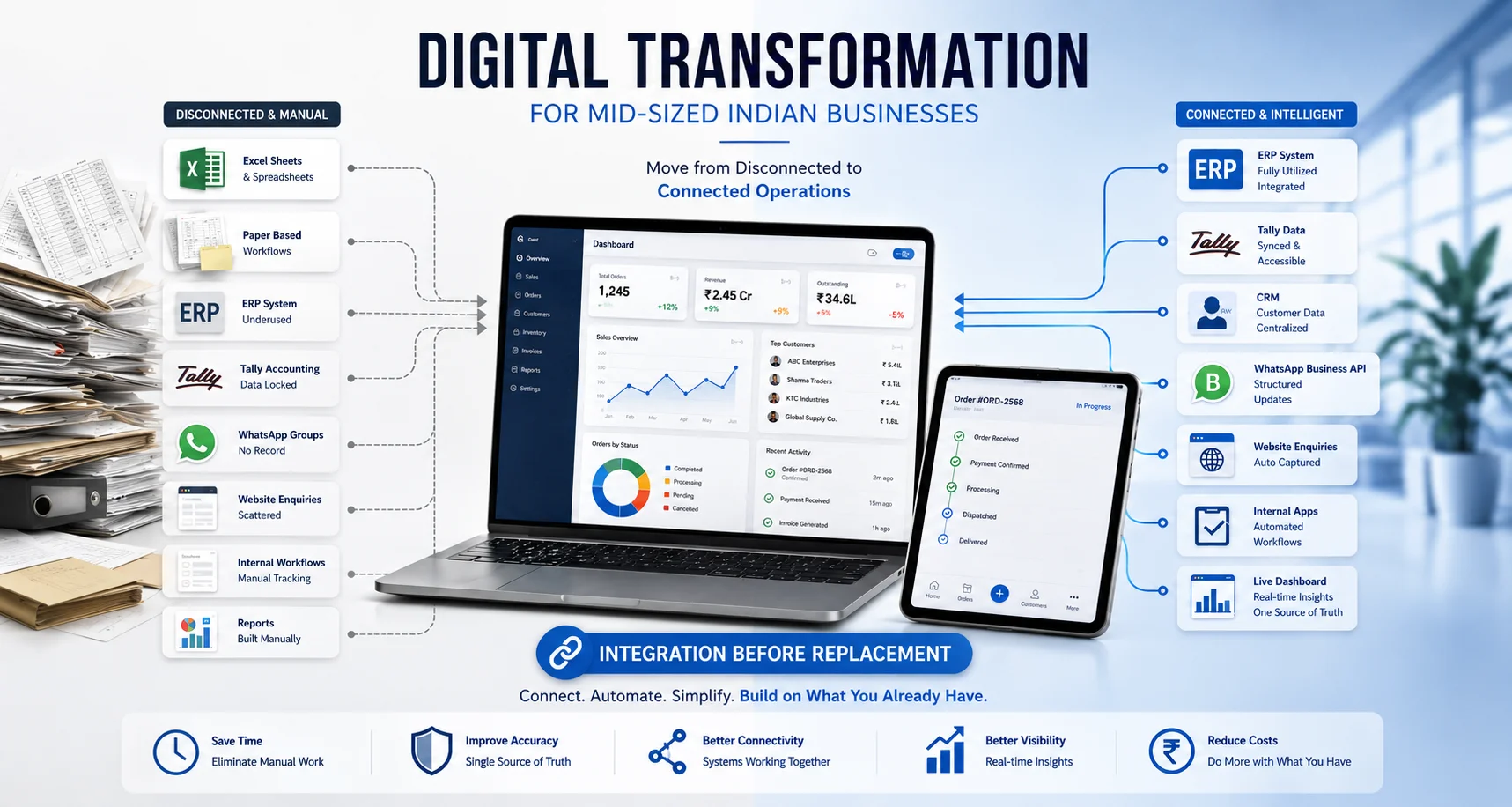 Technology
Enterprise IT for Digital Transformation
A practical look at how Indian businesses can use technology, integrate existing systems and automate everyday work without costly IT projects.