We build websites, web apps and mobile apps in Next.js, NestJS, Shopify and Flutter for businesses across India. Free 1-page audit, no obligation.
Get a free quote- Who Owns Your Website? The 10-Minute Check (2026)October 5, 2026
- Website Renewal Charges: What You Should Pay Yearly (2026)October 2, 2026
- Website Says "Not Secure" in Chrome? How to Fix It (2026)September 29, 2026
- Website Development Quotation: Format and Sample (2026)September 28, 2026
GST on Website Development in India: What You Pay (2026)
The quote said ₹45,000. The invoice said ₹53,100. The client messaged me at ten at night asking which number was the real one.
Both were. ₹45,000 was the price of the work. The invoice added 18 percent GST on top of it, ₹8,100, and that is the law rather than a markup. What nobody had explained to him was the part that actually mattered: his business is GST registered, so that ₹8,100 was never really his money. He was going to get it back.
This is the most common money question on a website project in India, and it almost always gets asked after the invoice arrives instead of before the quote is signed. So here is the whole thing in one place. What GST you pay on a website or an app in 2026, when you get it back, what TDS has to do with any of it, and what a correct invoice has to show. I run a web development agency, so I raise these invoices every month. I am not a chartered accountant, and none of this replaces yours for your own numbers.
The short answer
- Website design, website development, app development and website maintenance are all taxed at 18 percent GST.
- If your business is GST registered and the website is for the business, that 18 percent normally comes back to you as input tax credit. A ₹45,000 website still costs ₹45,000.
- If you are not registered, the 18 percent is a real cost. Budget ₹53,100, not ₹45,000.
- If the agency's turnover is below the registration threshold, it cannot charge you GST at all, and there is nothing for you to claim.
- Your accountant will also deduct TDS from the payment. That is a separate thing, it is not a discount, and it does not reduce the price.
Why 18 percent, and on what
Services sit in the 18 percent slab. The rate overhaul of September 2025, the one everyone called GST 2.0, cleared out the 12 and 28 percent brackets and left 5, 18 and 40. IT services did not move. Custom website development, mobile app development, SaaS subscriptions, cloud hosting, IT consulting and annual maintenance contracts are all still 18 percent.
It applies to the full value of the service, which is where people get caught out. Design is 18. Development is 18. The monthly maintenance retainer is 18. If the agency buys your domain and hosting and bills them on to you, those lines are 18 too, because they have become part of a service being sold to you rather than a bill you paid yourself.
The code on the invoice
You will see a SAC code, a Services Accounting Code, in a column on the invoice. Website and software work is usually billed as 998314, IT design and development services, or 998313, IT consulting and support. Either is correct for a website build and both carry 18 percent. What is not correct is a blank column.
CGST plus SGST, or IGST
If you and the agency are in the same state, the 18 is split into 9 percent CGST and 9 percent SGST. If you are in different states, it appears as a single 18 percent IGST line. The total is identical and so is the credit; only the reporting changes. For a registered buyer the place of supply is your registered address, which is why an agency in Noida bills a client in Bengaluru IGST and a client in Ghaziabad CGST plus SGST.
The ₹45,000 invoice, in full
Here is that invoice with every number on it, because seeing it written out once usually ends the argument.
textWebsite development (SAC 998314)        45,000.00
IGST @ 18%                               8,100.00
                                        ----------
Invoice total                           53,100.00

What actually leaves your bank account
  Invoice total                         53,100.00
  Less TDS @ 2% on 45,000                 (900.00)
  Transferred to the agency             52,200.00

What the website finally costs you
  GST registered      45,000   (the 8,100 returns as credit)
  Not registered      53,100
Three different true numbers for one ₹45,000 website. ₹53,100 is the invoice. ₹52,200 is the bank transfer. ₹45,000 is the cost, if you are registered. Most disagreements about a website bill in India are really two people quoting different ones of those three figures at each other.
Getting the 18 percent back
Input tax credit is the mechanism. GST you pay on business purchases is set off against the GST you collect from your own customers, so for a registered business the tax on a website is a float rather than an expense. Four things have to be true for it to work.
- You are GST registered and not under the composition scheme. Composition dealers pay a flat rate on turnover and claim no credit on anything.
- The website is for the business. A business site is fine. A family portfolio billed to the company is not.
- You hold a proper tax invoice with your GSTIN printed on it. The checklist for that is below.
- The invoice reaches your GSTR-2B, which only happens once the agency files its GSTR-1. There is now an Invoice Management System on the portal sitting between the two, where invoices are accepted or rejected before they land in your 2B.
The fourth one is the one that bites, and it is entirely out of your hands. If the agency does not file, the credit never appears, and you are ₹8,100 down on a ₹45,000 job with a valid-looking invoice in your folder. It is a perfectly reasonable thing to ask before you pay: do you file GSTR-1 monthly or quarterly? A real vendor answers that in one line.
If you are not registered, stop doing the arithmetic and plan on the gross figure. Our pricing page and the website cost calculator quote work before tax, the way most agencies do, so add 18 percent to anything you read there before you compare it against your budget. The same goes for every quote you collect, which is the only way to compare them fairly.
What a valid tax invoice has to show
If you want the credit, the paperwork is not optional. Check the invoice for all of this before it goes anywhere near your accountant.
- The agency's name, address and GSTIN.
- Your name, address and GSTIN. A missing buyer GSTIN is the single most common reason a credit gets stuck.
- A unique, sequential invoice number, and the date of issue.
- A description of the work and the SAC code.
- The taxable value, the rate, and the tax shown separately as CGST and SGST or as IGST. One line reading ₹53,100 all inclusive is not a tax invoice.
- Place of supply, for work across state lines.
- A signature or digital signature.
One hard rule sits underneath all of that. If there is no GSTIN on the invoice, nobody is entitled to charge you GST on it. Tax collected by an unregistered supplier is not tax, and you will never see that money again. Thirty seconds on the GST portal's search page tells you whether a GSTIN is real and active, and it is worth doing before the first payment on any project of size.
TDS, the other number on the payment
This one runs in the opposite direction and has nothing to do with GST, which is why it causes so much confusion when both appear on the same payment. Your business deducts income tax at source from what it pays us and deposits it against our PAN. We claim it when we file our return. It is our money, held by the government on our behalf for a few months.
Website development generally falls under Section 194J. Most accountants treat it as fees for technical services and deduct 2 percent; some treat it as a professional service and deduct 10 percent; occasionally it is argued as a contract under 194C instead. Ask your CA which view they are taking and tell the agency, because an unannounced 10 percent deduction on a large invoice is a serious cash flow event for a small vendor. Since 1 April 2025 nothing is deducted until payments to that vendor cross ₹50,000 in the financial year, so a single small job may need no deduction at all.
Two details worth getting right. TDS is calculated on the taxable value, the ₹45,000, not on the GST. And it comes off the payment, never off the price: deducting ₹900 and then also asking for ₹900 off the quote is asking for the work at a discount.
GST on everything around the website
- Indian hosting, domains and business email: 18 percent with a GSTIN on the invoice. Put your GSTIN into the hosting account and the credit follows automatically.
- Google Ads and Meta ads billed through their Indian entities: 18 percent, GSTIN on the invoice, claimable. Add your GSTIN in billing settings on day one, because fixing old invoices afterwards is painful and often impossible.
- Software bought from a company with no Indian presence: this is an import of service. A registered business pays the IGST itself under reverse charge and claims it back in the same return. Your CA handles the mechanics; your job is to forward the receipts instead of leaving them buried in a card statement.
- An agency below the registration threshold, which is ₹20 lakh of turnover for services and ₹10 lakh in the special category states: no GST on the invoice and nothing to claim. A smaller bill, and a smaller vendor.
Red flags on a website invoice
- GST charged with no GSTIN printed anywhere. Send it back and ask for a corrected invoice before you pay.
- A quote that said all inclusive followed by an invoice with 18 percent added on. That argument has to be settled at the quote stage, in writing. Our quotation format post shows the line to look for.
- An offer to skip the bill for a cash discount. You lose the credit, the expense deduction and any clean way of proving you own the work if the relationship goes wrong. For a registered buyer, a 10 percent cash price on a ₹45,000 job is worse than the invoice.
- The invoice raised in an individual's personal name while the contract is with a company.
- A maintenance retainer where the GST quietly disappears a few months in. That usually means the agency stopped filing or lost its registration, and your credit stopped with it.
- No SAC code, no invoice number, or two invoices carrying the same number.
What to ask before you sign
- Is this price inclusive or exclusive of GST? Get the answer written into the quote, not said on a call.
- What is your GSTIN? Check it on the GST portal before the first payment.
- Will the invoice carry my GSTIN? Hand them the number up front rather than after the invoice arrives.
- Do you file GSTR-1 monthly or quarterly? That tells you when your credit will actually appear.
- Will domain, hosting and third-party tools be billed by you or bought in my own name? Buying them yourself keeps the accounts, the credit and the ownership with you, which is the right answer for several other reasons covered in our renewal charges post.
- Which TDS section is my accountant applying, and does the agency know about it?
Short version
- 18 percent on the website, the app and the maintenance. Not negotiable and not a markup.
- Registered buyer: it comes back, so budget the pre-tax number.
- Not registered: it does not come back, so budget 18 percent more.
- No GSTIN on the invoice means no GST should have been charged.
- TDS of 2 or 10 percent comes off the payment, not off the price.
- Get plus GST written into the quote and none of this is ever a surprise.
Tell us the pages and features you need. You get a flat rupee price with GST shown as its own line, our GSTIN on the quote itself, and a written scope with milestones. No obligation.
Get a quote with the tax spelled outOne honest note to close on. I am on the other side of these invoices, so this is written from the vendor's desk, and you should weigh it accordingly. The positions above are the general ones for 2026 and your own case can differ, so put anything involving real money past your chartered accountant. What I would not do is let an unexplained ₹8,100 sit between you and a website your business needs.
Frequently asked questions
Is GST applicable on website development in India?
Can I claim the GST I paid on my website?
What is the SAC code for website development?
Do I have to deduct TDS on website development payments?
What if the agency is not registered for GST?
Founder of buildbyravirai, a web development agency based in Noida, India. Building websites, web apps and mobile apps in Next.js, NestJS, Shopify and WordPress since 2021, for clients in India, the US, Canada and the UK.
Working with us in your city
Keep Reading
 Pricing
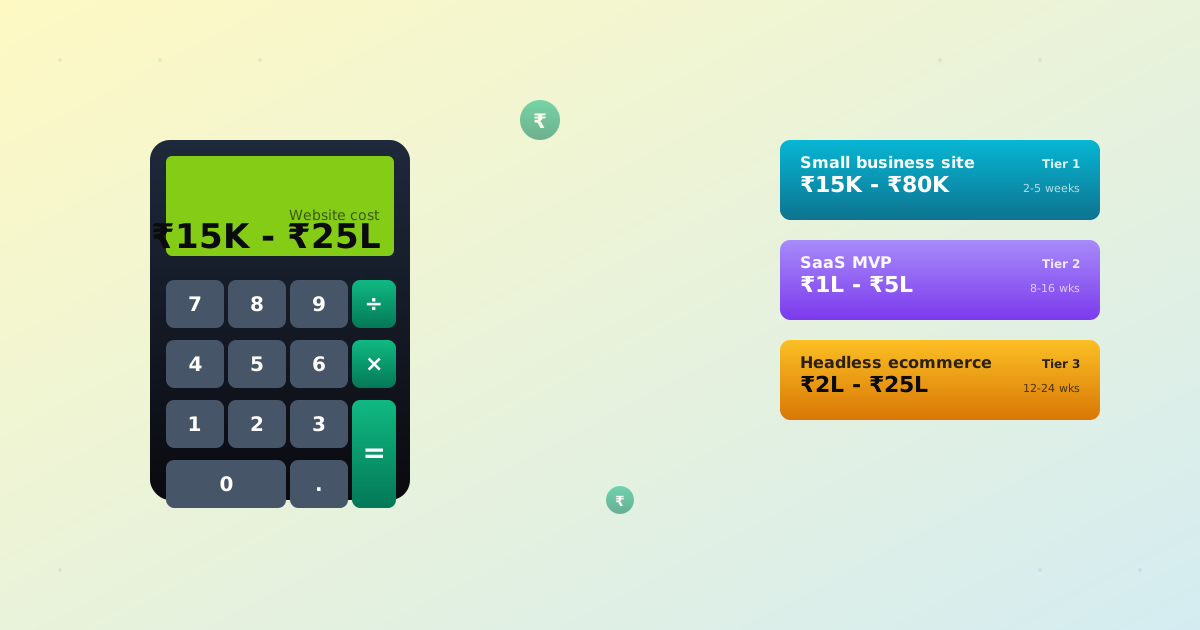
Website Development Cost in India (2026 Guide)
Real 2026 INR website costs by type: ₹5-25K static, ₹15-80K small business, ₹20K-2L Shopify, ₹2-8L headless, ₹5-25L SaaS, plus the hidden costs founders miss.
AI Chatbot Development Cost in India (2026): Build and Run
What an AI chatbot costs to build and run in India in 2026: our INR prices, the monthly model bill worked out, and why enterprise quotes start at ₹6 lakh.
Is a New Website Actually Worth It for Your Small Business? The Honest ROI Math (India, 2026)
Every Indian small-business owner asks the same quiet question before spending on a website: "will I actually get my money back?" Most agencies dodge it. This is the honest ROI math, with a real worked example using Indian numbers, what different budgets actually return, when a new website is NOT worth it, and how to work out your own number in 5 minutes.
 Pricing
Cheap Website in India Under ₹10,000 in 2026: 6 Honest Options + What You Actually Get (and Lose)
Founders ask me weekly, "Ravi, I have ₹8-10K. Can I get a working website?" Yes, but with real trade-offs. Here are 6 honest options (Wix Free, Wix Paid, GoDaddy, Fiverr, Indian solo developer, DIY with AI), what works for who, and the hidden cost trap that turns a ₹5K website into ₹20K by month 6.
Website Renewal Charges: What You Should Pay Yearly (2026)
What each line of a yearly website renewal bill in India should cost in 2026: domain, hosting, SSL, email, maintenance, and how to check yours.