We build Next.js, Shopify, Laravel, Flutter, in Noida, India. Free 1-page audit, no obligation.
Get a free quote- Top Healthcare IT Solutions Improving Patient ExperienceAugust 12, 2026
- Top IT Solutions Transforming Financial Services in 2026August 10, 2026
- Website Development Cost in India in 2026 | Complete Pricing GuideAugust 4, 2026
- OCPP and UPI: How EV Chargers in India Can Take Payments Without an AppJuly 27, 2026
- Find the leads worth chasing
- Let the follow-up run itself
- Meet customers where they already are: WhatsApp
- Know which deals are real
- Learn from every call
- Keep your data yours
- The numbers we built it around
- Off-the-shelf or built for your workflow?
- How we build it
- Common questions about getting a CRM
- Honest summary
 Products
What a Modern Sales CRM Should Do in 2026 (Inside BuildByRavi CRM)
Most businesses do not lose deals because their product is weak. They lose deals because follow-up leaks. A lead comes in, someone means to call back, and three days later it is buried under newer work. The spreadsheet forgot, the sticky note vanished, and a customer who was ready to buy quietly went to whoever replied first. A CRM exists to stop that leak. We built BuildByRavi CRM as our own take on what a modern sales platform should do, and this post is a walk through what is inside it and why each piece earns its place.
One honest thing up front: a CRM is only worth it if your team actually uses it. Half of CRM rollouts fail because the tool is heavier than the problem it solves, so reps go back to WhatsApp and notebooks. So everything here is built around speed and clarity, not a feature checklist. A good CRM should feel like it removes work, not adds it.
Prefer to see it rather than read about it? Take a look at our MultiVendor CRM and book a walkthrough of the dashboard, pipeline, and reports. Here is what each part does and why it is there.
Find the leads worth chasing
Most pipelines are full of names that will never buy. The cost is not just wasted time, it is that real buyers get the same lukewarm attention as dead ones. BuildByRavi CRM filters prospects by intent signals, so reps spend their hours on the accounts actually showing buying behaviour instead of working the list top to bottom. The job of a CRM is not to store every contact, it is to point you at the next right conversation.
Let the follow-up run itself
Follow-up is where humans are weakest and software is strongest. BuildByRavi CRM runs multi-step sales sequences with built-in A/B testing, so the second, third, and fourth touch happen on schedule whether or not anyone remembers. No-code automation workflows handle the busywork around them: move a deal stage, assign an owner, fire a reminder, log an activity, all without a developer. The rep does the human part, the talking, and the system does the parts humans forget.
Meet customers where they already are: WhatsApp
In India, deals do not close over email. They close on WhatsApp. A CRM that ignores that is fighting reality, so BuildByRavi CRM has WhatsApp Business messaging built in, with conversations logged against the right lead instead of trapped on one rep's phone. If you are weighing this seriously, we wrote a full guide to a WhatsApp CRM setup and cost, and a primer on what the WhatsApp Business API actually is. For Indian sales teams, this single feature usually moves the needle more than any other.
Know which deals are real
Every founder has been burned by a forecast built on optimism. A rep says a deal is 'almost closed' and it slips for the third month running. BuildByRavi CRM uses AI-powered forecasting and deal risk scoring to flag the deals that are stalling, the ones with no recent activity, and the ones the numbers say will not land, so your forecast reflects what is actually happening rather than what everyone hopes. Knowing a deal is at risk while you can still save it is worth more than any dashboard.
Learn from every call
Your best rep does something on calls your newest rep does not, and usually nobody can say exactly what. BuildByRavi CRM records and transcribes calls and turns them into coaching, so the patterns that win become teachable instead of locked in one person's head. A built-in AI co-pilot drafts replies and summarises calls, which means less time typing notes and more time selling. The CRM stops being a filing cabinet and starts being a coach.
Keep your data yours
A CRM holds your most valuable asset: every customer relationship you have. So control is not optional. BuildByRavi CRM has role-based access and audit trails, so the right people see the right data, departing employees cannot walk out with your whole pipeline, and you can always see who changed what. This matters more the moment you grow past a handful of trusted people.
The numbers we built it around
Every feature above exists to move a real metric. These are the targets BuildByRavi CRM is designed to hit, and the reason each module is in the product rather than the goals of any one customer, since your results depend on your team and your market:
- Around 2.4x more replies from disciplined, tested sequences instead of one-and-done outreach.
- Roughly 38% faster sales cycles when follow-up is automatic and the right leads get worked first.
- Forecast accuracy within about 4%, so the number you tell your board is closer to the number that lands.
- A free tier for up to 3 seats, so a small team can start without a budget conversation.
- Setup in under an hour, because a CRM nobody finishes configuring is a CRM nobody uses.
Off-the-shelf or built for your workflow?
Salesforce and HubSpot are powerful, but they are heavy, priced in dollars, and they make you bend your process to fit their software. For a lot of Indian teams that means paying for ninety features to use nine, and fighting the tool every day. A CRM shaped around how your team actually sells wins on the only metric that matters for a CRM: whether people use it. We break down the real cost and trade-offs in custom CRM vs Salesforce and HubSpot, and for marketplace and multi-vendor businesses we package this as the MultiVendor CRM, a CRM built for businesses that sell through many sellers at once.
How we build it
Under the hood, BuildByRavi CRM is a multi-tenant web application on a Node.js backend, with the WhatsApp Business API for messaging, a clean internal API for the automations and integrations, and role-based security throughout. The same engineering we use for client SaaS builds goes into it, which is the point: when we build a custom CRM for your business, you get a real product, not a spreadsheet with a login screen.
Common questions about getting a CRM
Can you build a custom CRM for my business?
Yes. BuildByRavi CRM is our own product, but we also build CRMs shaped around how a specific business sells, with only the modules you need, your fields, your stages, and integrations like WhatsApp, payments, or your accounting tool. The fastest path is usually to start from what we have already built and customise, rather than from a blank page. Tell us how your team sells and we will scope it.
How long does it take to set up a CRM?
BuildByRavi CRM itself is designed to set up in under an hour for a standard sales workflow. A customised CRM built around your exact process takes longer, typically a few weeks depending on integrations, but you are never staring at a blank, generic system wondering where to start. We get you to a usable pipeline first, then refine.
Does it work with WhatsApp?
Yes, WhatsApp Business messaging is built in, because for most Indian sales teams that is where deals actually happen. Conversations are logged against the right lead so nothing lives only on a personal phone. See our WhatsApp CRM guide for how it works in practice.
Is it cheaper than Salesforce or HubSpot?
For most small and mid-sized Indian businesses, yes, both to run and to actually adopt. Global CRMs charge per seat per month in dollars and pile on features you will not use. A focused CRM, or a custom one built around your workflow, usually costs less over time and gets used more. We lay out the full comparison in custom CRM vs Salesforce and HubSpot.
Who owns the data?
You do. With role-based access and audit trails, you control who sees what, and with a custom build you can host it where you want. Your pipeline is your business, and it should never be hostage to a vendor or a single employee's phone.
Honest summary
A modern sales CRM in 2026 should do five things well: point you at the leads worth chasing, run the follow-up automatically, meet customers on WhatsApp, tell you honestly which deals are real, and turn your best calls into coaching for everyone else. That is what we built BuildByRavi CRM to do, and it is the same standard we hold a custom CRM to when we build one for a client. A CRM that just stores contacts is a spreadsheet with extra steps. A CRM that grows revenue earns its place.
Want a CRM built around how your team actually sells? See our MultiVendor CRM to explore what it does, then message us on WhatsApp with how you sell today, or use the cost calculator for a rough estimate on a custom CRM build.
Tired of leads leaking out of spreadsheets? We build sales CRMs that surface the right leads, automate follow-up, plug into WhatsApp, and forecast honestly, shaped around how your team actually sells. See what we have built, then let us build yours.
Explore the MultiVendor CRMFounder of buildbyravirai, a web development agency based in Noida, India. 5+ years shipping Next.js, WordPress, Shopify, and Laravel projects for clients in India, USA, Canada, and the UK.
Working with us in your city
Keep Reading
 Guides
From Excel to a CRM in 2026: When to Switch, and How to Move Without the Chaos
The honest guide to moving from Excel to a CRM: the signs you have outgrown the sheet, what a migration actually involves, and how to bring your data over cleanly.
BackendPasskeys in 2026: How Passwordless Login Actually Works (and Why You Should Add It)
Passwords get reused, phished, and forgotten. Passkeys fix all of it. The developer-honest guide to how passkeys actually work on WebAuthn, and when to add them.
GuidesBest Web Development Company in India 2026: An Honest Buyer's Guide (Not a Sales Pitch)
Every 'best web development company in India 2026' list is a sponsored ranking. This one isn't. How to actually pick, what to ask, and what to walk away from.
TechnologyNext.js vs WordPress in 2026: Which Should You Build Your Business Website On?
Practical guide for Indian founders deciding between Next.js and WordPress: cost, SEO, speed, dev talent, and maintenance, with a clear pick for each case.
 Healthcare IT
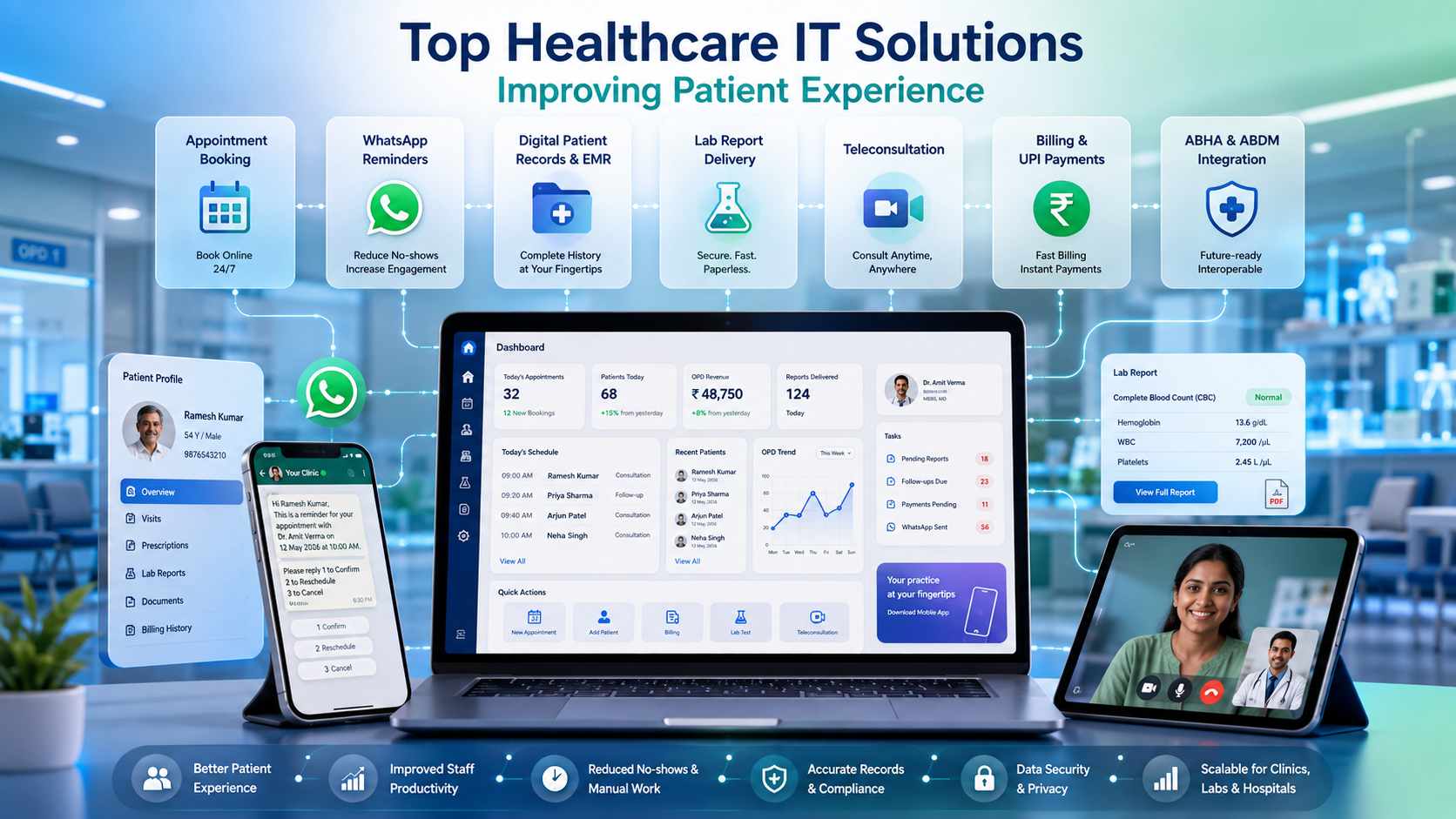
Top Healthcare IT Solutions Improving Patient Experience
Healthcare IT solutions for Indian clinics and labs covering booking, WhatsApp reminders, EMR, lab reports, billing, teleconsultation and ABHA.