We build websites, web apps and mobile apps in Next.js, NestJS, Shopify and Flutter for businesses across India. Free 1-page audit, no obligation.
Get a free quote- How to Get Google Reviews for Your Business in India (2026)October 17, 2026
- Payment Gateway Rejected Your Website? 5 Pages to Add (2026)October 16, 2026
- How Clients Judge Your Business Name Before They Ever See Your WorkOctober 15, 2026
- EV Charging Rules Every Indian Company Has to Follow in 2026 (And the Software That Proves It)October 13, 2026

Top Retail Technology Trends Boosting Sales
Every year a fresh list of retail technology trends goes around, and most of it is written for companies with a hundred stores and a data team. If you run one shop in Noida or a D2C brand shipping 40 orders a day, almost none of it applies to you this quarter.
We build retail and e-commerce software at buildbyravirai, so we get to see where the money actually leaks. It is rarely the missing AI. It is a product page that takes nine seconds on a mid-range Android, a search box that returns nothing for a spelling mistake, and a checkout that asks for the pincode twice. This post is aimed at Indian retailers doing somewhere between 10 lakh and 10 crore a year, and some of it is dull. The dull parts pay.
The three things that actually move sales
If you do only three things in the next six months, do these. Everything further down is either one of them explained properly, or a decision you will have to make anyway.
- Get product pages loading in under three seconds on a 4G phone, because that single change lifts every other number on the site.
- Fix checkout so a buyer can pay by UPI in two taps and never retypes an address.
- Put WhatsApp to work for order updates, abandoned carts and repeat buying, because that is the channel where Indian customers actually reply.
Product pages that load before the buyer leaves
Speed is not a vanity metric in India. A large share of your traffic sits on a phone that cost under 15,000 rupees, on a network that quietly drops to 3G speeds inside buildings and basements.
The culprits are boring and repeatable. Someone uploaded 4 MB photos straight off the camera. The theme loads six apps on every page. A review widget blocks rendering while it phones home to a server in another continent.
- Serve images in WebP or AVIF at the size they are actually displayed. This alone often halves page weight.
- Delete apps and plugins you stopped using. Each one adds script to pages that do not need it.
- Lazy load everything below the fold, including the Instagram feed nobody scrolls to.
- Use a CDN with an Indian edge so the first byte does not travel to Virginia and back.
- Test on a real mid-range phone on mobile data, never on office WiFi and a laptop.
Aim for Largest Contentful Paint under 2.5 seconds on mobile. If you sit at eight seconds today, getting to four is worth more revenue than a full redesign, and it costs a tenth as much.
Search that finds the product
Buyers who use site search convert at several times the rate of buyers who browse, because they already know what they want. Then most Indian store search boxes fail them at the first hurdle.
Someone types kurti when your catalogue says kurta set. Someone types blu shirt with a typo. Default search on a stock theme returns an empty page, and the buyer goes back to the marketplace tab that was already open. Fixing this is usually a one week job and it is the cheapest conversion work available.
- Add typo tolerance and synonyms, mapping the words your customers use to the words in your catalogue, in both Hindi and English spellings.
- Show results as the buyer types, with a thumbnail and a price.
- Never return a blank page. Show close matches, popular items, or a WhatsApp link to ask a human.
- Read the search log every week. Queries with zero results are a free list of products to stock or rename.
Checkout is where the money leaks
Cart abandonment in Indian e-commerce commonly runs between 60 and 80 percent. Part of that is browsing behaviour you cannot fix. A large part is friction you built yourself and stopped noticing.
- Put UPI at the top, above cards. Most buyers under 35 will pay by UPI intent or a QR if you let them.
- Auto-fill city and state from the pincode. Nobody should type both.
- Allow guest checkout. Forcing account creation before payment kills orders outright.
- Show the final amount early, including shipping and any COD fee. Surprise charges on the last screen are the most common reason people quit.
- Keep it to one page, two at most, and save the cart so a returning buyer does not start over.
Gateway pricing in 2026 sits around 1.8 to 2 percent for cards and wallets, while UPI stays at or near zero for merchants under the MDR threshold. Shift volume to UPI and your effective payment cost falls without touching your prices.
Cash on delivery is still real, so price it in
COD remains a big share of orders outside the metros, and pretending otherwise just loses sales. The move is to make prepaid more attractive rather than banning COD. A 3 to 5 percent prepaid discount, or free shipping on prepaid, shifts a meaningful slice of orders and quietly cuts your return-to-origin losses too.
WhatsApp is your second storefront
Email open rates in Indian retail are weak and getting weaker. WhatsApp messages get read, and more usefully, people reply to them with questions that turn into orders.
Once you cross a few hundred orders a month, the WhatsApp Business API is the version that matters. It lets the store send templated messages automatically and lets a human take over the same thread when the customer asks something the template cannot answer.
- Order confirmation and shipping updates, which cut the where is my order calls sharply.
- Abandoned cart nudges. One message an hour later, one the next day, then stop.
- Reorder reminders for anything consumable, timed to when the product actually runs out.
- A catalogue of the 30 to 50 items that sell most, so a regular can order without opening the site.
- Back-in-stock alerts, the highest intent message you will ever send.
Costs run per conversation, roughly 0.10 to 1.00 rupee for utility messages and higher for marketing ones, plus whatever platform sits on top. At the volumes we are discussing, budget 3,000 to 15,000 rupees a month.
One rule holds above all others here. Do not blast offers. Indian customers mute business numbers fast, and a muted number is a channel you no longer own.
Inventory that matches the shelf
Selling something you do not have is worse than never listing it. The customer waits, calls, cancels and does not come back, and on marketplaces the cancellation damages your seller rating for weeks.
Most shops running a counter and an online store keep two separate versions of the truth. Billing software says one number, the website says another, and somebody reconciles at night when they remember to.
- Pick one system as the source of truth, usually your billing or POS software, and push stock outward from there to every channel.
- Sync on a schedule you trust. Every 15 minutes is plenty for most catalogues.
- Hold a buffer on fast movers so the last two pieces are not sold twice in the same minute.
- Barcode the top 200 SKUs first. Full barcoding of a 5,000 item shop can wait a year.
Most Indian POS and billing tools now expose an API, or at least a scheduled CSV export. If yours offers neither, that is a genuine reason to switch, and one of the few times we tell a client to replace software that otherwise works.
Weighing this up for your own business? Send us the scope and you get a written scope and a fixed quote back within 24 hours.
Get a fixed-price quoteReturns and RTO are a product page problem
Return to origin eats margin quietly. In fashion and footwear, RTO plus returns on COD orders often lands between 20 and 35 percent, and each one costs you shipping both ways plus handling plus a product that comes back looking used. Trace those returns and most of them start with a buyer who did not know what they were getting.
- Put real measurements on the page, in inches and centimetres, with a size chart for that specific product rather than a generic one.
- Show photographs on a real person, plus one close shot of the fabric so texture is judgeable.
- Verify high value COD orders over WhatsApp with a single tap to confirm. Impulse and fake orders drop out here.
- Flag repeat RTO phone numbers and require prepaid from them.
- Make genuine returns painless. A buyer who returns smoothly buys again, a buyer who has to fight you writes a review instead.
Pulling RTO from 30 percent down to 20 percent adds more to your bottom line than a 10 percent traffic increase, and it costs a fraction as much to achieve.
Loyalty without building an app
Almost nobody at this size needs a custom loyalty app. Your customers will not install it, and the handful who do will not open it twice. What works is simpler. Points tied to the phone number, visible on the printed bill at the counter and in the cart online, redeemable without staff having to remember any rules.
Marketplace, ONDC, or your own store
This is the decision owners get wrong in both directions. Some sell only on Amazon and Flipkart and never build a customer list they own. Others build a lovely website, get 40 visitors a month, and wonder what went wrong.
The honest framing is that marketplaces buy you demand and cost you margin and customer data, while your own store costs you demand generation and hands both of those back.
- Marketplaces are for discovery and cash flow. Expect 15 to 30 percent gone in commission, fees and returns depending on category.
- ONDC is worth listing on if your category is served in your city, especially grocery, food and local retail. Buyer volumes vary a lot city to city, so treat it as a low cost extra channel rather than a strategy.
- Your own store is the only place you own the customer, the pricing and the repeat purchase.
- WhatsApp and phone orders remain the highest margin channel for a neighbourhood shop, and the easiest one to formalise.
On platform choice, Shopify launches faster and costs less to maintain, while WooCommerce gives you more control and no per-order platform cut. We work with both, Shopify when speed to launch matters and WooCommerce when the catalogue or the billing integration is unusual enough to need custom code.
Quick commerce changed the clock
Ten minute delivery has retrained metro buyers for a specific set of categories, mostly grocery, personal care and small essentials. If you sell those, competing on speed alone is a losing fight against companies burning investor money to win it.
Range, advice and relationship still work. Stock what they do not carry, answer on WhatsApp within minutes, and deliver the same day within three kilometres using your own boy on a scooter. That combination is defensible in a way that a ten minute promise is not.
GST invoicing and the boring plumbing
Every online order needs a compliant GST invoice with the right HSN code and the correct split between CGST, SGST and IGST based on where you ship. Getting this wrong is a filing headache three months later, not an error you will notice on the website today.
Automate it end to end. The store should generate the invoice at order confirmation, send it by email and WhatsApp, and push it into your accounting software. If your turnover crosses the e-invoicing threshold, that push has to reach the IRP as well, and it needs to happen without anyone remembering to click a button.
Trends you can skip this year
Not every item on the annual list deserves your money at your size. Revisit these when your order volume doubles, and not before.
- AI chatbots answering from a knowledge base you have not written. A WhatsApp number with a human on it beats them at 40 orders a day.
- A custom mobile app, unless you already have thousands of monthly repeat buyers. A fast website plus WhatsApp does the same job for a tenth of the cost.
- AR try-on, outside of eyewear and a few furniture categories.
- A full ERP implementation. It will eat a year and rarely fixes the problem you actually have.
- Smart shelves, computer vision footfall counting and electronic shelf labels for a single store. The payback maths does not work below a certain scale.
What this costs in India in 2026
Rough ranges we see for agency work in the NCR market, so you can sanity check any quote you are handed.
- Speed and conversion cleanup on an existing store: 25,000 to 75,000 rupees, usually two to three weeks.
- New Shopify store with real design, 100 to 500 products: 60,000 to 2.5 lakh.
- Custom WooCommerce build with billing or inventory integration: 1.5 to 6 lakh.
- WhatsApp automation setup: 20,000 to 60,000 one time, plus platform and per message costs monthly.
- POS to website inventory sync: 40,000 to 1.5 lakh, depending on how cooperative the POS vendor is.
Anything quoted at 8,000 rupees for a complete store is a template with your logo dropped into it, and you will pay again in six months to undo it.
A ninety day order of work
- Weeks 1 and 2: measure. Page speed on a real phone, search queries returning nothing, checkout drop-off by step, RTO percentage by category.
- Weeks 3 to 5: compress images, remove dead apps and plugins, get mobile load under three seconds.
- Weeks 6 and 7: rebuild search and checkout. UPI first, pincode autofill, guest checkout, all costs shown early.
- Weeks 8 to 10: WhatsApp order updates, abandoned cart flow, back-in-stock alerts.
- Weeks 11 and 12: sync inventory between counter and website, then add RTO controls on COD orders.
That is one quarter of work and it does not require a new website. Most of it is repair on what you already own, which is why it pays back faster than a rebuild.
If you want a second opinion on which of these your store actually needs, send us the URL and your monthly order count and we will tell you what to fix first, in order. You can reach the team here.
Frequently asked questions
What is the fastest way to increase online sales for a small Indian store?
Should I sell on Amazon and Flipkart or build my own website?
Is ONDC worth it for a small retailer in 2026?
How much does a good e-commerce website cost in India?
Do I need a mobile app for my retail business?
How do I reduce COD returns and RTO?
Founder of buildbyravirai, a web development agency based in Noida, India. Building websites, web apps and mobile apps in Next.js, NestJS, Shopify and WordPress since 2021, for clients in India, the US, Canada and the UK.
How this worked in practice
Working with us in your city
Keep Reading
 E-commerce
Shopify vs WooCommerce in India 2026: Real Numbers from 12 Stores
We ran 12 Indian e-commerce stores on both platforms. Here's what Shopify wins, where WooCommerce saves you money, and which one to pick based on your order volume.
What to Send a QA Team, and What You Should Get Back
Most manual testing engagements go wrong in the brief, not the testing. What a QA team actually needs from you, what a bug report has to contain to be actionable, and how to tell a good one from a list of screenshots.
 Technology
Angular vs React in India 2026: Which Front End to Commit To
React for startups and SMBs, Angular for banks and enterprise teams, Next.js for most Indian SMB sites. The 2026 call turns on hiring, not benchmarks.
 Technology
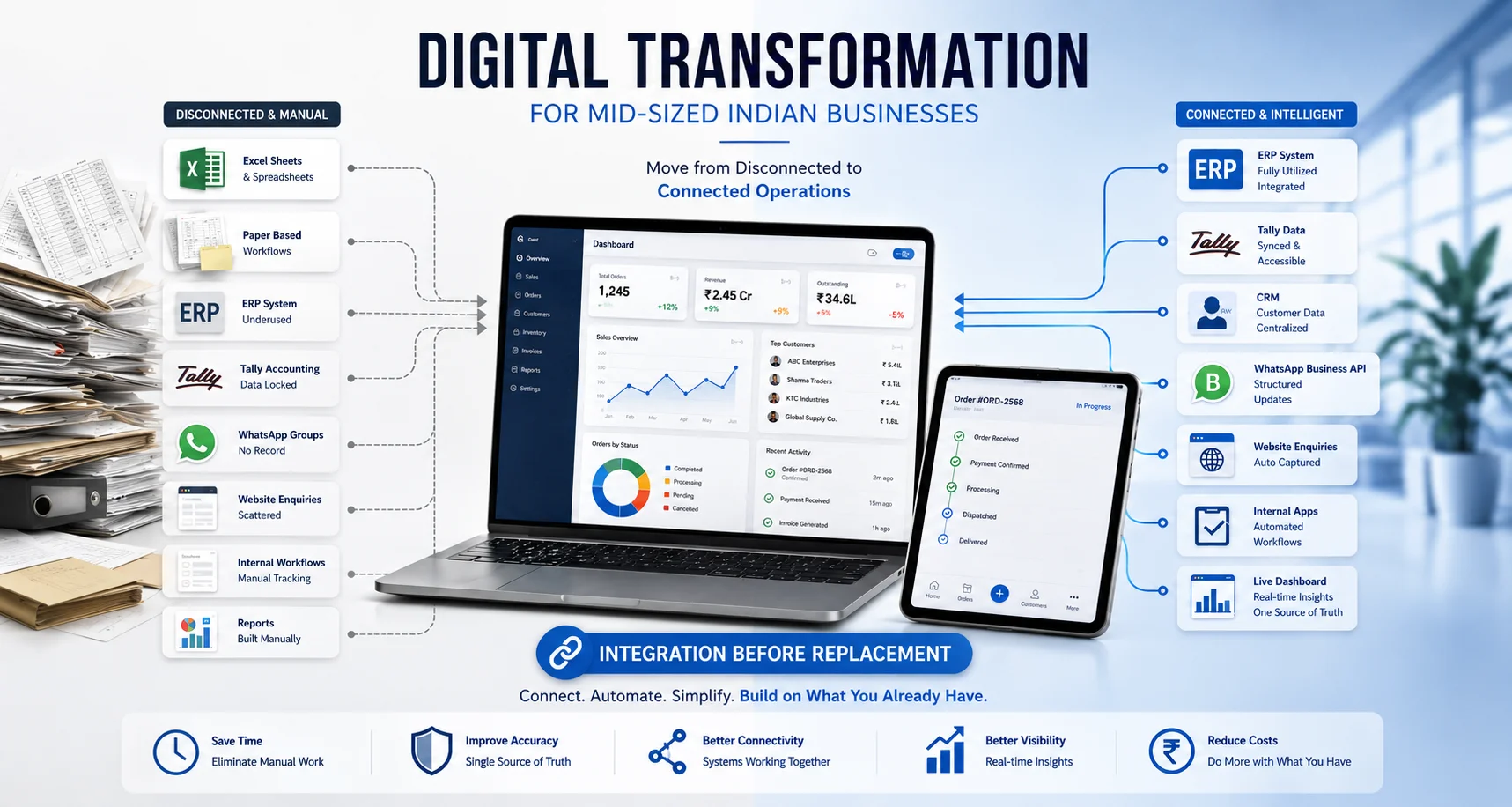
Enterprise IT for Digital Transformation
A practical look at how Indian businesses can use technology, integrate existing systems and automate everyday work without costly IT projects.
 Artificial Intelligence
How AI Is Transforming Businesses in India in 2026
See how Indian businesses are using artificial intelligence in 2026, what actually works, what fails, and what AI implementation costs in India.