We build Next.js, Shopify, Laravel, Flutter, in Noida, India. Free 1-page audit, no obligation.
Get a free quote- Unified Bharat e-Charge (UBC), Explained for EV OperatorsSeptember 25, 2026
- What to Send a QA Team, and What You Should Get BackSeptember 19, 2026
- The javax to jakarta Break: Why Your Old Java App Is Stuck, and What It Costs to MoveSeptember 19, 2026
- OCPP 1.6-J Source Code: Five Open-Source Codebases Worth Reading Before You Write a CSMSSeptember 19, 2026
 Pricing
AI Chatbot Development Cost in India (2026): Build and Run
Ask five companies in India what an AI chatbot costs and you'll get five answers between a few thousand rupees a month and several lakh up front. The odd thing is that most of them are honest. They're quoting different things: a plug-in tool you configure, a bot that answers from your own content, or an agent that can go into your systems and do work.
This post puts numbers on each of those. The build prices are the ones we quote, the monthly running cost is worked out from published model prices at today's exchange rate, and the last few sections cover what pushes an enterprise quote up and how to spend less. If you'd rather skip to a number for your own project, the cost calculator or a quick quote will get you there faster.
The short answer: what an AI chatbot costs in India in 2026
- Website chatbot that answers from your own content: ₹40,000 to ₹90,000 to build, ₹2,000 to ₹15,000 a month to run. Live in two to four weeks.
- Document extraction (invoices, contracts, forms into your database): ₹60,000 to ₹2 lakh to build, and cheap to run.
- An AI feature inside a product you already have: from ₹2.5 lakh, with evaluation and cost tracking included.
- Enterprise chatbot or agent system with retrieval over company data, tool access, guardrails and monitoring: ₹6 lakh to ₹14 lakh.
- Multi-feature AI platform with several models, internal system connectors and per-team budgets: ₹15 lakh and up.
The first line is what most small and mid-sized businesses actually need, and it's where the rest of this post spends most of its time.
What the build money actually pays for
The chat window is the cheap part. A widget that opens in the corner of a website is a day's work. The money goes into the parts that decide whether the bot is right or embarrassing.
First, your content. The bot can only answer from what it's given, and in most businesses the answers live in six places: a help page last updated in 2023, a policy PDF, a product sheet, and the heads of two support people. Pulling that into one clean source is often the biggest job on the project, and it's the main reason one quote is ₹40,000 and another is ₹90,000.
Second, a test set. Before we write a prompt, we collect 50 to 100 real questions your customers ask, with the correct answers. Every change to the bot is run against that set. It sounds like overhead. It's the only way to know that a tweak which fixed one answer didn't quietly break ten others.
Third, the safety rails. The bot answers only from your content and shows where each answer came from, it hands over to a person when it isn't confident, and it has a hard monthly spend limit so the model bill can't run away. None of this is visible in a demo, which is exactly why cheap quotes leave it out.
The things that push a build towards the top of the range: content spread across many formats, answers that need Hindi as well as English, a hand-off into an existing helpdesk or CRM, and more than one channel (say, website and WhatsApp) from day one.
The monthly bill, worked out
Running cost is mostly model usage, and model usage is priced per token, roughly per three-quarters of a word. Here's the working for a typical support bot, so you can redo it with your own numbers.
Assume a conversation of four questions. Each question sends the model about 4,000 tokens: 1,500 of fixed instructions (which can be cached and billed at a tenth of the price), around 2,000 of your content retrieved for that question, and the conversation so far. Each answer is about 250 tokens. So one conversation is roughly 16,000 tokens in, 6,000 of them cached, and 1,000 tokens out.
At Anthropic's published API prices and ₹96 to the US dollar, that comes to:
- Claude Haiku 4.5 ($1 in, $5 out per million tokens): about ₹1.50 a conversation. 1,000 conversations a month is ₹1,500; 5,000 is ₹7,500.
- Claude Sonnet 5 ($2 in, $10 out): about ₹3 a conversation. ₹3,000 a month at 1,000 conversations, ₹15,000 at 5,000.
- Claude Opus 5 ($5 in, $25 out): about ₹7.50 a conversation. ₹7,500 at 1,000, ₹37,500 at 5,000.
Add ₹1,000 to ₹2,500 a month for a server if the bot can't share your existing hosting. Turning your content into searchable vectors costs a few rupees a month at this scale, so it barely registers.
Two things move these numbers more than people expect. Hindi written in Devanagari takes noticeably more tokens than the same sentence in English, so a bilingual bot costs more per conversation. And a bot that stuffs every document into every request, instead of retrieving the two or three relevant passages, can cost five times as much for worse answers.
For a FAQ-style support bot, Opus is almost never needed. Most website bots are well served by Haiku or Sonnet, and the model can be swapped later without a rebuild. OpenAI's smaller models land in a similar range; we pick on accuracy against your test set first and price second.
“If a support hire costs ₹25,000 a month and the bot takes the repeat questions off them for ₹3,000, it pays for itself quickly. If you get twenty questions a week, it probably doesn't, and you should be told that before you pay for a build.”
Adding WhatsApp
Most Indian customers would rather ask on WhatsApp than open a chat window on a website. The same bot can serve both, so you maintain one set of content and one test set. The WhatsApp side needs the WhatsApp Business API through Meta or a provider, and Meta's own fees are separate from the model bill. Replies to customer-initiated messages inside the 24-hour window are free from Meta; messages you start, like order updates, are charged. Our WhatsApp Business API guide goes through the providers and the fees in detail.
Enterprise AI chatbot development cost: why it jumps to ₹6 lakh and up
An internal assistant for a company of a few hundred people is a different build, and most of the cost has nothing to do with the model.
- Access control per document. HR policy for everyone, salary bands for HR only, board papers for nobody. The bot has to respect the same permissions your file system does, on every answer.
- Sign-in through your identity provider, so people log in with their work account and leavers lose access the same day.
- Audit logs of who asked what and which documents were used to answer, for when legal or compliance asks.
- Data that can't leave your servers. Some sectors need an open model you host yourselves instead of a cloud API. That moves cost from the monthly bill to hardware and setup.
- Actions, not just answers. An agent that raises a ticket, checks an order or updates a CRM record needs tightly scoped tools, a log of every action, and a human approval step for anything touching money.
- Evaluation at scale. Hundreds of test questions across departments, run before every release, with a dashboard someone actually reads.
Each of those is a normal software problem with a normal software price. That's why the enterprise range starts around ₹6 lakh and why anyone quoting an "enterprise chatbot" at website-bot prices is quoting the website bot.
Custom build or a subscription tool?
There are good subscription tools that add an AI assistant to a helpdesk for a monthly fee per seat or per resolved conversation. If your questions are standard, your volume is modest, and you already live in that helpdesk, use one. You'll be live this week and nobody has to maintain anything.
A custom build starts to make sense when the per-conversation fees add up past what you'd pay to run your own, when the bot has to reach into your own database or order system, when it needs to work on WhatsApp the way your customers actually use it, or when you want to own the content, the logs and the model choice. We'd rather talk someone into a subscription tool than build them something they didn't need.
How we build one
Our standard stack for a chatbot is a Next.js widget on the front, a NestJS service behind it, and PostgreSQL with pgvector holding your content and its embeddings, so there's no separate vector database to pay for at small scale. The model sits behind an API call we can swap, with per-request cost tracking and a hard monthly ceiling. The widget drops into WordPress, Shopify or a custom site without a rebuild.
A first bot usually goes live in two to four weeks: a call about the questions you actually get, building the content source and test set, building and testing against it, then a month of reading real conversations and fixing what it gets wrong. That last month matters more than the launch. We wrote about what actually happens once AI features hit production if you want the longer version.
Ways to spend less
- Start with your top 50 questions, not every document you own. Most support volume is a short list asked over and over.
- Use rules where the answer is fixed. Opening hours and order status don't need a model. A plain lookup is cheaper, faster and never wrong.
- Route by difficulty. Send simple questions to a small model and only the hard ones to a bigger one.
- Cache the fixed instructions, which cuts that part of every request to a tenth of the price.
- Build the chatbot before the agent. Let it prove people use it, then add actions one at a time.
Thinking about an AI chatbot for your website or WhatsApp? Send us the ten questions your customers ask most and roughly how many you get a month. We'll tell you what it would cost to build and run, or tell you honestly that you don't need one yet.
Get a chatbot quoteFrequently asked questions
How much does it cost to build an AI chatbot in India?
What does an AI chatbot cost per month to run?
Why is an enterprise AI chatbot so much more expensive?
Is it cheaper to use a chatbot subscription tool?
How long does it take to build an AI chatbot?
Which AI model is best for a chatbot?
Founder of buildbyravirai, a web development agency based in Noida, India. 5+ years shipping Next.js, WordPress, Shopify, and Laravel projects for clients in India, USA, Canada, and the UK.
Working with us in your city
Keep Reading
 Pricing
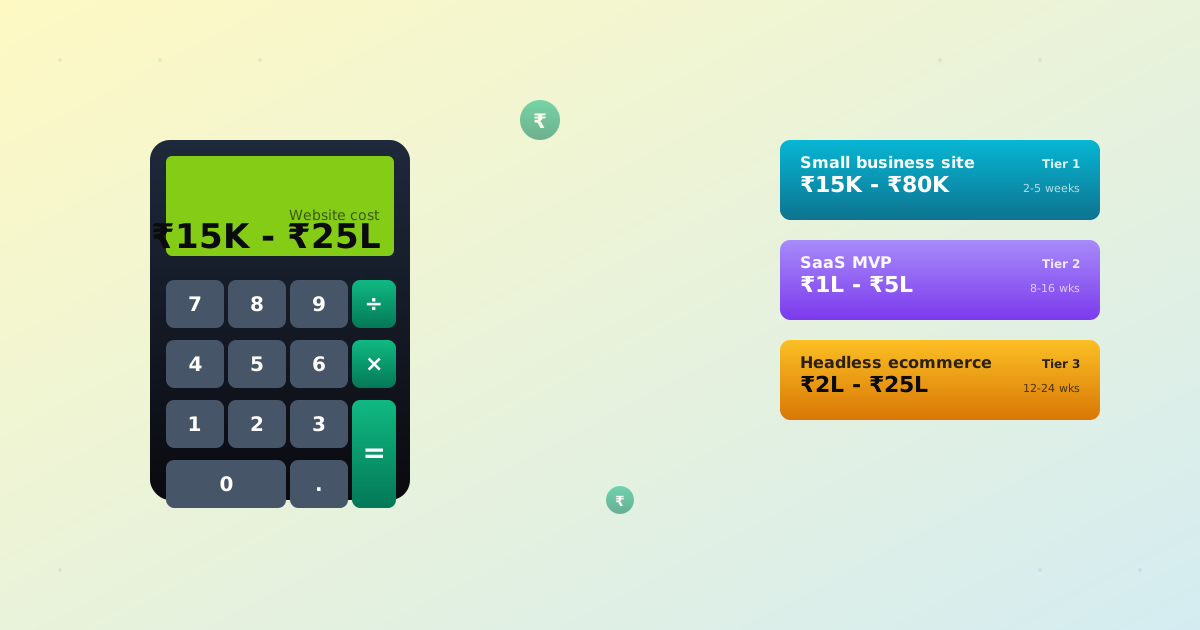
Website Development Cost in India (2026 Guide)
Real 2026 INR website costs by type: ₹5-25K static, ₹15-80K small business, ₹20K-2L Shopify, ₹2-8L headless, ₹5-25L SaaS, plus the hidden costs founders miss.
PricingIs a New Website Actually Worth It for Your Small Business? The Honest ROI Math (India, 2026)
Every Indian small-business owner asks the same quiet question before spending on a website: "will I actually get my money back?" Most agencies dodge it. This is the honest ROI math, with a real worked example using Indian numbers, what different budgets actually return, when a new website is NOT worth it, and how to work out your own number in 5 minutes.
 Guides
Custom CRM Development in India 2026: Why a ₹40K-1.5L Build Beats Salesforce + HubSpot for Most Indian SMBs
Salesforce and HubSpot bill in USD per user, ₹3-8 lakh/year for a 10-person team. A custom CRM is ₹40K-1.5L one-time. Real INR costs and when custom wins vs SaaS.
 Pricing
Cheap Website in India Under ₹10,000 in 2026: 6 Honest Options + What You Actually Get (and Lose)
Founders ask me weekly, "Ravi, I have ₹8-10K. Can I get a working website?" Yes, but with real trade-offs. Here are 6 honest options (Wix Free, Wix Paid, GoDaddy, Fiverr, Indian solo developer, DIY with AI), what works for who, and the hidden cost trap that turns a ₹5K website into ₹20K by month 6.
 Backend
.NET Does Not Need Windows Any More: What It Actually Costs to Run in 2026
The licensing objection to .NET is a decade out of date, and it still decides stacks. What .NET actually costs to host in India now, where the real costs sit, and when it is still the wrong pick.