We build Next.js, Shopify, Laravel, Flutter, in Noida, India. Free 1-page audit, no obligation.
Get a free quote- EV Charging Tariffs in India: Per kWh, Per Minute, Idle Fees and the Maths Behind the BillSeptember 12, 2026
- Laravel vs Node.js in India 2026: Which Backend to Build OnSeptember 5, 2026
- PWA vs Native App in India 2026: Do You Need the App Store?September 5, 2026
- We Published Our Search Console Numbers. They Were Wrong.September 5, 2026
 Cloud
CloudCloudNX: What We Built, and Why the Free 3 Months Ended
Correction, September 2026. This post went up on 30 April 2026 to announce that CloudNX was free for your first three months. That offer has ended, and the product moved a long way since. Rather than quietly delete the page, here is what changed and what CloudNX is today.
We left this at the same address because people arrive here searching for CloudNX by name, and sending them to a 404 or to a silently rewritten page that pretends the offer never existed would be worse than saying it plainly.
What CloudNX is now
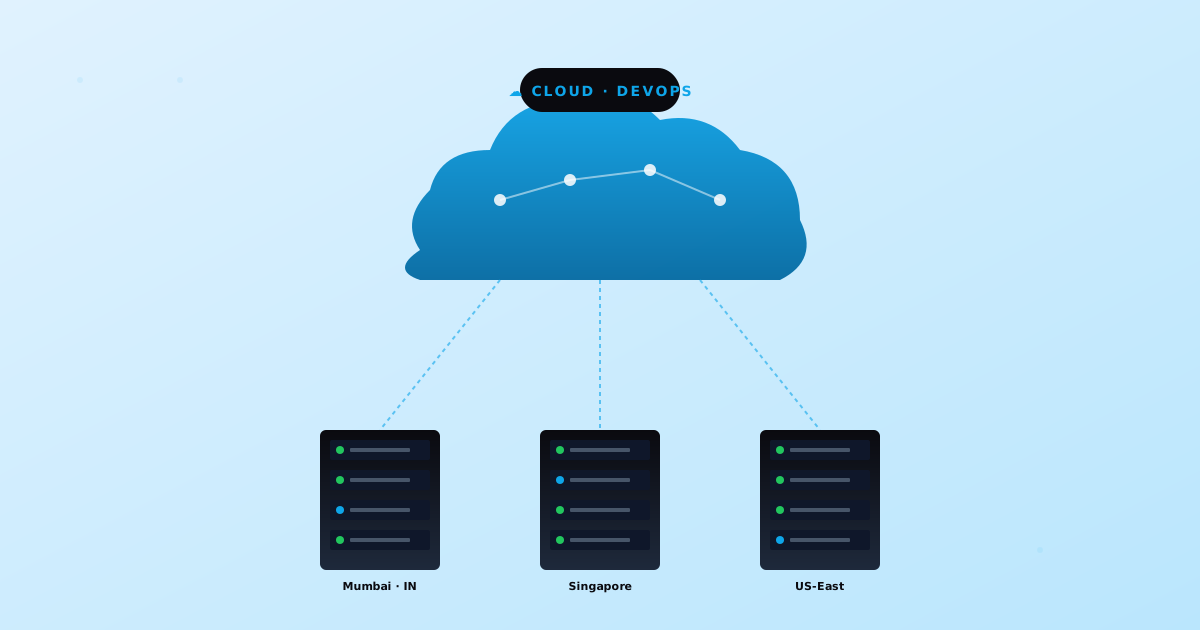
CloudNX is a cloud compute platform running dedicated bare-metal NVMe hardware, not virtual slices carved out of an oversold host. An instance provisions in about a minute and you get browser SSH and full root access from the moment it is up.
- Two live regions. India in Mumbai and EU West in Finland. US regions are on the roadmap and are described that way rather than as available.
- Dedicated hardware. Real NVMe, not a shared VPS. That is the whole point, and it is why the pricing sits where it does.
- Per-minute billing from a prepaid wallet. You pay for what actually runs. No card is required before you top up.
- Local payment and invoicing. International cards, net banking, UPI and SEPA, with autopay across all of them, and GST-compliant invoices against a GSTIN for anyone claiming input credit.
What happened to the free three months
It was a launch offer and it did its job. The product now answers the question directly on its own site: there is no free signup credit. You top up a wallet when you are ready, and because billing is per minute rather than monthly, an experiment costs what it runs for instead of costing a month.
That is a less exciting sentence than "free for 3 months", and it is the true one.
How it compares, including where it loses
CloudNX is roughly 35 per cent cheaper than AWS on the m-class workhorse SKUs, and comparable to DigitalOcean and Linode on raw price while giving bare metal instead of a shared VPS.
It is not cheaper on everything. CloudNX publishes a line-by-line AWS comparison that names the SKUs where AWS wins, which we would defend on any product we build. A prospect who finds the weakness themselves stops believing everything else on the page. Better to hand it to them.
- Stay on a hyperscaler if you need deep multi-region managed services, or your architecture leans on a dozen of their proprietary pieces.
- Look at CloudNX if what you actually need is real hardware, root access and a bill you can predict, which describes most Laravel apps, Node backends, staging boxes and production gateways.
- Look elsewhere if the bulk of your traffic sits outside India and Europe, because two regions is two regions.
The SLA, stated the awkward way
99.5 per cent on compute, written into the MSA rather than into marketing copy. The platform is single-host until the second box lands, at which point it moves to 99.9 per cent with multi-AZ. Prospects are told that before signing rather than after, on the view that losing a deal costs less than missing an SLA.
The data centres it builds on hold ISO 27001. CloudNX itself is not yet certified, and it says so rather than letting the data centre's badge stand in for its own.
Getting in, and getting out
Moving in is the normal path: IAM-style access keys, S3-compatible object storage and standard Linux VMs, so rsync, scp or any container workflow brings an AWS, DigitalOcean or Linode deployment across.
Moving out is the part almost nobody documents. Everything runs on Proxmox, so you can export a qcow2 image of any machine whenever you like and import it into another cloud in about two hours. Ask that question of any host before you commit, and treat a vague answer as the answer.
What we run on it
PlugEV, our production OCPP charging platform, runs its stack on CloudNX, including the gateway holding live charger WebSocket connections. The Node.js backend behind the three-app grocery system we built for a Delhi NCR kirana runs on it too. Those are the reason we can say anything about it at all: it carries our own production work, not just our marketing.
We still pick infrastructure per project rather than defaulting to our own product, and we will say when a global provider is the better answer. Running a hosting product mostly changed our defaults elsewhere: backups, SSL renewal, monitoring and log retention stopped being line items to argue about and became things we assume.
The full build story, including the architecture decisions and the figures we will and will not publish, is in the case study. If you want the same thinking applied to your own infrastructure, our cloud and DevOps work starts with a look at what you are running today.
Read the CloudNX case studyFrequently asked questions
Is CloudNX still free for 3 months?
Where are CloudNX servers located?
Is CloudNX cheaper than AWS?
Can I get a GST invoice from CloudNX?
Founder of buildbyravirai, a web development agency based in Noida, India. 5+ years shipping Next.js, WordPress, Shopify, and Laravel projects for clients in India, USA, Canada, and the UK.
How this worked in practice
Working with us in your city
Keep Reading
CloudDeploying a Web App to Production in 2026: Docker, CI/CD, and Zero-Downtime (Without the Overkill)
The practical guide to shipping web apps reliably in 2026: what Docker and CI/CD actually do, how zero-downtime deploys work, and whether you even need Kubernetes.
 Lessons
We Built the Software for an EV Cycle, Then Drove to IIT Jammu to Watch It Roll
The behind-the-scenes story of building the app, firmware and dashboard for an EV cycle, and what the day at IIT Jammu watching our code move a machine taught me.
 Business
We Built 3 Live Products Last Year. Here's What That Changes for Our Clients.
We run three SaaS products in production right now: PlugEV, CloudNX, and ToolKiya. Here's what running our own software means for the way we build for you.
MobilityEV Charging Tariffs in India: Per kWh, Per Minute, Idle Fees and the Maths Behind the Bill
How a charge point operator in India should price a session, what the bill is actually computed from, why offline sessions are where billing breaks, and how the money splits with the site host.
 E-commerce
Shopify vs WooCommerce in India 2026: Real Numbers from 12 Stores
We ran 12 Indian e-commerce stores on both platforms. Here's what Shopify wins, where WooCommerce saves you money, and which one to pick based on your order volume.