We build websites, web apps and mobile apps in Next.js, NestJS, Shopify and Flutter for businesses across India. Free 1-page audit, no obligation.
Get a free quote- How to Get Google Reviews for Your Business in India (2026)October 17, 2026
- Payment Gateway Rejected Your Website? 5 Pages to Add (2026)October 16, 2026
- How Clients Judge Your Business Name Before They Ever See Your WorkOctober 15, 2026
- EV Charging Rules Every Indian Company Has to Follow in 2026 (And the Software That Proves It)October 13, 2026
- Why the worse business keeps winning
- Step 0: pick the right competitor, not the one that annoys you
- The 20-minute teardown, in order
- The scorecard, ready to paste
- What to fix first, and roughly what it costs
- Four ways this goes wrong
- The message to send your developer or agency
- Things your competitor is doing that you should not copy
- The short version
Your Competitor's Website Is Beating Yours: The 20-Minute Teardown (2026)
The message came in at 9.40 on a Tuesday night. Four words and a full stop: "Sir, they went ahead."
It was a ₹6.2 lakh build. Three calls, a scoped proposal, a demo of software we already run in production. Lost to a company whose product I know is worse than ours, whose team is smaller than ours, and whose website, I would have told you before that night, was cheaper than ours.
I did the professional thing. I said thank you, wished them well, closed the laptop, and then sat in the dark for about forty minutes doing the unprofessional thing, which is going over every call in your head looking for the sentence where you lost it. I did not find it. There was no sentence. The next morning I opened the winner's website properly for the first time, not to admire it, with a notebook, and I found it in about nine minutes.
Their site answered the three questions a buyer asks before they trust anybody, and ours answered them on page four. That was the whole difference. Not the product. Not the price. The reading order.
I have run this teardown for clients maybe sixty times since, and it has never once taken longer than twenty minutes to find something that matters. It is the cheapest piece of marketing work available to any business in India, it needs no paid tool, and almost nobody does it, because it feels like admitting your rival is ahead.
Save this page rather than reading it once. There are two things in here you will want again: the 24-point scorecard you can paste into a notes app and fill in for any two websites, and the message to send your own developer afterwards so the work actually gets done. Bookmark it, or send it to yourself on WhatsApp now, because you will want it the next time you lose one you should have won.
Why the worse business keeps winning
Here is the thing that took me years to accept. Your buyer cannot judge your work. They are not a developer, a patient cannot judge a surgeon from the waiting room, and a factory owner buying software cannot tell good architecture from bad. So they judge the things they can judge, and every one of them is on your website.
Can I tell in five seconds what you do and who for. Is there proof that a real person got a real result. Can I reach a human without filling a form that asks for my budget. That is the list. A business with a worse offering and a clearer website beats a better business with a confusing one almost every time, and it does it quietly, without you ever learning why.
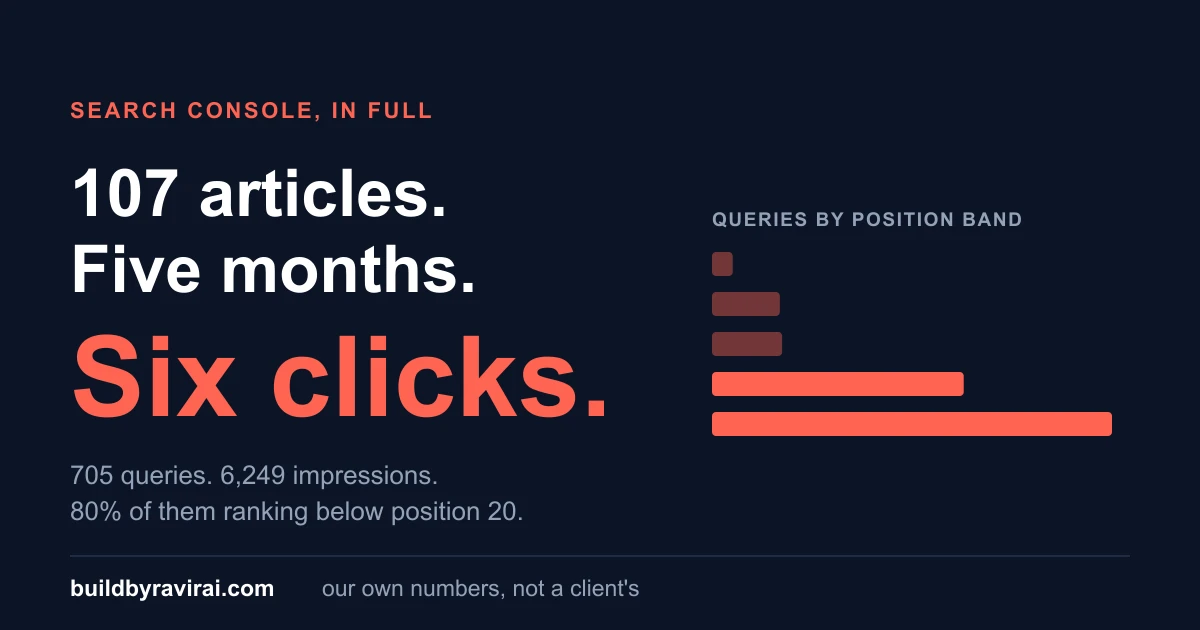
The second reason is uglier. Google is not ranking the better business either. It ranks the page that most obviously answers the search, on a site it can crawl quickly, with signals that other sites consider it worth linking to. None of those are quality of work. We wrote about our own hard version of this lesson in the post where we published our real Search Console numbers, which were embarrassing.
So the teardown is not flattery and it is not copying. It is reading what your rival has decided to say first, and checking whether the machine can read it faster than it can read you.
Step 0: pick the right competitor, not the one that annoys you
Most people run this on the big national brand they resent. Useless. You are not losing work to them and you cannot copy a company with a hundred crore of funding.
Pick the two or three businesses that actually take work off your table. The fastest way to find them is not guesswork.
- Open a private or incognito window, because your own Google results are warped by what you usually click. Search the exact phrase a customer would use, with the city if you sell locally. Not your industry jargon. "CCTV installation Indore", not "security surveillance solutions provider".
- Write down whoever sits in the top five, plus anyone in the map results above you.
- Then do the thing almost nobody does: ask the last three customers who did not buy from you who they went with. A short, unbothered WhatsApp message gets an answer about half the time. "No problem at all, genuinely helpful for us to know, who did you end up going with?" You will often find a name that never appears in search at all, and that tells you the work is moving through referrals, which is a completely different problem to fix.
- Pick one competitor who ranks and one who converts, if they are different businesses. Score both.
The 20-minute teardown, in order
Do these in this order, on a phone for the first half, because that is where your buyer is. Every tool here is free and none of them need an account.
1. The five-second test (2 minutes)
Open their homepage on your phone. Count to five, close the tab, and write down what the business does and who it is for. Then do the same to your own homepage and be honest about what you managed to write.
If your note for them is "custom software for EV charging companies" and your note for you is "something about technology, they seem experienced", stop the teardown here and go fix your first screen. Nothing else on this list will outrank a homepage nobody understands.
2. The three questions (3 minutes)
Still on the phone, scroll their homepage once and mark where each of these appears, counting screens, not pixels. What they do, proof it worked, and how to contact a human. Then do yours. The number you are looking for is how many swipes a buyer needs before each answer arrives. Ours were on screen four. Theirs were on screens one, two and one.
3. Speed, measured not guessed (3 minutes)
Put both homepages through Google's own PageSpeed Insights at pagespeed.web.dev, and read the mobile tab, not desktop. Ignore the big circled score, which moves around and makes people argue. Read the three field numbers above it if they are there: LCP, how long until the main thing appears, INP, how long until the page responds to a tap, and CLS, how much the page jumps while loading. Under 2.5 seconds, under 200 milliseconds and under 0.1 are the thresholds Google publishes.
Those field numbers come from real visits on real phones, so an empty slot means the site gets too little traffic to report, which is itself useful information about a competitor who looks enormous.
4. What Google has actually got from them (4 minutes)
Back on a laptop. Search site:theircompany.com and note roughly how many pages Google holds, then site:theircompany.com blog or site:theircompany.com services to see what sort of pages they are. A rival with 180 indexed service and city pages against your 11 is not beating you on talent, they are beating you on surface area.
While you are there, read their page titles in the results. That is their keyword strategy, written out in public, for free. If four of their pages are titled around a service you also sell but never named on your own site, you have found this quarter's work.
5. Trust signals, counted (4 minutes)
Count them, do not sense them. Google reviews and the rating. Named case studies with a client name on them. Photos of actual people versus stock images. A full address and a phone number that a human picks up. GST number, registered name, policy pages. Years in business stated anywhere.
This is where most Indian small business sites lose, and it is the cheapest category to fix. A rival with 84 real reviews and three named case studies will beat a better business with four reviews and a testimonial signed "Rahul S., Client" every time, because the second one looks invented.
6. The road in and the road out (4 minutes)
Two last things. First, how a visitor is meant to buy: count the taps from their homepage to a filled enquiry, and do the same on yours. Ours was four taps and a form with nine fields. Theirs was a WhatsApp button in the header. Second, check whether they are paying for traffic you think you are winning for free. Google's Ads Transparency Center lets you look up an advertiser and see the ads they are running, and Meta's Ad Library does the same for Facebook and Instagram. If they are bidding on your own service name and you are not, that explains a quiet month better than any theory about the market.
The scorecard, ready to paste
Fill this in for both sites, 0, 1 or 2 on each line. Zero means absent, one means there but weak or slow, two means a buyer would be satisfied. It takes about ten minutes once you have done the steps above, and the gap between the two columns is your to-do list in priority order.
WEBSITE TEARDOWN SCORECARD             US   THEM
(score each 0 = absent, 1 = weak, 2 = good)

FIRST IMPRESSION
1  What we do is clear in 5 seconds     __   __
2  Who it is for is named               __   __
3  Looks current, not 2016              __   __

PROOF
4  Named client case studies            __   __
5  Google reviews (count and rating)    __   __
6  Real photos of real people           __   __
7  Numbers a buyer can verify           __   __

FINDABLE
8  Pages indexed (site: search)         __   __
9  One page per service we sell         __   __
10 City or area pages                   __   __
11 Blog or guides updated this year     __   __
12 Page titles say what buyers search   __   __

FAST
13 Mobile LCP under 2.5s                __   __
14 No layout jump while loading         __   __
15 Images sized for phones              __   __

EASY TO BUY FROM
16 Taps from home to enquiry (fewer=2)  __   __
17 Phone number on every page           __   __
18 WhatsApp or chat a human answers     __   __
19 Enquiry form under 6 fields          __   __
20 Prices or ranges stated somewhere    __   __

TRUSTWORTHY
21 Full address, registered name, GST   __   __
22 Policy pages (privacy, refund)       __   __
23 HTTPS, no browser warning            __   __
24 Replies within one working day       __   __

TOTAL (out of 48)                      __   __

THE THREE GAPS WHERE THEY BEAT US BY 2:
1 ______________________________________
2 ______________________________________
3 ______________________________________
One honest warning about the totals. Do not chase the number. A site can score 41 and still not sell, and I have seen a one-page site score 26 and bring in work every week because the one thing it did was answer a phone. The score is only there to stop you arguing with yourself about what to do first.
What to fix first, and roughly what it costs
Fix in this order, because it is cheapest first and the early ones pay for the later ones.
- Lines 1, 2, 16, 17 and 18. Rewriting your first screen and putting a phone number and a WhatsApp link in the header costs nothing but an afternoon of somebody's time, and it is the single biggest mover of enquiries we see. What a realistic conversion rate looks like is the number to watch after it.
- Lines 5 and 24. Ask every customer for a Google review, and answer enquiries the same working day. Free. Takes a month to show. We wrote those request messages out in full in the Google reviews guide.
- Lines 4, 6 and 7. Three real case studies with client names on them, and photographs of your actual team. A writer and a photographer for a day, usually ₹8,000 to ₹25,000 all in.
- Lines 13, 14, 15 and 23. The technical layer. Compressing images and fixing a certificate is a few hours of a developer's time, typically ₹5,000 to ₹20,000 unless the site is built on something ancient. Our image weight post has the measurements.
- Lines 8 to 12. The slow compounding one: a page for every service you sell, an area page for every city you serve, and something published often enough that the site looks alive. Expect a quarter before it shows and a year before it is decisive. Budget ₹15,000 to ₹60,000 a quarter if somebody else writes it.
- Lines 19, 20, 21 and 22. Trim the form, state a price range, put your registered details in the footer. A day of work, and the form change alone usually lifts enquiries more than anything in step 5.
If any of those numbers look low against a quote you have in hand, our pricing page and the website cost calculator show what we actually charge in rupees, and the full cost guide breaks down why the published ranges are so wide.
Four ways this goes wrong
I have watched clients turn a good teardown into a bad month. Usually one of these.
- Copying their design. The design is the one thing that is not the reason they are winning, and a copy always looks like a copy. Copy the reading order and the proof, never the layout, the colours or the words. Lifting their text is also a straightforward copyright problem, not a grey area.
- Doing all 24 lines at once. Six months and a large invoice later, nothing has shipped. Three gaps, this quarter, measured. Then score again.
- Scoring once and never again. The whole value is in the second run. Put a reminder in your phone for three months from today with this page's link in it.
- Taking the loss personally and calling it a dirty market. I did that for a fortnight. The competitor had not cheated. They had answered the three questions before I had.
The message to send your developer or agency
This is where most teardowns die. You find three real problems, you describe them in a phone call, your developer says "yes yes, we will see", and nothing happens, because nothing was written down. Send this instead, with your filled scorecard attached.
Hi [name],

I compared our website against [competitor URL] on 24 points.
They score higher on three that matter to me, in this order:

1. [gap, e.g. our homepage does not say what we do or who for]
2. [gap, e.g. mobile LCP 6.1s vs their 1.9s on pagespeed.web.dev]
3. [gap, e.g. enquiry is 4 taps and 9 fields vs their WhatsApp button]

I am not asking for a redesign. I want these three closed.
For each one, please send me:
- what you will change, in one line
- how many hours, and the cost
- the date it will be live
- how we will know it worked (the number that should move)

If any of the three is not possible on our current setup,
tell me that plainly, and tell me what it would take.

Thanks,
[your name]
If the reply is a redesign quote with a lump sum and no dates, you have learned something about your developer as well as about your website. The questions to ask an agency covers the rest of that conversation.
Things your competitor is doing that you should not copy
A teardown also turns up things that look clever and are liabilities. Leave these alone.
- A suspiciously round pile of five-star reviews posted in the same fortnight. Bought reviews get removed and can get the profile restricted, so you are looking at a number that is about to disappear.
- Client logos for companies they never worked with. Common, and a trademark problem waiting to happen.
- "Trusted by 10,000+ businesses" with no source. Buyers in 2026 discount unverifiable numbers, and ours is the industry that trained them to.
- A chat widget nobody staffs. An unanswered chat is worse than no chat, because the visitor has now been ignored by you personally.
- Pages stuffed with every city in India. Google treats near-identical doorway pages as spam, and a penalty on a competitor is not a strategy to borrow. If you do build area pages, each one has to say something true and specific about that area.
The short version
If you read nothing else.
- Your buyer cannot judge your work, so they judge your website. The clearer site wins, even when the business behind it is worse.
- Pick the competitor who actually takes work off your table, not the national brand that annoys you.
- Twenty minutes, no paid tools: five-second test, the three questions, pagespeed.web.dev on mobile, a site: search, count the trust signals, count the taps to enquiry.
- Fill the 24-point scorecard for both sites. Act on the three lines where they beat you by two. Ignore the total.
- Fix the free things first: first screen, phone number, WhatsApp, reviews, same-day replies.
- Send your developer the written message, not a phone call. Ask for the hours, the date and the number that should move.
- Score again in three months. The second run is where the value is.
I run a web and app development agency, so yes, this is work we do and you can ask us for it. But none of the twenty minutes above needs us, and I would rather you ran it tonight than sat on it waiting for a quote. If you do run it and the gap turns out to be something we build, you will know exactly what you are buying, which makes you a much better client and me a much better supplier.
Now the part I actually want back. If you have ever lost work you were sure of, and only found out why months later, tell me what it turned out to be. I read every one, and the good ones go into this article with your name on them, because mine was "they answered the three questions and I did not", and I would have paid real money to read somebody else's a year earlier. If you would rather not say it in public, send it to me privately. Either way I will reply.
Or let us do it with you. Send your website and your competitor's, and we will run this same 24-point teardown on both and send you the filled sheet with the three gaps and what each one costs to close. Free, and no obligation after it.
Get the side-by-side teardownFrequently asked questions
How do I find out which websites are actually my competitors?
Which free tools do I need for a competitor website analysis?
Why does my competitor rank above me on Google when my work is better?
Is it legal to analyse a competitor's website like this?
How often should I redo this?
I only have a Facebook page and no website. Does this still apply?
Founder of buildbyravirai, a web development agency based in Noida, India. Building websites, web apps and mobile apps in Next.js, NestJS, Shopify and WordPress since 2021, for clients in India, the US, Canada and the UK.
Working with us in your city
Keep Reading
Your Website Is Not Showing on Google: How to Find Out Why (2026)
You paid for a website, you search your own business name, and nothing comes up. Here is the ten-minute diagnosis that tells you whether Google has never seen your site, has seen it and refused it, or has it indexed and simply ranks it below everyone else. Three different problems, three different fixes, and only one of them costs money.
Is Your Website Mobile Friendly? The 5-Minute Phone Test (2026)
Most visitors to a small business website in India arrive on a phone, and Google now reads only the phone version. Here is a five-minute test you can do yourself, the eight mistakes we see most, what a fix costs in 2026, and the exact message to send your developer.
Who Owns Your Website? The 10-Minute Check (2026)
Your domain, hosting, admin login and Google accounts should all be in your own name. How to check in ten minutes, and what to do if they aren't.
 SEO
SEOWe Published Our Search Console Numbers. They Were Wrong.
We said six clicks in 90 days. The real figure is 149. Here is the Search Console trap that produced the error, and what our numbers actually are.
How to Get Google Reviews for Your Business in India (2026)
A client paid ₹8,000 for 20 Google reviews and lost all of them in three weeks. The rules that delete reviews, four request messages you can copy, and what to do about a fake one star.