We build websites, web apps and mobile apps in Next.js, NestJS, Shopify and Flutter for businesses across India. Free 1-page audit, no obligation.
Get a free quote- Your Competitor's Website Is Beating Yours: The 20-Minute Teardown (2026)October 19, 2026
- How to Get Google Reviews for Your Business in India (2026)October 17, 2026
- Payment Gateway Rejected Your Website? 5 Pages to Add (2026)October 16, 2026
- How Clients Judge Your Business Name Before They Ever See Your WorkOctober 15, 2026
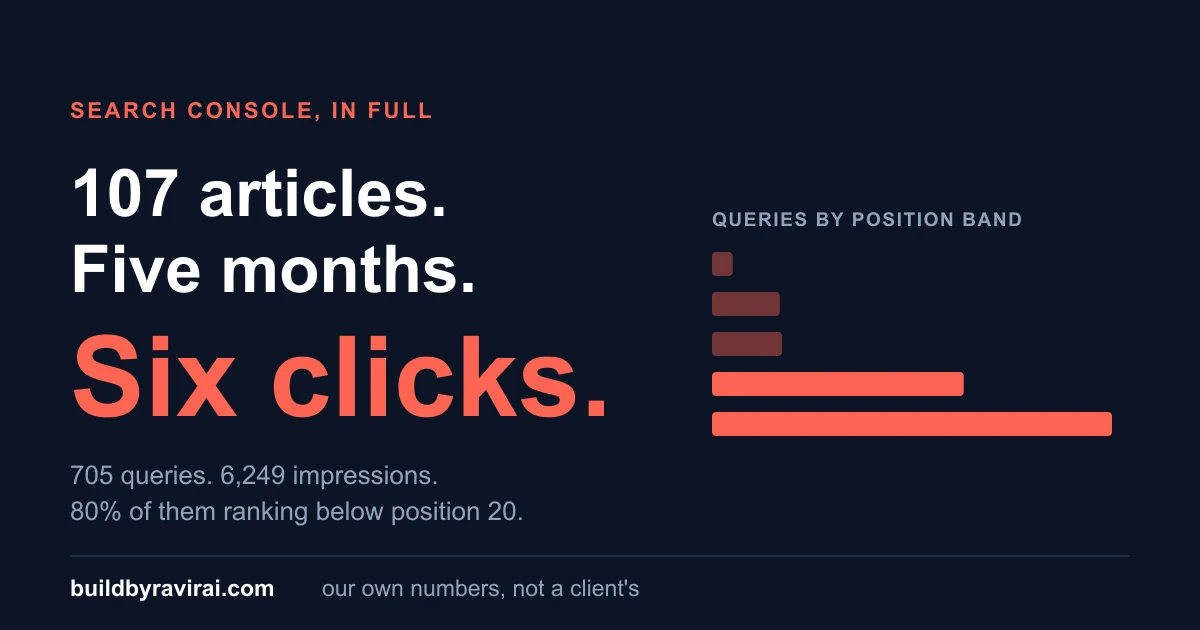
We Published Our Search Console Numbers. They Were Wrong.
Correction, 6 September 2026. This post went up yesterday under the headline "107 Articles in Five Months. Google Sent Us Six Clicks." That number was wrong. The site earned 149 clicks, not six, from 15,156 impressions rather than 6,249.
The mistake was ours and it was in the measurement, not the writing. It is worth walking through, because the trap that produced it is sitting in front of anyone who reads their own Search Console data through the API, and the wrong number was the flattering kind of wrong: it made a better story.
What went wrong
We pulled 90 days from the Search Console API asking for the query dimension, summed the rows, and reported the result as the site total. That felt reasonable. Every impression belongs to some query, so the queries should add up to everything.
They do not. Google withholds any query it judges rare enough to identify the person who typed it, and those impressions and clicks are simply absent from a query-dimension response. They are not zero, they are not grouped into an "other" row, they are gone.
Ask the same API for the same 90 days with no dimension at all and the answer changes completely:
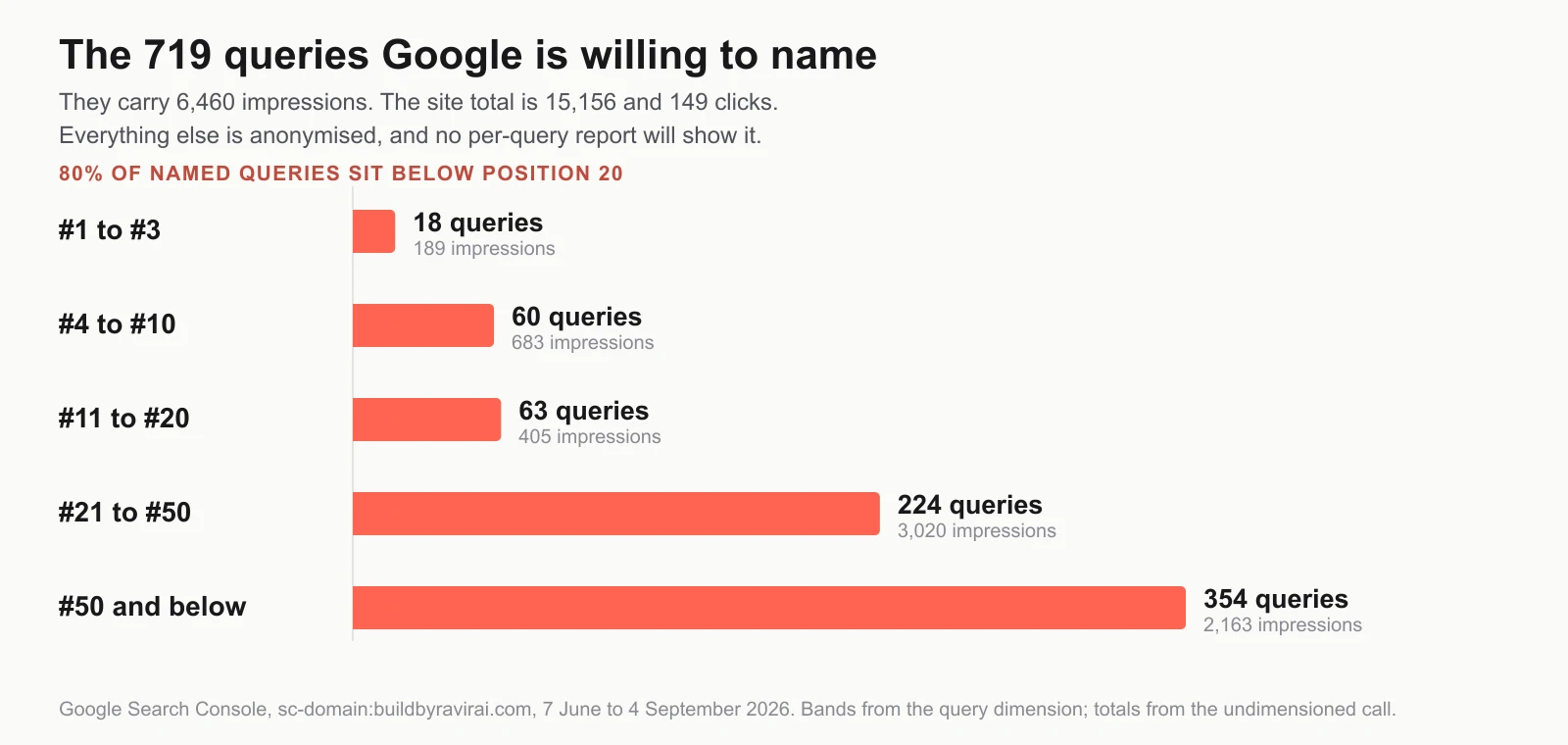
- By query: 6,460 impressions, 6 clicks, across 719 named queries.
- With no dimension: 15,156 impressions, 149 clicks, average position 28.2.
- By date, as a cross-check: 15,156 impressions, 149 clicks. It agrees, which is how we know which number is real.
So 57 per cent of impressions and 96 per cent of clicks were invisible to the way we asked. The query view is not a sample you can scale up either, because what it omits is biased: rare queries are exactly the long-tail phrases a small site ranks best for.
The numbers, correctly this time
Our domain went live in April 2026 and we have published 107 articles. Over the 90 days to 4 September 2026 the site recorded 15,156 impressions and 149 clicks, at an average position of 28.2. That is a click-through rate of about 1 per cent.
149 clicks in a quarter is a modest number. It is not the dramatic one we published, and the honest version of this article is less quotable than the wrong one was.
Of the queries Google will name, 578 of 719 sit below position 20, on page three or deeper where almost nobody looks. That part of the original piece survives intact, and it is still the shape of the problem.
What we can and cannot still claim
Two claims from the original post do not survive the correction, and it is worth naming them rather than quietly deleting them.
- We wrote that every top-20 click came from someone searching our own product names. That was drawn from the six named clicks, so it describes the visible tail and not the site.
- We wrote that the number of strangers who found us and chose us was three. With 149 clicks in the window, that figure was an artefact of the same error.
What does survive: 107 articles on a five-month-old domain produced 149 clicks in 90 days, most of the site's queries rank below position 20, and four of the six commercial phrases we deliberately built pages for have never recorded a single impression. Content alone did not rank this domain. That was the argument, and it still holds on the correct numbers.
How to check your own without making our mistake
- In the Search Console interface, the Performance page totals are already the real ones. This trap is specific to the API.
- If you use the API, request your headline totals with no
dimensionskey at all. That single call is the site total. - Cross-check it against a
date-dimension request. Those two should agree exactly. If your query-dimension sum disagrees with them, the query sum is the wrong one. - Use the query dimension for what it is good at, which is per-phrase positions, and never for anything described as a site total.
Why the post stayed up
We could have deleted it. The number was wrong in the direction that made us look worse, which is a comfortable sort of wrong to publish and an uncomfortable one to correct, because correcting it upward reads like walking back a humblebrag.
But the whole point of publishing our own data was that anybody could check it, and the first thing that happened when somebody did was that it failed. Leaving the correction at the same address is the only version of this that keeps the original promise.
The tooling has been fixed too. Our internal ranking script now prints the site total from the undimensioned call, with the named-query figures beside it and labelled, so this specific mistake cannot be made twice.
The caveats, unchanged
- Five months is short. Competitive commercial queries commonly take twelve to eighteen months on a new domain.
- This is one site in one niche. Software development is among the most saturated content categories on the internet, and your industry is probably kinder than ours.
- Our own website is not paying work, so it gets the hours left over after client projects. A funded campaign moves faster than this.
If you want to know where your own pages actually rank, we will look at your Search Console with you and say what we would do first. We will also tell you when the number you are looking at is not the number you think it is.
Get an honest look at your siteFrequently asked questions
Why do my Search Console query totals not match my site totals?
How do I get the real total from the Search Console API?
How long does SEO take for a new website in India?
Will publishing more articles fix it?
Founder of buildbyravirai, a web development agency based in Noida, India. Building websites, web apps and mobile apps in Next.js, NestJS, Shopify and WordPress since 2021, for clients in India, the US, Canada and the UK.
Working with us in your city
Keep Reading
Your Competitor's Website Is Beating Yours: The 20-Minute Teardown (2026)
We lost a ₹6.2 lakh project to a company with a worse product and a cheaper website. So I tore their site apart. Here is the 24-point scorecard I now run on any competitor, the free tools that do it, and the three things to fix first.
Your Website Is Not Showing on Google: How to Find Out Why (2026)
You paid for a website, you search your own business name, and nothing comes up. Here is the ten-minute diagnosis that tells you whether Google has never seen your site, has seen it and refused it, or has it indexed and simply ranks it below everyone else. Three different problems, three different fixes, and only one of them costs money.
 SEO
SEO vs GEO: What Changes When AI Answers the Question
GEO is mostly good SEO plus structure and citability. What genuinely changes when an AI answers the question, and why nobody can guarantee citations.
How to Rank #1 on Google Maps for Your City in 2026: The Local SEO Playbook for Indian Businesses
When someone searches "[your service] near me" or "[your service] in [your city]", do you show up in the top 3 on the map? Or are you invisible to a customer who's ready to buy right now? Ranking in the Google Maps 'map pack' is more achievable than you think, and most of your local competitors haven't done the basics. This is the step-by-step playbook.
 Performance
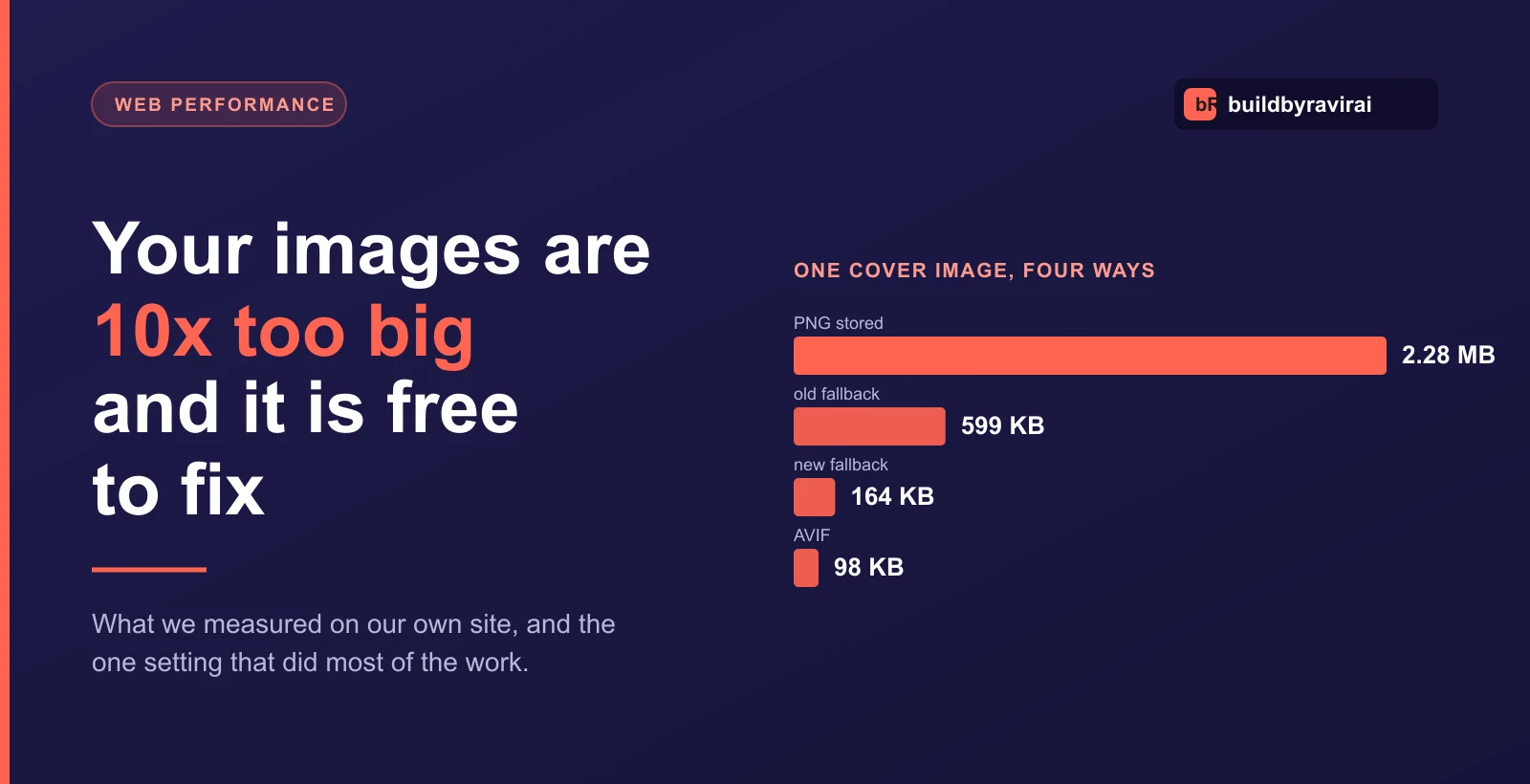
Your Website Images Are 10x Too Big. We Measured Ours.
We found 11.3 MB of cover images on our own site that should have been under 1 MB. What we measured, and who was actually paying for it.