We build websites, web apps and mobile apps in Next.js, NestJS, Shopify and Flutter for businesses across India. Free 1-page audit, no obligation.
Get a free quote- Your Competitor's Website Is Beating Yours: The 20-Minute Teardown (2026)October 19, 2026
- How to Get Google Reviews for Your Business in India (2026)October 17, 2026
- Payment Gateway Rejected Your Website? 5 Pages to Add (2026)October 16, 2026
- How Clients Judge Your Business Name Before They Ever See Your WorkOctober 15, 2026
SEO vs GEO: What Changes When AI Answers the Question
GEO is not a separate discipline. It is search engine optimisation with one thing changed: the output is a written answer that cites a few sources instead of a page of ten links. Get the fundamentals right and the citations follow. Get them wrong and no GEO package rescues you.
What genuinely differs is the unit of work. A ranking system picks pages. A generative answer picks sentences. So the thing you optimise shrinks from the page to the claim: one clear statement, with a number or a date or a named thing attached to it, that a model can lift and attribute without distorting it.
And here is the part most GEO pitches skip. You can measure a sliver of it. Search Console now reports AI Overview and AI Mode impressions, but with no clicks, no queries and no average position, and nothing at all from ChatGPT, Perplexity or Claude. Referral clicks from chat interfaces are a small visible tail of a mostly invisible process. Anyone promising a guaranteed number of AI mentions still cannot prove delivery.
What GEO actually means
GEO, generative engine optimisation, sometimes sold as answer engine optimisation, means getting your content quoted and linked inside AI answers: Google AI Overviews and AI Mode, ChatGPT with browsing, Perplexity, Claude, Copilot.
There are two paths into those answers. The first is model memory, what the model absorbed during training. You cannot influence that on any useful timescale, and it goes stale between releases. The second is retrieval: the system runs a search, reads a handful of results, and writes an answer from what it read. Almost every answer that carries a citation came from retrieval.
That second path is the whole game, and it runs on a search index. AI Overviews sit on Google's index. Several assistants query Bing or their own crawl. Being retrievable means ranking well enough to make the shortlist the model actually reads, usually the top handful of results for a query the system rewrote in its own words. Ranking still gates citation. That single fact deflates most of the hype.
What genuinely changes
The differences are real but narrow, and they all sit in the writing and markup layer.
- Answer first, then explain. The paragraph sitting directly under a heading is the one that gets lifted. If your answer arrives in paragraph six after a warm-up, the model summarises someone else.
- Claims that survive extraction. Specific, bounded, checkable statements get quoted. Vague ones get absorbed into a consensus paragraph with no credit to anyone.
- Named entities and explicit structure. Schema for Organization, Article, Product and LocalBusiness does not push you up the rankings, but it removes ambiguity about who you are and what you claimed.
- Entity consistency across the web. Same business name, same address, same phone number on your site, your Google Business Profile, LinkedIn and every directory. Machines resolve identity from agreement across sources.
- Original material. If a page only restates the top five results, nothing in it needs your name attached. Engines merge the consensus and cite whoever stated it first or most precisely.
- Formats that map to answers. Comparison tables, numbered procedures, plain definitions, and price ranges carrying a currency and a date.
What does not change at all
Crawlability. Rendering. Indexation. Page speed. Internal links pointing at the pages that matter. Clean titles and headings. All of it applies exactly as before, because the retrieval layer reads the same index built by the same crawlers.
Authority still decides most outcomes. A page nobody links to, on a domain nobody mentions, does not enter the shortlist in classic search and does not enter it in AI retrieval either. There is no shortcut around that in either discipline.
One practical detail catches people out: check your robots.txt, and check the right user agents. GPTBot and ClaudeBot are training crawlers. The ones that decide whether an engine can cite you are OAI-SearchBot for ChatGPT, Claude-SearchBot for Claude and PerplexityBot for Perplexity, plus the user-triggered fetchers ChatGPT-User and Claude-User. You can allow the search crawlers and still refuse the training ones, and most publishers should. If you are paying for AI visibility while OAI-SearchBot is disallowed, you are paying to stay invisible. Google is genuinely separate: Google-Extended governs Gemini training only, and appearing in AI Overviews follows ordinary Googlebot indexing, so blocking Google-Extended does not remove you from AI Overviews. Snippet directives matter too: nosnippet and a tight max-snippet limit what any engine is allowed to show from your page.
The measurement problem nobody advertises
Search Console now carries a generative AI performance report, announced in June 2026 and rolled out to every property by the end of August. It shows impressions from AI Overviews and AI Mode broken down by page, country, device and date. What it does not show is clicks, click-through rate, average position, or the queries that triggered the answer, and it covers Google only. So you can now see that you were surfaced. You still cannot see what it earned you, and you see nothing from ChatGPT, Perplexity or Claude. Analytics will show referral traffic from chatgpt.com or perplexity.ai, but only from the minority of readers who click a citation at all. Most AI answers end the session on the spot.
So you are measuring a small visible tail of something mostly invisible. That has one honest consequence: nobody can sell you guaranteed AI citations and then prove they delivered them.
What you can do is build proxies. Keep a fixed list of twenty buyer questions and run it across ChatGPT, Perplexity and Google AI Mode once a month, logging who gets cited. Watch referral hostnames in analytics. Watch branded search volume and direct traffic, which tend to move when people see your name in answers without clicking. Treat all of it as a scoreboard, not a KPI you can promise.
How to decide what to spend on
- Domain under a year old with few links: spend everything on fundamentals. Technical health, one strong page per commercial intent, a live Google Business Profile, real links. GEO work on a site nothing trusts yet is decoration.
- You rank in the top ten for money terms but never get quoted: this is the genuine GEO case. The gap is structure, not authority. Rewrite openings, add tables and definitions, add schema, attach dates and figures to claims.
- Your buyers ask comparison and cost questions, things like the cost of an ecommerce build in India, or which platform handles GST invoicing better: those queries get answered by an AI summary before anyone opens a website. Format for extraction there first.
- You sell locally in Noida or Delhi NCR: the profile, the reviews and consistent listings beat any content trick, for both the local pack and local AI answers.
- Purely transactional pages, cart and checkout and pricing: engines rarely cite those. Spend on conversion instead.
The foundations underneath SEO services and underneath generative engine optimisation overlap heavily by nature. That overlap is the thing to check before you sign anything.
The mistake people make with this choice
Paying twice for the same audit under two names. Ask any provider for both deliverable lists side by side. If the GEO scope reads as a crawl audit, a content plan and link building, you already bought that under the SEO line.
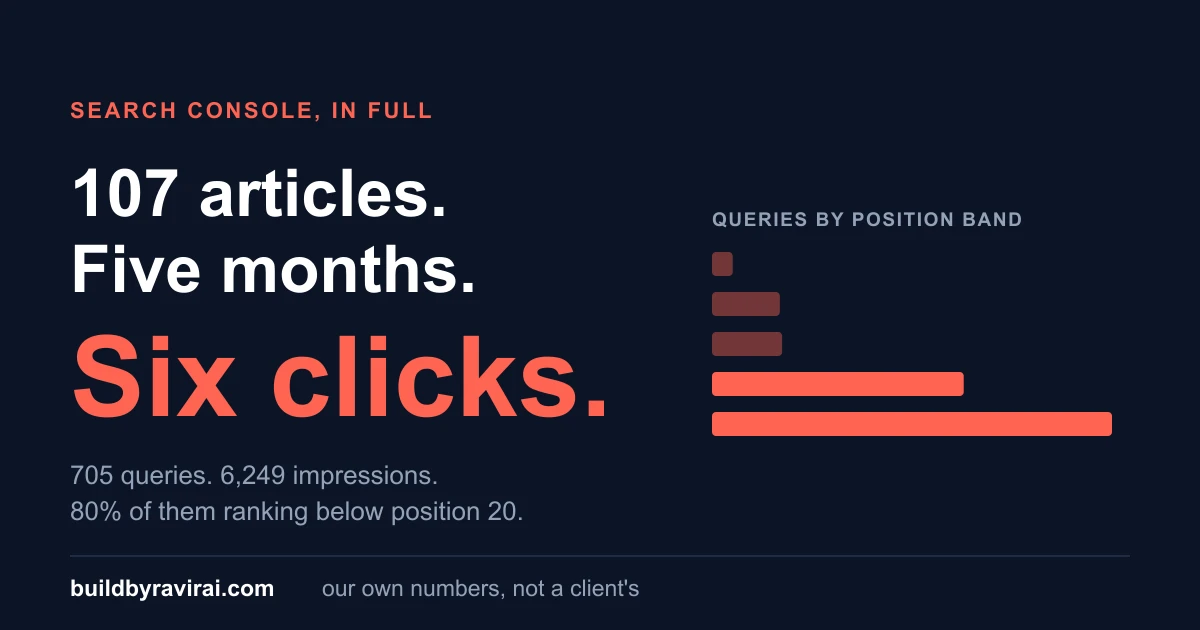
Publishing volume as a citation strategy is the second mistake. More articles saying the same thing does not make an engine cite you, it makes you cheaper to ignore, which is the same trap covered in 107 articles and six clicks.
The third is writing for the machine and losing the human. FAQ blocks stuffed with questions nobody asks, headings phrased as search queries over empty paragraphs, tables with no data in them. Readers leave, the page earns nothing, and it loses the links and engagement it needed to be retrievable at all.
The fourth is chasing the new thing while the basics quietly break. The failure list has not changed: pages excluded from the index, duplicated titles, a Google Business Profile nobody has touched since setup, no internal links to the pages that earn money. Most of the common small business SEO mistakes are still the ones costing the most.
A young domain hits the same wall in both
Authority is the bottleneck either way. A domain launched this year does not get preferred by AI retrieval because its markup is tidier than an established competitor's. Time, links and brand mentions are the inputs, and they take months.
There is a real opening in Indian specificity, though. Content covering GST invoicing rules, UPI checkout behaviour, RBI e-mandate rules for subscriptions, or realistic INR cost bands is thin in the global corpus. Engines have less to synthesise from, so a clear, well structured page on those topics has a genuine chance of citation long before a broad commercial term does. That is where a young site should aim.
On money: SEO retainers in the Indian market commonly sit somewhere between 20,000 and 1,00,000 rupees a month depending on scope and competition. A separate GEO retainer stacked on top, delivering the same audit and the same content plan, is not a second service. It is the same service invoiced twice.
What to actually do, in order
- Fix crawl and index problems first. Nothing else matters if the page cannot be fetched.
- Check robots.txt allows the AI crawlers you want citations from.
- Give each real buyer question its own page, with the answer in the first forty words under the heading.
- Attach a number, a date, a currency or a named entity to every claim you want quoted.
- Add Organization, Article and LocalBusiness schema, and keep FAQ markup for questions people genuinely ask.
- Make your business name, address and phone identical everywhere, and keep the Google Business Profile current.
- Earn links and mentions. Still the hard part, still the deciding one.
- Log your fixed prompt set monthly and watch which competitors get cited, and why.
Nothing in that list is exotic. That is the point.
If you have been quoted a GEO retainer on top of an SEO retainer, send both scopes over and we will tell you which parts are genuinely different. If you would rather start with the foundations that feed both, that is the same conversation.
Get a scoped quoteFrequently asked questions
Is GEO just SEO with a new name?
How do I see if ChatGPT or Google AI Overviews is citing my website?
Should I pay for GEO services separately from SEO?
How long before a new Indian website gets cited in AI answers?
Founder of buildbyravirai, a web development agency based in Noida, India. Building websites, web apps and mobile apps in Next.js, NestJS, Shopify and WordPress since 2021, for clients in India, the US, Canada and the UK.
Working with us in your city
Keep Reading
Your Competitor's Website Is Beating Yours: The 20-Minute Teardown (2026)
We lost a ₹6.2 lakh project to a company with a worse product and a cheaper website. So I tore their site apart. Here is the 24-point scorecard I now run on any competitor, the free tools that do it, and the three things to fix first.
Your Website Is Not Showing on Google: How to Find Out Why (2026)
You paid for a website, you search your own business name, and nothing comes up. Here is the ten-minute diagnosis that tells you whether Google has never seen your site, has seen it and refused it, or has it indexed and simply ranks it below everyone else. Three different problems, three different fixes, and only one of them costs money.
 SEO
SEOWe Published Our Search Console Numbers. They Were Wrong.
We said six clicks in 90 days. The real figure is 149. Here is the Search Console trap that produced the error, and what our numbers actually are.
How to Rank #1 on Google Maps for Your City in 2026: The Local SEO Playbook for Indian Businesses
When someone searches "[your service] near me" or "[your service] in [your city]", do you show up in the top 3 on the map? Or are you invisible to a customer who's ready to buy right now? Ranking in the Google Maps 'map pack' is more achievable than you think, and most of your local competitors haven't done the basics. This is the step-by-step playbook.
 Technology
Angular vs React in India 2026: Which Front End to Commit To
React for startups and SMBs, Angular for banks and enterprise teams, Next.js for most Indian SMB sites. The 2026 call turns on hiring, not benchmarks.