We build Next.js, Shopify, Laravel, Flutter, in Noida, India. Free 1-page audit, no obligation.
Get a free quote- Logo Design and Report Design: What Indian Businesses Get Wrong22 August 2026
- Manufacturing Software for Indian MSMEs Industry 4.0 GuideAugust 22, 2026
- Top Healthcare IT Solutions Improving Patient ExperienceAugust 12, 2026
- Top IT Solutions Transforming Financial Services in 2026August 10, 2026
 Guides
Top 10 Web Developers in India 2026: The Honest Criteria + How to Actually Pick One (Not Just a Listicle)
Type "top 10 web developers in India" into Google and you'll find 50 listicles. About 80% of them are paid placements, agencies pay ₹15-50K to appear on each list. The other 20% are written by SEO content shops who've never hired a developer in their life. Neither is useful to a founder trying to actually pick someone.
This is the founder-honest version. Instead of naming 10 specific shops (whose quality changes month-to-month based on who their senior people are), here are the 7 criteria that actually separate top-tier Indian web development agencies from the rest in 2026, the 5 categories they break down into, and the 4 disqualifying questions that filter 80% of self-styled "top" agencies in 5 minutes.
I run buildbyravirai, a senior-engineering-only shop in Noida shipping for clients across 41 Indian cities + 4 international. I've interviewed at 6 Indian agencies before going solo, worked with 4 of them as a sub-contractor, and competed with another ~30 in client proposals. The criteria below come from that operational view, not marketing fluff.
The 7 criteria that actually matter
1. Senior-engineering ratio (NOT total headcount)
Most Indian "top 10" agencies have 50-500 employees. Sounds impressive, until you ask: "how many have 5+ years of actual production experience?" The honest answer for most is 5-15%. The rest are juniors and freshers being trained on your project at your expense. Top shops in 2026 are senior-heavy (40-60% senior ratio), usually small teams of 5-20 people, not 500-employee body shops.
2. Public production work you can click on
Top-tier shops have a portfolio of LIVE production sites you can visit RIGHT NOW. Not screenshots. Not "NDA-protected client work". Click-through URLs. If their portfolio page has more anonymized case studies than working URLs, they're hiding low-quality work.
3. Direct technical access during pre-sales
Top shops let you talk to the actual senior engineer who'd be on your project in the SECOND call. Body-shop agencies route every call through account managers + project managers. If you can't talk to the dev before signing, the dev will be different from what they pitched. Every time.
4. Written scope before coding
Top shops deliver a written scope document (4-10 pages), features, screens, tech stack, milestones, exclusions, payment terms, BEFORE the first invoice. Bottom-tier shops start coding from a verbal brief and bill you for changes when reality hits. Demand written scope; 70% of agencies will balk because they don't actually have process discipline.
5. INR flat-fee pricing (not USD hourly disguised as INR)
Top Indian shops quote in INR with GST clarity. They give you a flat project price OR a clean monthly retainer. They DON'T do "USD $X per hour, billed monthly in INR at current FX rate", that's how cheap agencies hide rate increases. Top shops also handle TDS deduction guidance + 26AS reconciliation without making it your problem.
6. Live code in YOUR GitHub repo from day one
Top shops insist on YOUR GitHub repo from day one. Bottom-tier shops keep code in their repo and "hand it over on launch", which becomes leverage if anything goes wrong, or just disappears if they fold. Ask explicitly in the proposal: "Will the code live in our GitHub from day 1?" A "yes" immediately separates top 20% from bottom 80%.
7. Real reviews on platforms they don't control
Top shops have Google Business Profile reviews, Clutch reviews, LinkedIn endorsements, and Twitter/X testimonials, all from named clients with click-through profiles. Bottom-tier shops have only testimonials on their own website (which they can edit). Check Clutch, Google Reviews, LinkedIn. If the only positive signal is on their domain, that's a flag.
5 categories of Indian web development shops in 2026
Category 1: Large agencies (300-2000+ employees)
Examples (anonymized): the ones you've heard of, the ones that bid on government RFPs, the ones with offices in 5+ cities. Strengths: process discipline, big-team capacity, brand-name signal for risk-averse buyers. Weaknesses: most senior talent left years ago, junior-heavy delivery, ₹20L+ projects only, slow communication. Best for: enterprises ₹100cr+ revenue who need a vendor with formal procurement comfort.
Category 2: Mid-sized boutiques (30-150 employees)
Indian Tier-1 boutique shops with 5-10 years of track record. Strengths: better senior ratio than large agencies, real portfolio, partner-level access. Weaknesses: ₹5L+ projects only, longer timelines, varying quality between teams within the same agency. Best for: established Indian SMBs ₹10-100cr revenue OR US/UK enterprise outsourcing.
Category 3: Senior-team studios (5-20 engineers)
Small senior-only shops typically founded by ex-agency leads. This is where most of the actual quality production work happens in India in 2026. Strengths: direct dev access, ₹40K-5L flexible engagement, low overhead = better rates, top engineers, fast turnaround. Weaknesses: limited capacity (can't take 10 projects in parallel), less "brand name" signal for procurement-heavy buyers. Best for: Indian SMBs ₹1-50cr revenue, foreign startups outsourcing, anyone tired of category 1 + 2 pain. buildbyravirai is in this category.
Category 4: Solo developer collectives
2-5 senior solo developers operating as a loose "agency". Strengths: very low overhead, direct talent, sub-₹50K projects feasible. Weaknesses: bus-factor risk (any one solo developer leaving kills a project), informal process, often weak documentation. Best for: single-project work under ₹2L for tech-comfortable founders who can manage risk themselves.
Category 5: Body shops / template farms
100-1000 employees, ₹5-30K project bids, ChatGPT-generated proposals, WordPress template installs marketed as "custom development". Avoid. These are the agencies whose "top 10" listicle placements got you to this article in the first place. Save your money + your project.
The 4 disqualifying questions (use these on every shortlist)
Q1: "Can I talk to the senior engineer who'll be on my project before I sign?"
If they say no / route you through a project manager / introduce you to "the team" (generic): they pull-and-bait. The person you talk to pre-signing is NOT who'll be on your code. Disqualify.
Q2: "Will the code live in MY GitHub from day one?"
If they hedge / want to keep code in their repo until launch: vendor lock-in play. Disqualify.
Q3: "Will you send a written scope document before the first invoice?"
If they push back / want to "start with the design and add the scope as we go": no process discipline. Will scope-creep you into 2x the budget. Disqualify.
Q4: "Show me 3 LIVE production URLs you built in the last 6 months, with the client name I can verify on LinkedIn."
If they offer only NDA-protected case studies / dead-link portfolio / generic project descriptions: they don't have recent quality work. Disqualify.
These 4 questions filter ~80% of self-styled "top" Indian agencies in 5 minutes. The remaining 20% are worth a real evaluation.
How to actually find your top 10 shortlist
- Start with Clutch.co India filter (DA 92, real reviews): Sort by 4.5+ rating, 10+ reviews. Shortlist any that pass the 7 criteria.
- LinkedIn search for "founder + agency in India + 5+ years": Read their last 6 months of posts. Founders who write thoughtfully = shops with thoughtful processes.
- Founder referrals from your network: Ask 3 founders in your industry/stack who they've hired. Referrals carry the strongest signal.
- Cross-reference Indian tech Twitter/X: Small senior shops are visible there. Cheap body shops aren't.
- Avoid these signals: agency-of-the-year award listicles (paid), "top 100 web developers" rankings on random SEO blogs (paid), email outreach from agency BDRs (volume play).
Then run your 4-question filter call with each finalist. After 30 minutes you'll have a real shortlist of 3-4 worth proposal-stage conversations.
Where buildbyravirai fits
Honest disclosure: I run buildbyravirai. We're in Category 3 (senior-team studio, ~6 engineers, Noida HQ, founded 2021, 56+ projects shipped). We pass all 7 of the criteria above and pass all 4 disqualifying questions. We're not the right fit for everyone, if you're a ₹500cr enterprise with formal vendor procurement, Category 1 fits you better.
For Indian SMBs ₹1-50cr revenue, foreign startups (US/CA/UK/UAE) wanting senior offshore, and founders who want direct access to the people writing the code, we're a strong fit. Real pricing, city coverage across 41 Indian cities + 4 international, free 1-page audit before any engagement, and interactive cost calculator so you can ballpark before talking to us.
FAQ
Is there a real "top 10" list I can trust?
Clutch India filtered to 4.5+ rating + 10+ reviews is the closest to an honest list. Even there, ~30% are still paid placements. The 7 criteria + 4 disqualifying questions in this article work better than any ranked list because rankings go stale every quarter as senior talent moves around.
Why don't you name 10 specific agencies?
Two reasons. (1) Naming competitors in a self-promo article would be obvious bias either way. (2) The agencies that were great in 2024 aren't necessarily great in 2026, their senior talent rotates fast. Teaching you the criteria is more useful than naming names that'll be stale by next quarter.
What's the minimum budget for a "top" Indian web developer?
Below ₹40K total budget: no "top" shop will take you seriously. Hire a solo senior solo developer or use Wix/WordPress yourself. ₹40K-3L: Category 3 (senior-team studios) is your sweet spot. ₹3L-25L+: Category 2 (mid boutiques) OR Category 3 with multi-month engagement. ₹25L+: Category 1 (large agencies) if you need vendor formality, otherwise Category 2/3 give you better engineering for the same spend.
How long do top-tier engagements take?
Discovery to live: marketing site 3-6 weeks, ecommerce 6-12 weeks, SaaS MVP 8-16 weeks, mobile app 6-14 weeks, enterprise SaaS 4-12 months. Anyone promising 2x faster than this is either rushing OR using templates OR padding their first invoice.
Should I hire a top-10 agency or a top-10 solo developer?
Depends on project size + risk tolerance. Sub-₹2L project + tech-comfortable founder: senior solo developer wins (lower overhead). ₹2L+ project OR risk-averse founder OR needs continuity: senior-team studio (Category 3) wins. The biggest mistake is hiring a Category 5 body shop because they're cheap, costs you 3-6 months and ₹50K-2L in eventual rebuild.
What questions should I ask after the 4 disqualifying ones?
After the filter survives those 4, real evaluation questions: (1) Show me code from your last 3 projects on GitHub. (2) Who specifically will be on my project, what's their resume? (3) What happens if the project hits a roadblock at week 6, who owns the decision? (4) What does your post-launch maintenance retainer cost + cover? (5) Have you done [specific tech / compliance / industry] before, show me the project.
Honest summary
"Top 10 web developers in India" lists are mostly paid placements. The real way to find a top-tier shop is to apply 7 criteria (senior ratio, public portfolio, direct dev access, written scope, INR flat-fee, your-GitHub-from-day-one, real reviews) + 4 disqualifying questions in your first call. That filter alone separates the top 20% from the bottom 80% in 5 minutes.
For Indian SMBs and foreign startups looking for senior offshore engineering, Category 3 (senior-team studios) is usually the right tier. For enterprises with formal vendor procurement needs, Category 1 (large agencies). Avoid Category 5 (body shops / template farms) regardless of price.
We're a Noida-based Category 3 senior-team studio. 56+ projects shipped, 41 Indian cities + 4 international served. Pass all 7 criteria + all 4 disqualifying questions in this article. Send WhatsApp or use the contact form, we respond within 24 hours.
Schedule a 30-min scoping callFounder of buildbyravirai, a web development agency based in Noida, India. 5+ years shipping Next.js, WordPress, Shopify, and Laravel projects for clients in India, USA, Canada, and the UK.
Working with us in your city
Keep Reading
GuidesBest Web Development Company in India 2026: An Honest Buyer's Guide (Not a Sales Pitch)
Every 'best web development company in India 2026' list is a sponsored ranking. This one isn't. How to actually pick, what to ask, and what to walk away from.
 Guides
AI Website Builders vs Hiring a Developer in India 2026: The Honest Take
AI can build a website in two minutes, so why pay a developer? The honest answer: what AI website builders are good at, where they fall apart, and the hidden costs.
GuidesWebsite Maintenance & AMC Cost in India 2026: What You Actually Pay For
A website is not a one-time purchase. The honest guide to what website maintenance and an AMC cost in India in 2026, what is included, and when you need a plan.
 Guides
Outsourcing Web Development to India in 2026: The Honest Guide for US, Canadian & UK Startups (Real USD Costs + 9 Risks)
US founders pay $150-300/hr, UK agencies £100-200/hr, Indian senior devs $30-60/hr. The savings are real, so are the 9 hidden risks. Honest 2026 USD pricing inside.
 Guides
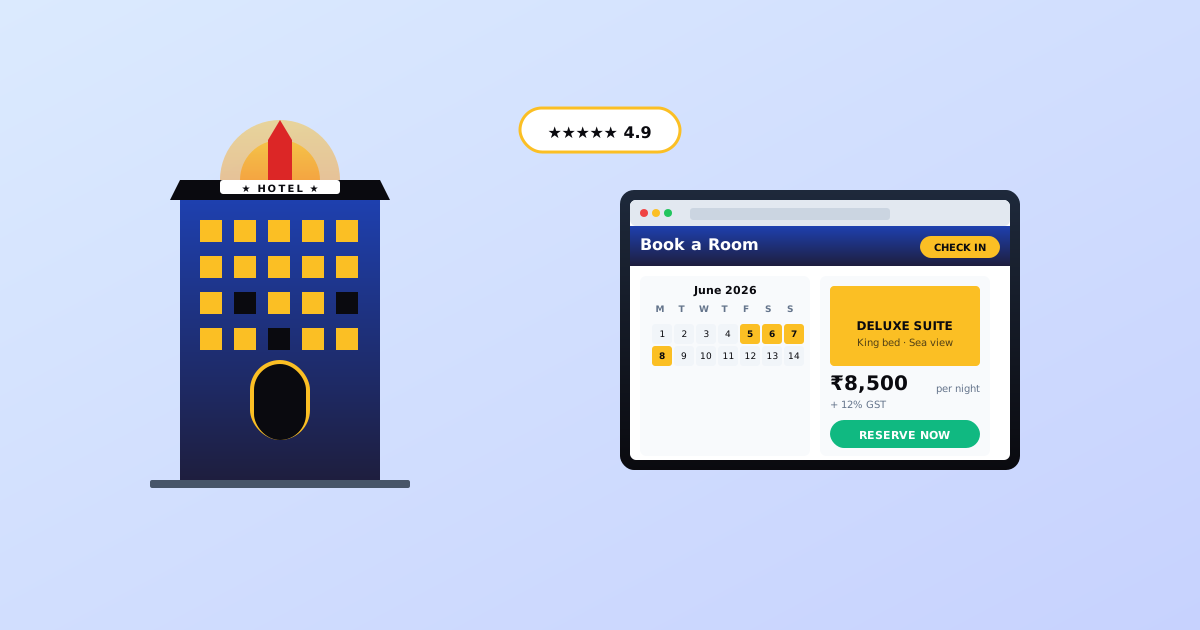
Hotel Website Development in India: What Booking Features, OTA Integrations, and 2026 Pricing Actually Look Like
Indian hotels leak 30-50% of direct bookings to OTAs because their websites can't handle real-time availability or channel sync. Real 2026 pricing (₹40K-8L).